White-tailed Tropicbird (Plate 262)
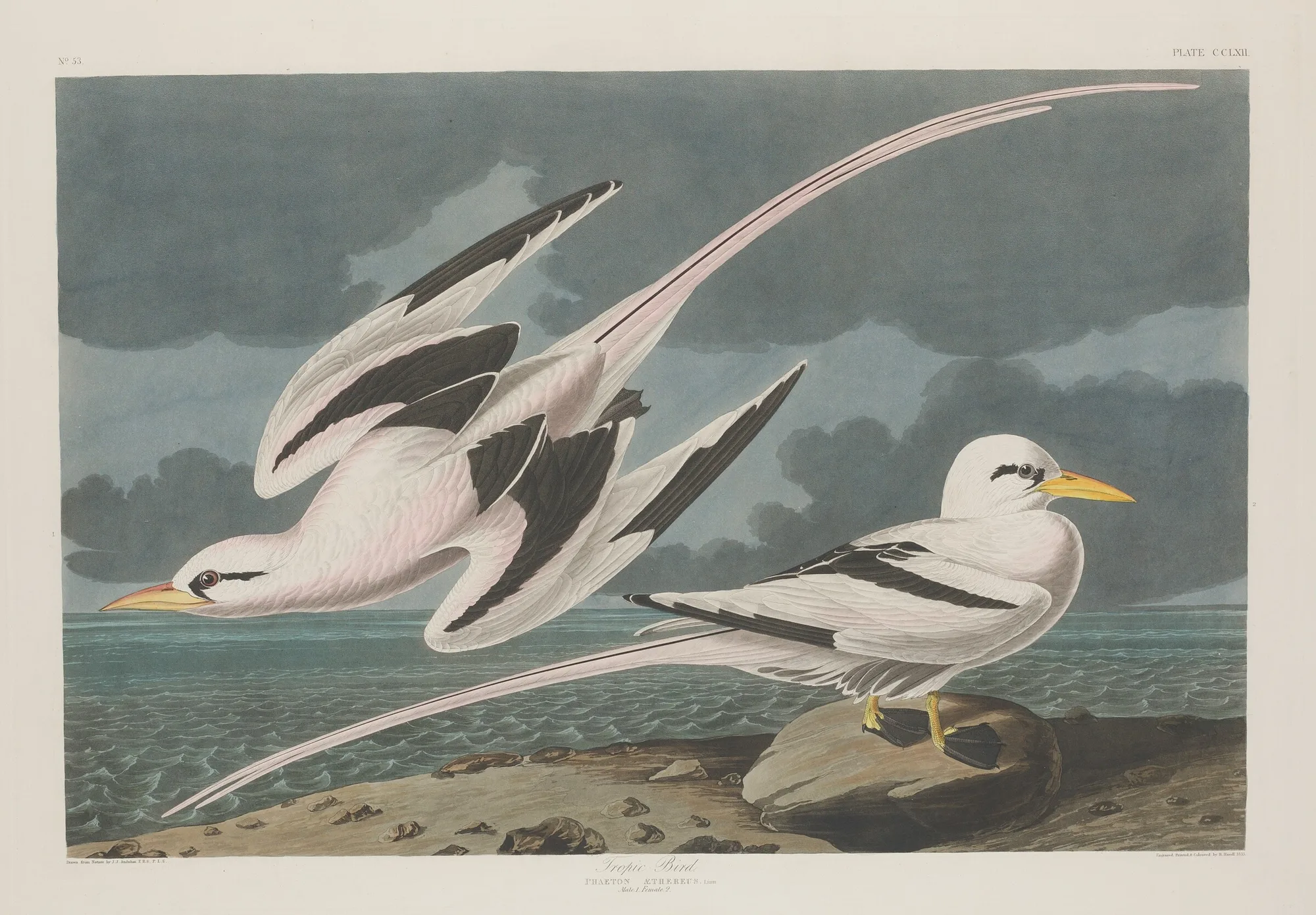
Audubon's “Tropic Bird”, The Birds of America, plate CCLXII
Click or press Enter to enlarge
Open the full-resolution image (3861 px, National Gallery of Art)
| Plate | 262 (CCLXII) |
|---|---|
| Audubon's name | Tropic Bird |
| Modern name | White-tailed Tropicbird |
| Scientific name | Phaethon lepturus |
| Status | Least Concern |
| Engraved by | Robert Havell, after Audubon's watercolor |
| Date | 1835 |
| Medium | Hand-colored engraving and aquatint on Whatman wove paper |
| Size | plate: 66 x 55.6 cm (26 x 21 7/8 in.) sheet: 100.3 x 68.3 cm (39 1/2 x 26 7/8 in.) |
| Collections | Seabirds, Florida and Wading Birds |
| This impression | National Gallery of Art, Washington, 1945.8.262; Gift of Mrs. Walter B. James |
About this plate
Plate 262 shows an adult male and female tropicbird, white tinged with pink, with a black stripe through the eye, a black bar across the wing and two very long central tail feathers. Audubon gave the male an orange-red bill and the female a yellow one.
The chapter is one of the shortest in the work. Audubon wrote that the specimens were obtained in the summer of 1832 at the Tortugas by his friend Robert Day, commander of the revenue cutter Marion, from a flock of eight or ten. He represented them in what he took to be breeding plumage but said he had never studied the living bird and could say nothing of its habits.
Audubon used the name Phaeton aethereus, which today belongs to the Red-billed Tropicbird. His description, however, with an unbarred pinkish back and a bold diagonal black bar across the wing, fits the White-tailed Tropicbird, Phaethon lepturus, and the plate is usually identified as that species.
The White-tailed Tropicbird nests in cliff holes on tropical islands around the world, including Bermuda, where it is called the longtail, and the Caribbean. It feeds by plunging for flying fish and squid far out at sea and is seen only occasionally off Florida. It is listed as Least Concern.
In Audubon's words
The specimens from which the figures in the plate were taken, were obtained on the Tortugas, in the summer of 1832, by my kind friend Robert Day, Esq. of the United States’ Revenue Cutter, the Marion. They were shot out of a flock of eight or ten, and were in fine condition. I have represented the Male and Female, in what I suppose to be their full summer or breeding plumage; but not having had an opportunity of studying the habits of this remarkable bird, I am unable to give any information respecting them.
John James Audubon, Ornithological Biography, vol. 3 (1835), “The Tropic Bird”. Read the full chapter.