Red-headed Woodpecker (Plate 27)
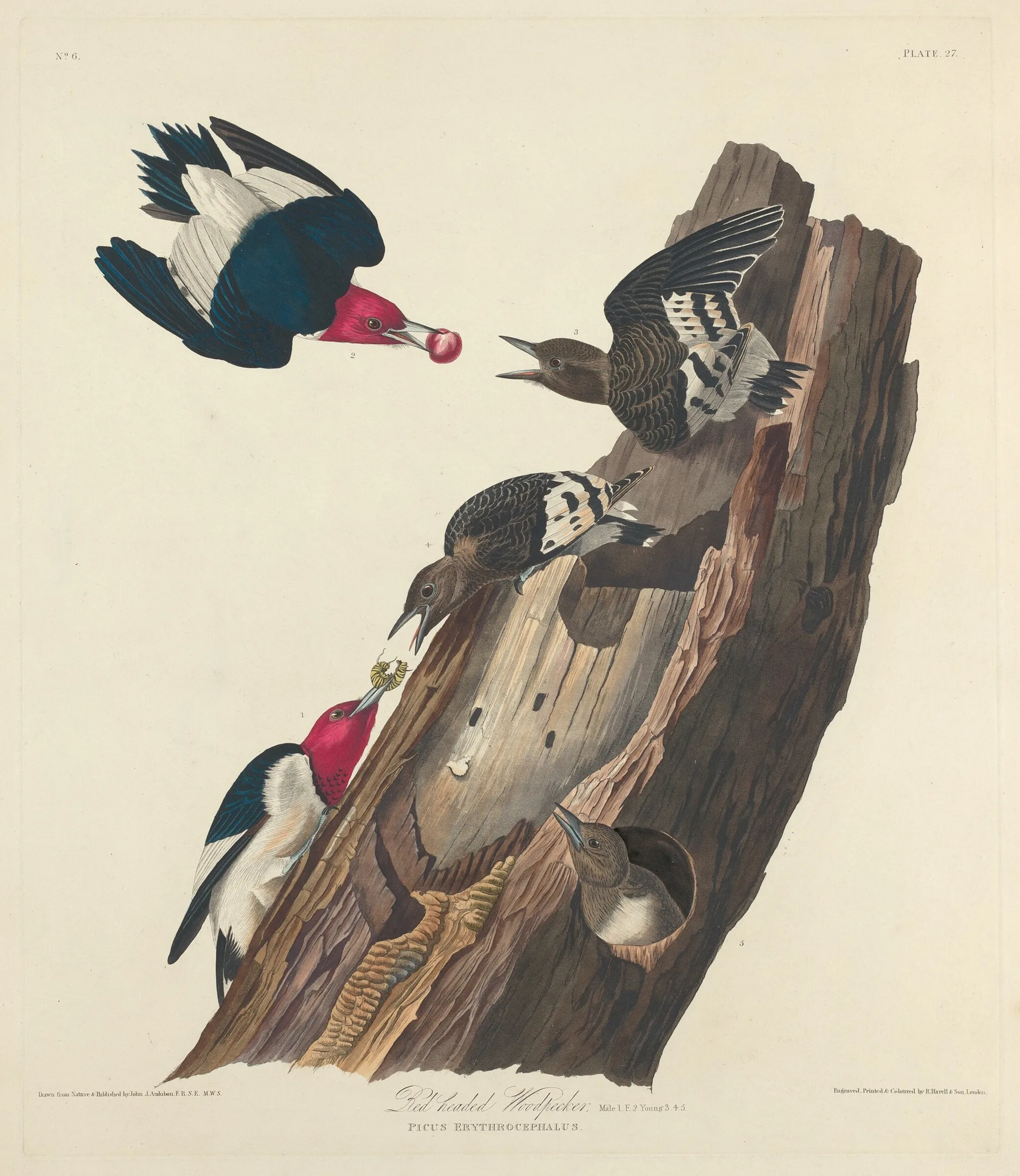
Audubon's “Red-headed Woodpecker”, The Birds of America, plate XXVII
Click or press Enter to enlarge
Open the full-resolution image (3227 px, National Gallery of Art)
| Plate | 27 (XXVII) |
|---|---|
| Audubon's name | Red-headed Woodpecker |
| Modern name | Red-headed Woodpecker |
| Scientific name | Melanerpes erythrocephalus |
| Status | Least Concern |
| Engraved by | Robert Havell, after Audubon's watercolor |
| Date | 1828 |
| Medium | Hand-colored engraving and aquatint on Whatman wove paper |
| Collections | Woodpeckers |
| This impression | National Gallery of Art, Washington, 1945.8.27; Gift of Mrs. Walter B. James |
About this plate
Plate 27 shows a family of Red-headed Woodpeckers on a dead, broken tree trunk with nest holes. The adults have the solid crimson head, white body and large white wing patches. The young bird has a brown head and lacks the red. The plate was engraved by Robert Havell in 1828.
Audubon wrote that the bird was so well known he hardly needed to describe it. He called it the most gay and frolicsome bird he knew after the Mockingbird. He described Red-heads on fence stakes sliding out of sight as a person passed, then hopping back on top to drum, and diving into gardens to take the best strawberries. He wrote that they came from miles around to strip ripening cherry trees.
The name is unchanged: Red-headed Woodpecker, Melanerpes erythrocephalus. Audubon described its migration at night in loose groups in autumn and its habit of reusing and deepening old holes rather than digging new ones. It also stores nuts and insects in cracks in bark and fence posts, sometimes covering them with wood or bark.
The species lives in open woodland, savanna, river bottoms and farmland across the eastern and central United States. Its numbers have fallen sharply since the 1960s because of the loss of dead trees, collisions with cars and competition from starlings for nest holes. It was listed as Near Threatened for some years and is now listed as Least Concern.
In Audubon's words
When alighted on a fence-stake by the road, or in a field, and one approaches them, they gradually move sidewise out of sight, peeping now and then to discover your intention; and when you are quite close and opposite, lie still until you are past, when they hop to the top of the stake, and rattle upon it with their bill, as if to congratulate themselves on the success of their cunning. Should you approach within arm's length, which may frequently be done, the Woodpecker flies to the next stake or the second from you, bends his head to peep, and rattles again, as if to provoke you to a continuance of what seems to him excellent sport. He alights on the roof of the house, hops along it, beats the shingles, utters a cry, and dives into your garden to pick the finest strawberries which he can discover.
John James Audubon, Ornithological Biography, vol. 1 (1831), “The Red-headed Woodpecker”. Read the full chapter.