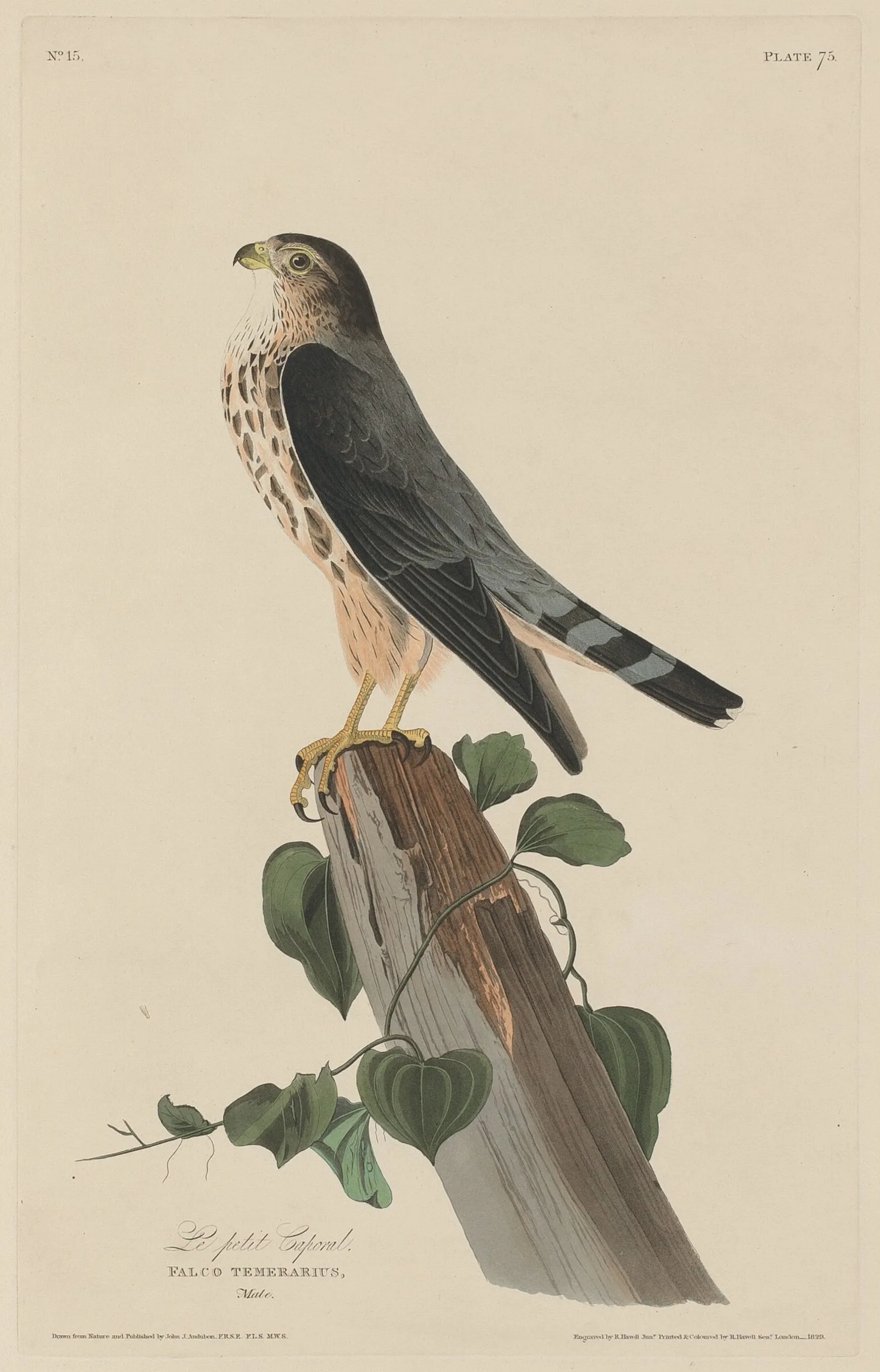
Merlin (Le Petit Caporal) (Plate 75)
Audubon's “Le Petit Caporal”, The Birds of America, plate LXXV
Click or press Enter to enlarge
Open the full-resolution image (2379 px, National Gallery of Art)
| Plate | 75 (LXXV) |
|---|---|
| Audubon's name | Le Petit Caporal |
| Modern name | Merlin (adult male) |
| Scientific name | Falco columbarius |
| Status | Least Concern |
| Engraved by | Robert Havell, after Audubon's watercolor |
| Date | 1829 |
| Medium | Hand-colored engraving and aquatint on Whatman wove paper |
| Plants and setting | Old fence stake |
| Collections | Hawks, Eagles and Falcons |
| This impression | National Gallery of Art, Washington, 1945.8.75; Gift of Mrs. Walter B. James |
About this plate
Plate 75 shows a single small falcon perched upright, as Audubon first saw it, on an old fence stake. He collected it in April 1812 near Fatland Ford, his father-in-law's farm in Pennsylvania, as it chased a dove. He compared it with the European Hobby and never met another.
Believing it a new species, he named it Falco temerarius and gave it the English title Le Petit Caporal, the nickname of Napoleon's soldiers for their emperor. He wrote that he would have used Napoleon or Bonaparte if he had found a new eagle, but that the soldiers' name suited a little hawk. The plate is one of the few in the work with a French title.
The bird is an adult male Merlin, the same species Audubon painted as the Pigeon Hawk in plate 92. Male Merlins are slate blue above, while females and young are brown, which helped early naturalists divide the species in two. The Merlin breeds across the boreal forests and prairies of North America, Europe and Asia and has spread into many northern cities. It hunts small birds in fast, low flight. It is listed as Least Concern.
In Audubon's words
This beautiful little Hawk appears to be nearly allied to the European Hobby (Falco Subbuteo, Linn.), and is not inferior to that species in spirit and activity. I procured the individual represented, in April 1812, near Fatland Ford in Pennsylvania, whilst in pursuit of a Dove, which it would doubtless have secured, had I not terminated its career. When I first discovered this species, the individual was standing perched on an old fence-stake, in the position in which it is figured. Never having met with another of the kind, I conclude that it is extremely rare in the United States. Of its nest or young I am unable to say any thing at present. The name which I have given to this new and rare species was chosen at the time when Napoleon Le Grand was in the zenith of his glory.
John James Audubon, Ornithological Biography, vol. 1 (1831), “Le Petit Caporal”. Read the full chapter.