Blue-headed Vireo (Plate 28)
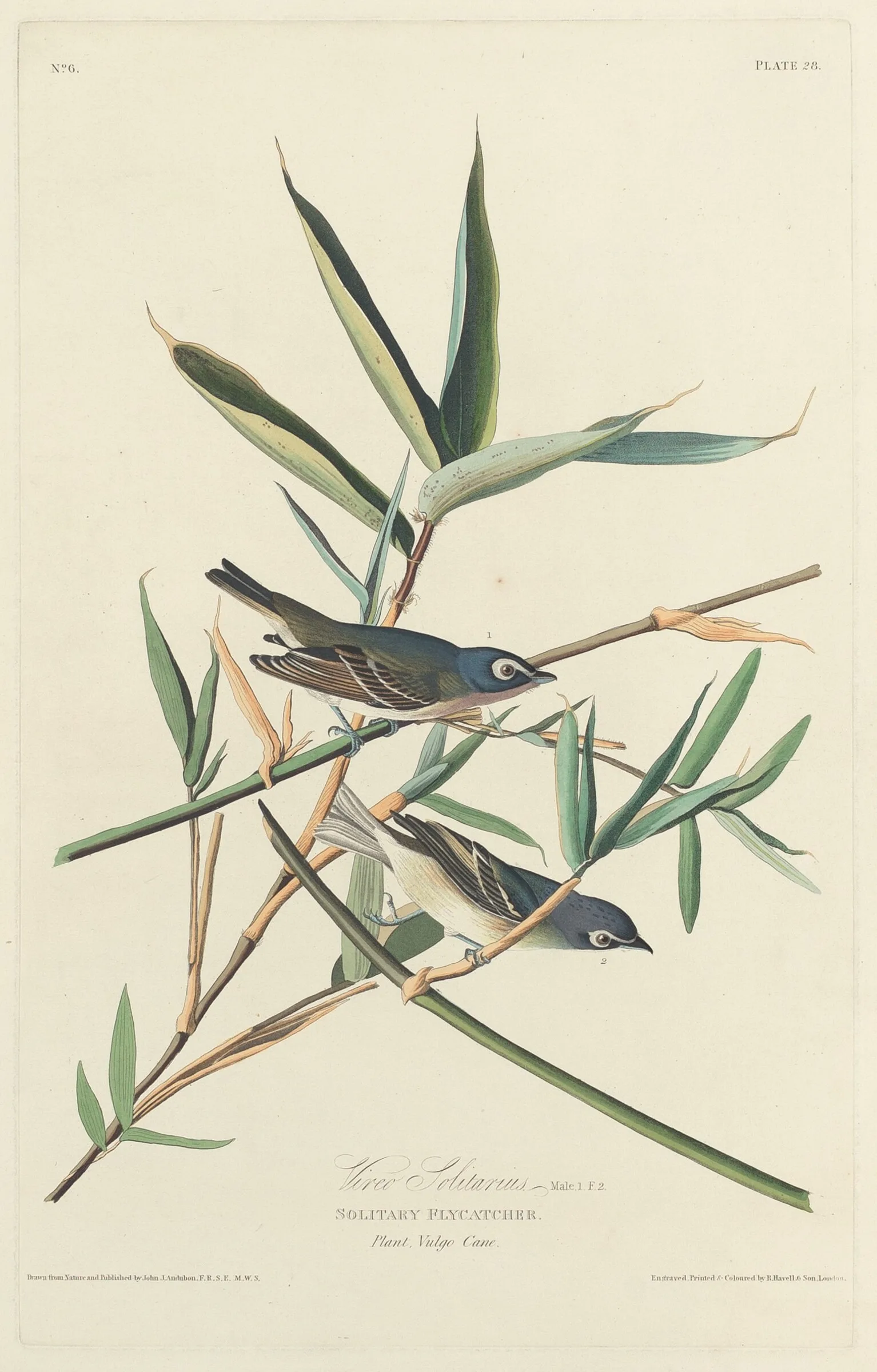
Audubon's “Solitary Flycatcher”, The Birds of America, plate XXVIII
Click or press Enter to enlarge
Open the full-resolution image (2497 px, National Gallery of Art)
| Plate | 28 (XXVIII) |
|---|---|
| Audubon's name | Solitary Flycatcher |
| Modern name | Blue-headed Vireo |
| Scientific name | Vireo solitarius |
| Status | Least Concern |
| Engraved by | Robert Havell, after Audubon's watercolor |
| Date | 1828 |
| Medium | Hand-colored engraving and aquatint on Whatman wove paper |
| Plants and setting | Cane (Arundinaria) in a cane-brake |
| Collections | Songbirds |
| This impression | National Gallery of Art, Washington, 1945.8.28; Gift of Mrs. Walter B. James |
About this plate
Plate 28 shows a male and female vireo with grey heads, white spectacles and wing bars, near a nest hung between twigs. Audubon wrote that he represented a pair killed near a nest in a cane-brake, so the setting is the native cane of the southern bottomlands. The plate was engraved by Robert Havell in 1828.
Audubon described the bird as a scarce summer visitor from the south that lived in thick cane-brakes along the Mississippi. He wrote that he killed a pair near the mouth of the Ohio in May 1809, a female near Henderson, Kentucky, the next spring, and a pair with nest and eggs near the mouth of Bayou Lafourche in 1821. In 1829 he shot a male in the Great Pine Swamp of Pennsylvania in September.
The species in the plate is the Blue-headed Vireo, Vireo solitarius. Until 1997 it was the eastern form of the Solitary Vireo, which was then split into three species: Blue-headed, Cassin's and Plumbeous. Audubon's life history fits the Blue-headed Vireo poorly. It breeds mainly in cool northern and mountain forests and passes through the lowland South only on migration, so parts of his account may refer to another vireo.
The Blue-headed Vireo breeds across Canada, the northeastern United States and the Appalachians, and winters in the southeastern states, Mexico and Central America. It is listed as Least Concern.
In Audubon's words
It is an inhabitant of Louisiana during the spring and summer months, when it resorts to the thick cane-brakes of the alluvial lands near the Mississippi, and the borders of the numberless swamps that lie in a direction parallel to that river. It is many years since I discovered it, but as I am not at all anxious respecting priority of names, I shall not insist upon this circumstance. In the month of May 1809, I killed a male and a female of this species, near the mouth of the Ohio, while on a shooting expedition after young swans. The following spring, I killed a female near Henderson in Kentucky. In 1821, I again procured a pair, with their nest and eggs, near the mouth of Bayou La Fourche, on the Mississippi, and since that period have killed eight or ten pairs.
John James Audubon, Ornithological Biography, vol. 1 (1831), “The Solitary Fly-catcher, or Vireo”. Read the full chapter.
Other impressions of this plate: The Metropolitan Museum of Art.



