Willet (Plate 274)
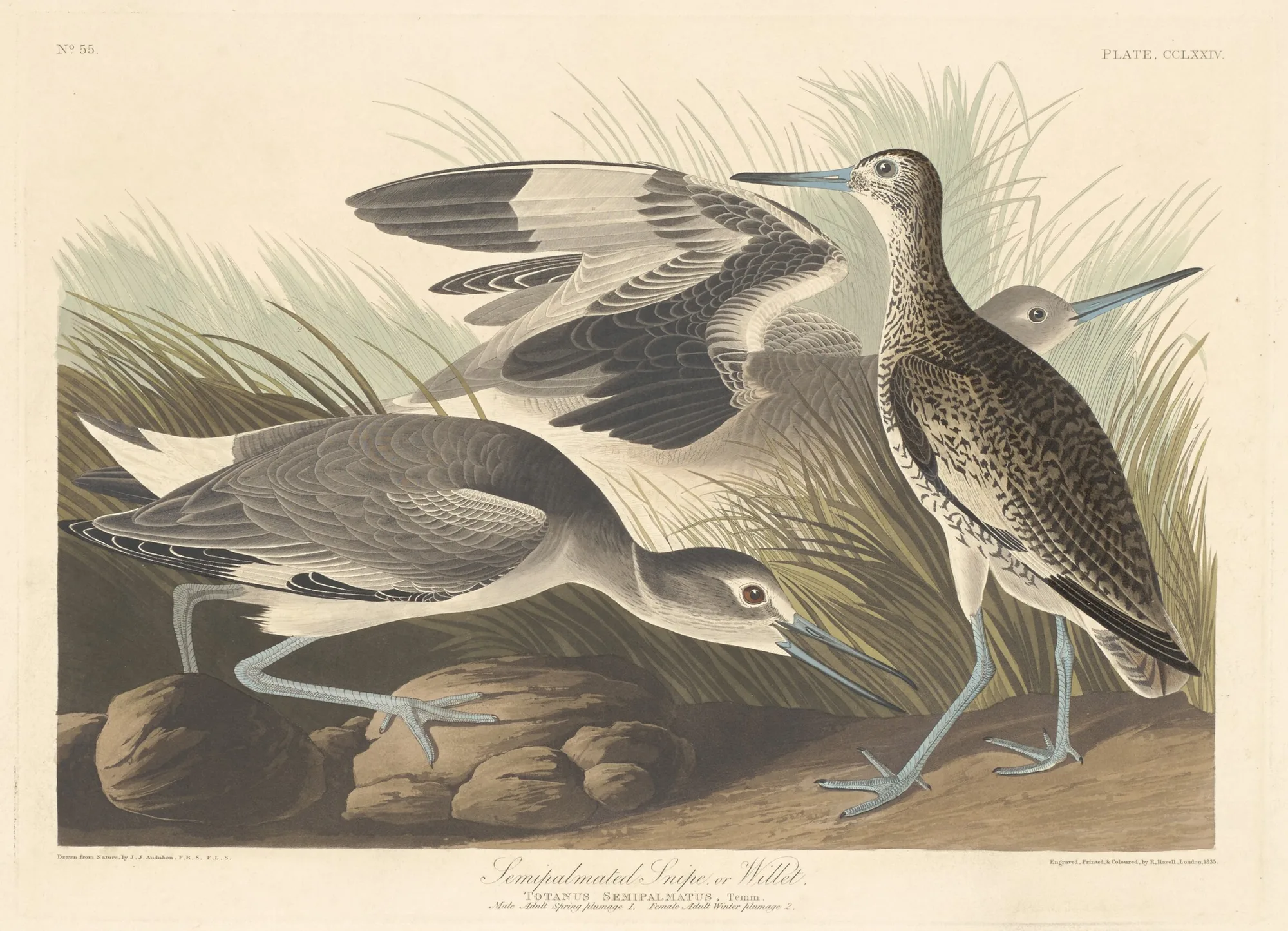
Audubon's “Semi-palmated Snipe or Willet”, The Birds of America, plate CCLXXIV
Click or press Enter to enlarge
Open the full-resolution image (2983 px, National Gallery of Art)
| Plate | 274 (CCLXXIV) |
|---|---|
| Audubon's name | Semi-palmated Snipe or Willet |
| Modern name | Willet |
| Scientific name | Tringa semipalmata |
| Status | Least Concern |
| Engraved by | Robert Havell, after Audubon's watercolor |
| Date | 1835 |
| Medium | Hand-colored engraving and aquatint on Whatman wove paper |
| Collections | Shorebirds, Rails and Cranes, Florida and Wading Birds |
| This impression | National Gallery of Art, Washington, 1945.8.274; Gift of Mrs. Walter B. James |
About this plate
Plate 274 shows a male and female Willet, large, sturdy grey-brown shorebirds with long straight bills and grey legs. At rest they look plain, but in flight they show a bold black and white wing pattern. The partial webbing between the front toes gave Audubon's name, Semipalmated Snipe.
Audubon wrote that every fisherman gunner of the Middle States knew the bird as the Willet, after its call, while from the Carolinas south it was called the Stone Curlew. He found it bound to the salt marshes and sea beaches, rarely seen inland. On 1 May 1832, on the half-flooded Duck Keys in Florida, he watched paired Willets perch on bushes and mangroves, standing upright and opening their wings to the sun, a habit he had never seen before. He described nesting pairs that rose and circled any intruder, calling loudly, and adults that ran over the ground as if wounded to lead people from their young.
Audubon's Totanus semipalmatus is now Tringa semipalmata. The eastern and western populations differ in size, voice and habitat. The eastern birds nest in coastal salt marshes, the western ones on prairie wetlands, and some authorities treat them as separate species.
Like many shorebirds, the Willet was heavily hunted in the nineteenth century and was nearly lost from much of the Atlantic coast before protection. It is listed as Least Concern.
In Audubon's words
On the 1st of May 1832, while rambling over some large and partially submersed islets of the Floridas called Duck Keys, scantily covered with bushes and some mangroves, I saw a good number of these birds in company with the Great Marbled Godwit. The Willets were all paired and very clamorous, although we found none of their nests. To my great surprise, I saw them alight on the bushes and trees with as much ease as if they had been land birds, stand erect, open their wings to the sun, and await our approach, exhibiting, when thus perched, much less shyness than when on the ground. Until then I had never observed such a habit in this bird, and indeed had felt surprised at seeing the Bartram Snipe, Totanus Bartramius, alight on fences and trees.
John James Audubon, Ornithological Biography, vol. 3 (1835), “The Semipalmated Snipe, or Willet”. Read the full chapter.