Eastern Towhee (Plate 29)
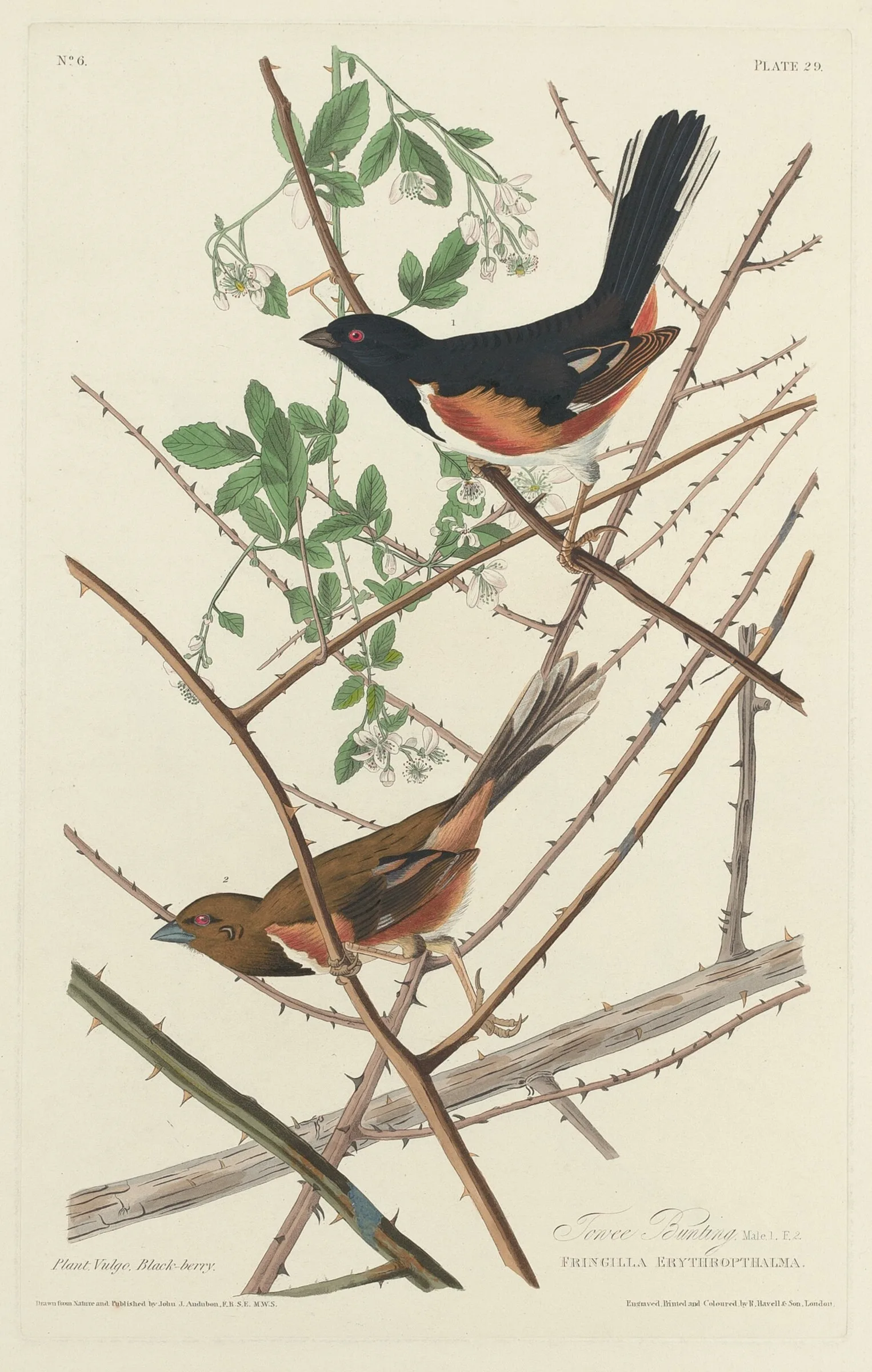
Audubon's “Towee Bunting”, The Birds of America, plate XXIX
Click or press Enter to enlarge
Open the full-resolution image (2533 px, National Gallery of Art)
| Plate | 29 (XXIX) |
|---|---|
| Audubon's name | Towee Bunting |
| Modern name | Eastern Towhee |
| Scientific name | Pipilo erythrophthalmus |
| Status | Least Concern |
| Engraved by | Robert Havell, after Audubon's watercolor |
| Date | 1828 |
| Medium | Hand-colored engraving and aquatint on Whatman wove paper |
| Plants and setting | Black Briar (blackberry, Rubus) |
| Collections | Songbirds |
| This impression | National Gallery of Art, Washington, 1945.8.29; Gift of Mrs. Walter B. James |
About this plate
Plate 29 shows a male and female Eastern Towhee among the twigs of the Common or Black Briar, a blackberry. The male is black above with rufous sides. The female has the same pattern in brown. The plate was engraved by Robert Havell in 1828.
Audubon described the towhee's short, low flight with strong jerks of the tail, its habit of scratching among dead leaves, and its call, tow-hee, which gives it its name. He wrote that it sang sweetly from the top of a small tree or briar. He described a large nest sunk into the ground so that its rim was level with the surface, often at the foot of a sapling or a clump of grass.
The bird is the Eastern Towhee, Pipilo erythrophthalmus. From 1983 to 1995 it was merged with the western Spotted Towhee as the Rufous-sided Towhee. Older names include Chewink and Ground Robin. Audubon noted that it became very fat in winter and that the French planters of Louisiana called it Grasset and shot many for the table.
Audubon wrote that none bred in Louisiana or Mississippi until the open woods of the Choctaw Nation. Today the Eastern Towhee breeds across the eastern United States, including the Gulf states, in brushy woodland edges and thickets, and northern birds winter in the South. It is listed as Least Concern.
In Audubon's words
The flight of the Towhe Bunting is short, low, and performed from one bush or spot to another, in a hurried manner, with repeated strong jerks of the tail, and such quick motions of the wings, that one may hear their sound, although the bird should happen to be out of sight. On the ground, where it is more usually to be seen, it hops lightly, without moving the tail more than the Common Sparrow of Europe. It is a diligent bird, spending its days in searching for food and gravel, amongst the dried leaves and in the earth, scratching with great assiduity, and every now and then uttering the notes tow-hee, from which it has obtained its name. At other times, it ascends to the top of a small tree, or its favourite low bushes and briars, on which it sings very sweetly a few continued mellow notes.
John James Audubon, Ornithological Biography, vol. 1 (1831), “The Towhe Bunting”. Read the full chapter.



