Solitary Sandpiper (Plate 289)
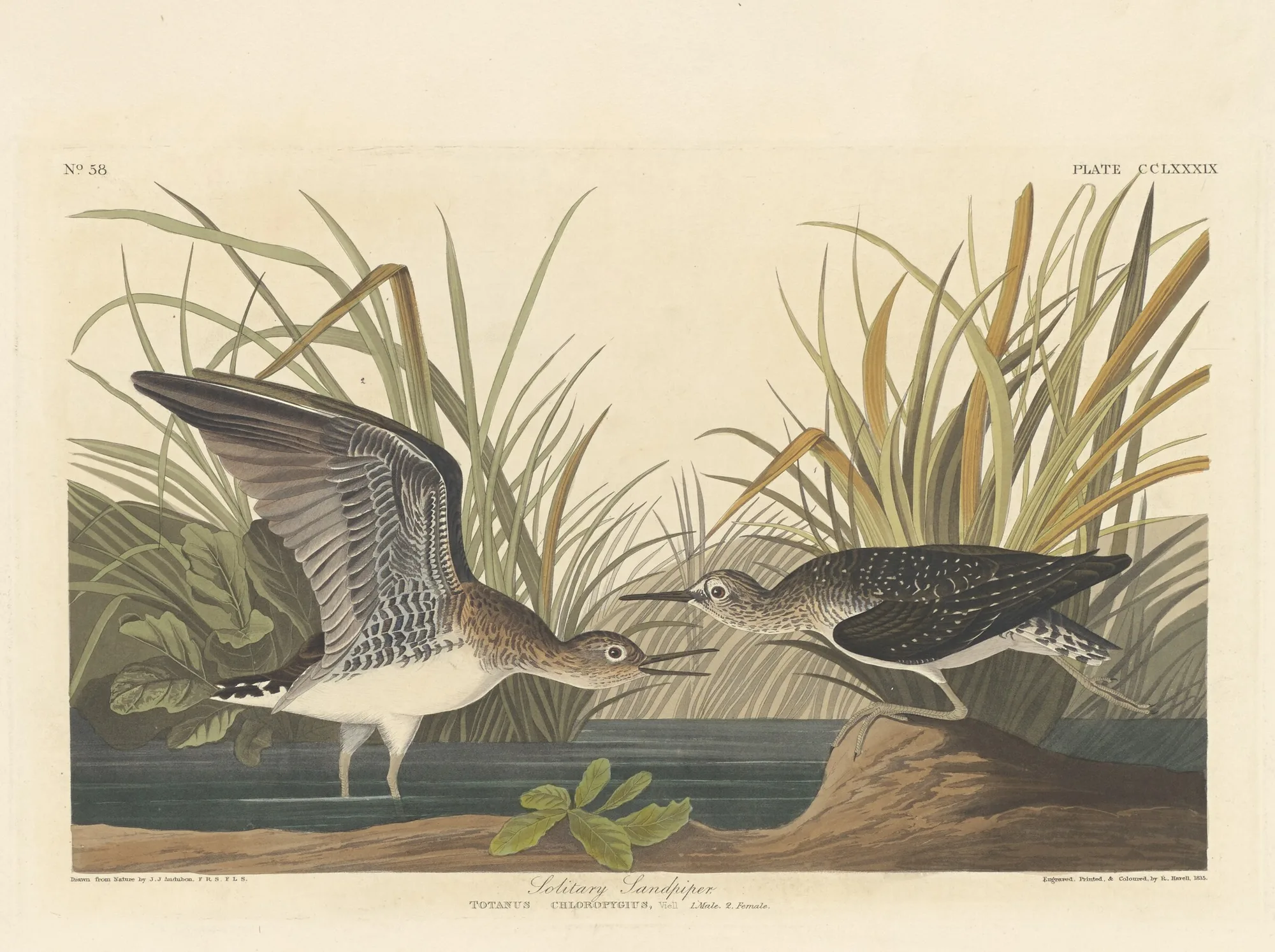
Audubon's “Solitary Sandpiper”, The Birds of America, plate CCLXXXIX
Click or press Enter to enlarge
Open the full-resolution image (2804 px, National Gallery of Art)
| Plate | 289 (CCLXXXIX) |
|---|---|
| Audubon's name | Solitary Sandpiper |
| Modern name | Solitary Sandpiper |
| Scientific name | Tringa solitaria |
| Status | Least Concern |
| Engraved by | Robert Havell, after Audubon's watercolor |
| Date | 1836 |
| Medium | Hand-colored engraving and aquatint on Whatman wove paper |
| Collections | Shorebirds, Rails and Cranes |
| This impression | National Gallery of Art, Washington, 1945.8.289; Gift of Mrs. Walter B. James |
About this plate
Plate 289 shows one Solitary Sandpiper, dark olive-brown above with fine white spots, a white eye-ring and greenish legs. Audubon's chapter dwells on its habit of feeding at small, shaded ponds in woods, often alone, and of bobbing its body and tail like a waterthrush.
Audubon's Totanus chloropygius is now Tringa solitaria. It is a close relative of the yellowlegs but behaves differently. It is the rare sandpiper that perches readily on branches. It is also one of only two shorebirds known to lay its eggs in the old tree nests of songbirds such as American Robins and Rusty Blackbirds, rather than on the ground.
The species breeds in boreal forest bogs and muskeg from Alaska across Canada. It winters from Mexico through Central America to Argentina. It passes through much of the United States in spring and autumn but does not breed in the Southern States. The IUCN lists it as Least Concern.
Audubon described the only nest he ever found. It was beside a small pond in the woods near Bayou Sara, Louisiana, a grass-and-leaf nest on the ground with three eggs, later robbed, he thought, by a racoon. Since the species is not known to breed that far south, modern writers doubt that the nest belonged to this bird. Audubon also noted that it catches small dragonflies on the wing over woodland ponds.
In Audubon's words
The only nest of this bird that I ever met with was placed in an elevated part of the woods near Bayou Sara, on the margin of a small pond scarcely ten yards broad, overgrown with low bushes, and cumbered with fallen branches of trees. It was formed of grass and withered leaves, arranged without much care, and contained three eggs. Both birds were greatly disconcerted, ran round me, and frequently alighted on the twigs and branches with all the nimbleness of land birds, constantly throwing their heads forward and vibrating their body and tail in the manner of the Louisiana Water Thrush.
John James Audubon, Ornithological Biography, vol. 3 (1835), “Solitary Sandpiper”. Read the full chapter.



