Vigors's Warbler (Pine Warbler) (Plate 30)
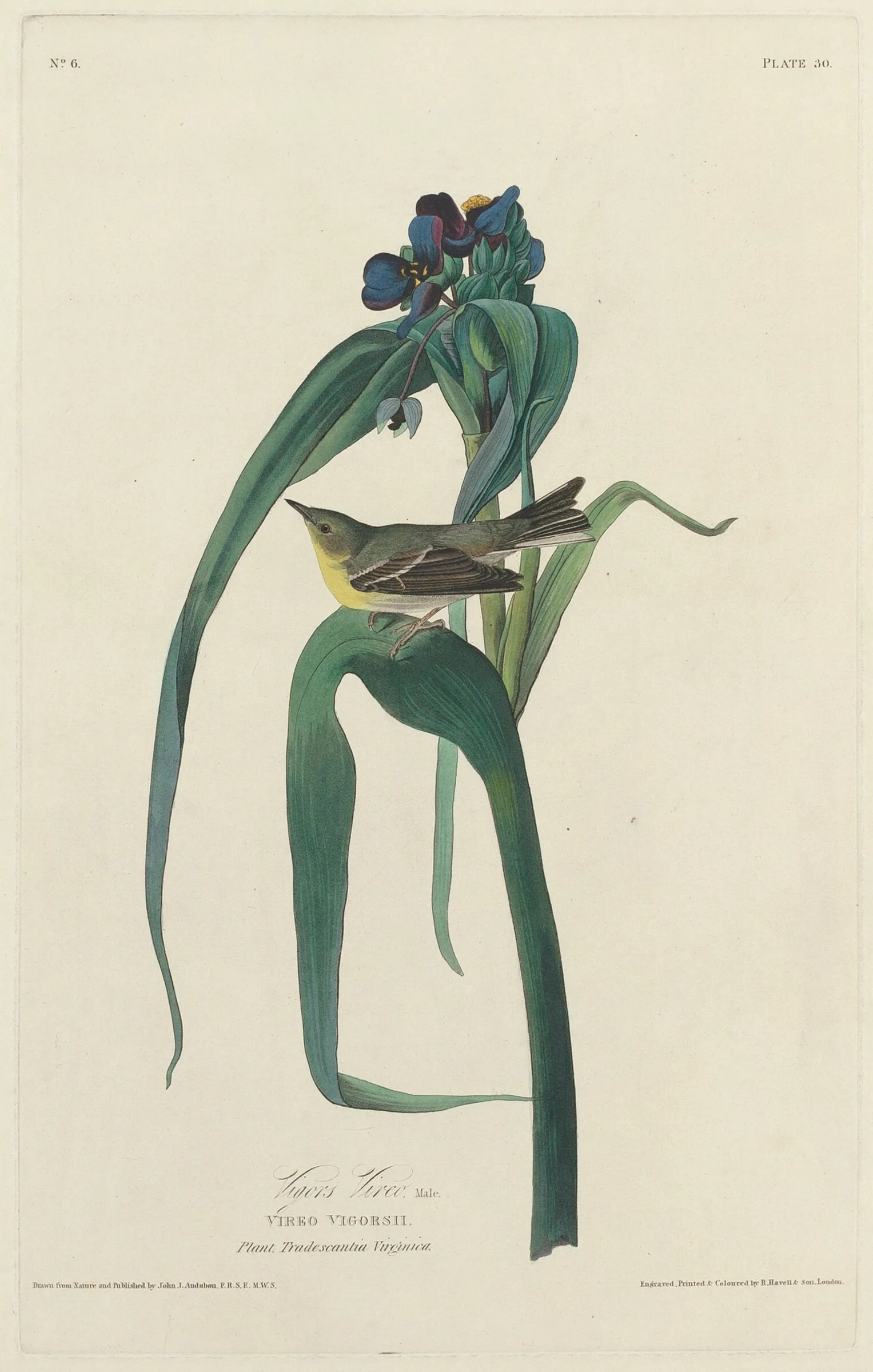
Audubon's “Vigors Vireo”, The Birds of America, plate XXX
Click or press Enter to enlarge
Open the full-resolution image (2484 px, National Gallery of Art)
| Plate | 30 (XXX) |
|---|---|
| Audubon's name | Vigors Vireo |
| Modern name | Pine Warbler (immature) |
| Scientific name | Setophaga pinus |
| Status | Least Concern |
| Engraved by | Robert Havell, after Audubon's watercolor |
| Date | 1828 |
| Medium | Hand-colored engraving and aquatint on Whatman wove paper |
| Plants and setting | Spider-wort (Tradescantia) |
| Collections | Songbirds |
| This impression | National Gallery of Art, Washington, 1945.8.30; Gift of Mrs. Walter B. James |
About this plate
Plate 30 shows a single small, plain olive and yellowish bird perched on a flowering Spider-wort, Tradescantia. Audubon wrote that the plant is the one on which the bird was perched when he shot it, and that Spider-wort grows in damp, shady places and near brooks. The plate was engraved by Robert Havell in 1828.
This is one of the earliest records in the work. Audubon wrote that he shot the bird more than twenty years before, in May, on a small island in Perkiomen Creek that was part of his farm at Mill Grove, Pennsylvania. Mill Grove was the estate his father owned near Philadelphia, where Audubon lived as a young man after arriving from France. The bird was flitting among grasses and calling cheep. He never saw another.
Audubon named it for Nicholas Aylward Vigors, the Irish zoologist and a founder of the Zoological Society of London. The plate title calls it a vireo and the text a warbler. No such species is recognized. Vigors's Warbler is generally treated as an immature Pine Warbler, Setophaga pinus, a dull plumage that is easy to mistake for something new.
The Pine Warbler breeds in pine forests of the eastern United States and southeastern Canada and is the only warbler that winters mainly within the United States. It is listed as Least Concern.
In Audubon's words
I regret that I am unable to give any account of the habits of a species which I have honoured with the name of a naturalist whose merits are so well known to the learned world. The individual represented in the plate I shot upwards of twenty years ago, and have never met with another of its kind. It was in the month of May, on a small island of the Perkioming Creek, forming part of my farm of Mill Grove, in the State of Pennsylvania. The bird was flittering amongst grasses, uttering an often repeated cheep.
John James Audubon, Ornithological Biography, vol. 1 (1831), “Vigors's Warbler”. Read the full chapter.



