Purple Finch (Plate 4)
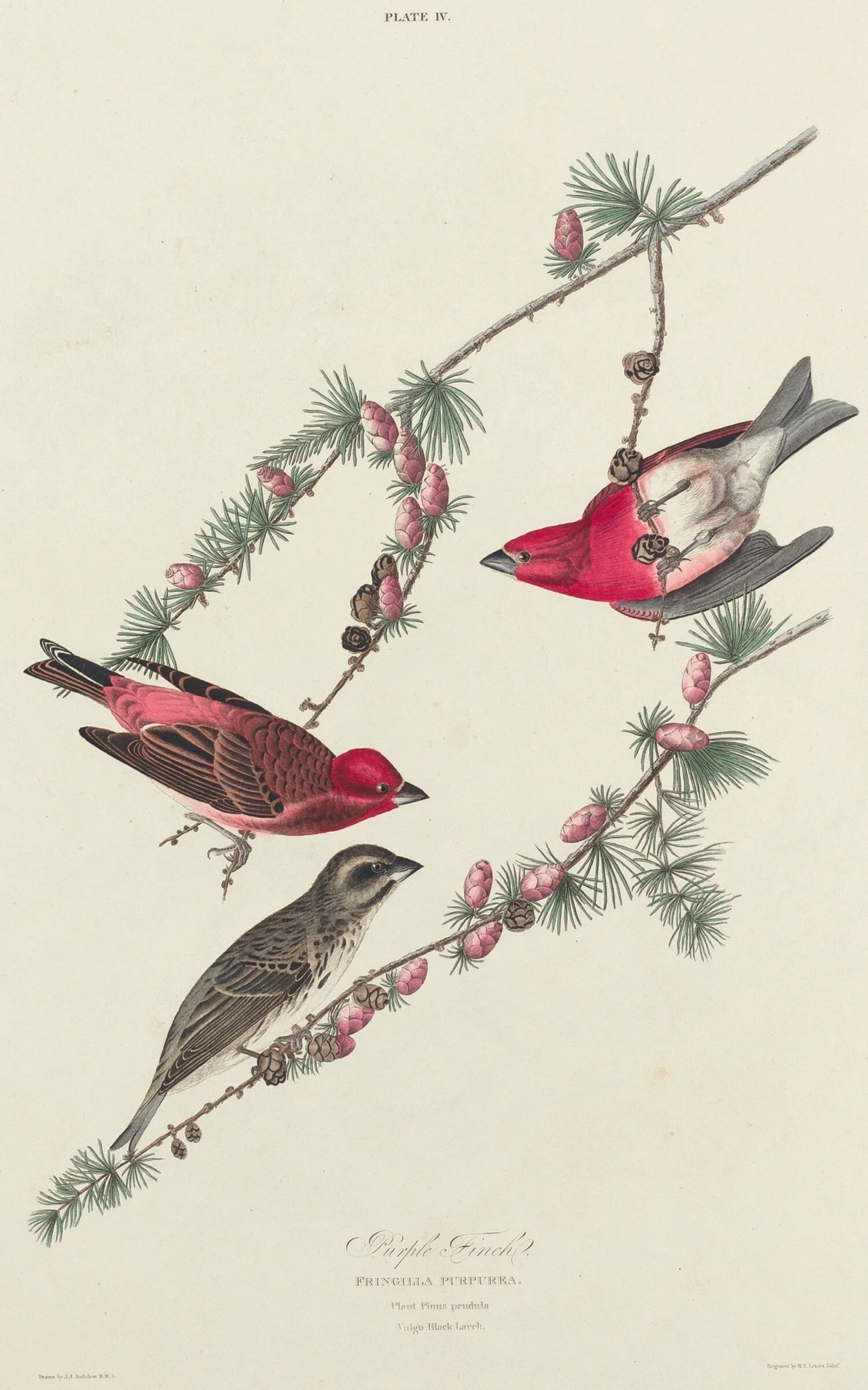
Audubon's “Purple Finch”, The Birds of America, plate IV
Click or press Enter to enlarge
Open the full-resolution image (2477 px, National Gallery of Art)
| Plate | 4 (IV) |
|---|---|
| Audubon's name | Purple Finch |
| Modern name | Purple Finch |
| Scientific name | Haemorhous purpureus |
| Status | Least Concern |
| Engraved by | William Home Lizars, after Audubon's watercolor |
| Date | 1827 |
| Medium | Etching and engraving with hand coloring on Whatman paper |
| Collections | Songbirds |
| This impression | National Gallery of Art, Washington, 1945.8.4; Gift of Mrs. Walter B. James |
About this plate
Plate 4 shows a male and female Purple Finch perched together. The male is washed with raspberry red on the head and breast. The female is brown and heavily streaked. Audubon wrote that the female differs so little from young males that they can hardly be told apart, which is why he described a confusing mix of plumages in his winter flocks. The plate was engraved by William Home Lizars in 1827.
Audubon knew the bird mainly as a winter visitor to Louisiana, from November to April, in flocks of six to twenty. He described them feeding on buds at the ends of branches, hanging like titmice, and warning each other off with raised crown feathers. In summer he heard the song in the mountains of Pennsylvania around the Great Pine Forest, where he saw adults feeding newly fledged young.
The current name is Purple Finch, Haemorhous purpureus. It was long placed in Carpodacus with the rosefinches of Asia, and was moved to Haemorhous in 2012 with the House Finch and Cassin's Finch. Audubon's scientific name was Fringilla purpurea.
The species breeds in conifer and mixed forest across Canada, the northeastern United States and the Pacific coast, and winters through much of the eastern United States. It is listed as Least Concern. Audubon added that he had eaten many and thought them as good as any small bird except the Bobolink.
In Audubon's words
Towards sunset they reappear, fly about the skirts of the fields and along the woods, until, having made choice of a tree, they alight, and, as soon as each bird has chosen a situation, stand still, look about them, plume themselves, and make short sallies after flies and other insects, but without interfering with each other. They frequently utter a single rather mellow clink, and are seen occupied in this manner until near sunset, when they again fly off to the interior of the forest. I one night surprised a party of them roosting in a small holly tree, as I happened to be brushing by it. In their consternation they suddenly started all together, and in the same direction, when, not knowing what birds they were, I shot at them and brought down two.
John James Audubon, Ornithological Biography, vol. 1 (1831), “The Purple Finch”. Read the full chapter.



