Bald Eagle (Plate 31)
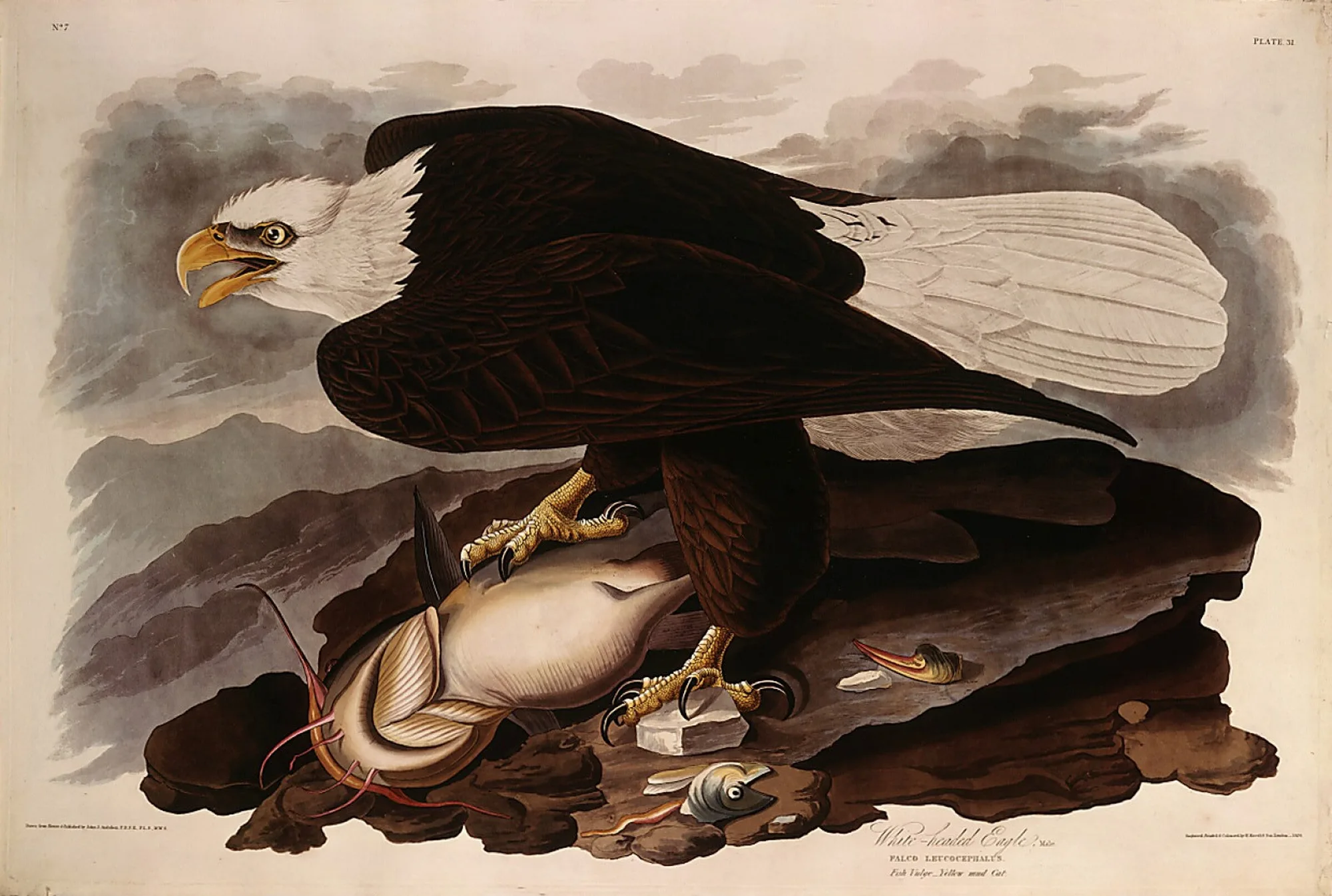
Audubon's “White-headed Eagle”, The Birds of America, plate XXXI
Click or press Enter to enlarge
Open the full-resolution image (1600 px, National Gallery of Art)
| Plate | 31 (XXXI) |
|---|---|
| Audubon's name | White-headed Eagle |
| Modern name | Bald Eagle |
| Scientific name | Haliaeetus leucocephalus |
| Status | Least Concern |
| Engraved by | Robert Havell, after Audubon's watercolor |
| Date | 1828 |
| Medium | Hand-colored engraving and aquatint on Whatman wove paper |
| Size | plate: 65.3 x 97.5 cm (25 11/16 x 38 3/8 in.) sheet: 67.7 x 100.5 cm (26 5/8 x 39 9/16 in.) |
| Collections | Hawks, Eagles and Falcons |
| This impression | National Gallery of Art, Washington, 1945.8.31; Gift of Mrs. Walter B. James |
About this plate
Plate 31 shows an adult Bald Eagle with white head and tail, standing on a catfish it has caught and tearing at it, its wings half raised. The plate was engraved by Robert Havell in 1828. Audubon's supposed larger eagle, the Bird of Washington, appears separately as Plate 11.
Audubon opened the chapter by noting that the bird was on the national standard. He then placed the reader on the Mississippi in winter, with a pair of eagles on tall trees on opposite banks. They ignore passing ducks until a Trumpeter Swan approaches. The male then drives the swan down, striking it from below so it cannot escape by diving, and forces it to the shore. He also described eagles robbing Ospreys of their fish along the coasts and rivers. Elsewhere in the chapter he agreed with Benjamin Franklin that the bird was a poor choice as a national emblem.
The Havell name is White-headed Eagle and Audubon's scientific name was Falco leucocephalus. The modern name is Bald Eagle, Haliaeetus leucocephalus, in which bald means white-headed. It is a sea eagle, related to the White-tailed Eagle of Eurasia.
The Bald Eagle lives across North America near large lakes, rivers and coasts. Shooting, habitat loss and DDT reduced it to about 400 nesting pairs in the lower 48 states by the early 1960s. After DDT was banned in 1972 and the bird was protected, it recovered strongly and was removed from the Endangered Species list in 2007. It is listed as Least Concern.
In Audubon's words
Now is the moment to witness the display of the Eagle's powers. He glides through the air like a falling star, and, like a flash of lightning, comes upon the timorous quarry, which now, in agony and despair, seeks, by various manœuvres, to elude the grasp of his cruel talons. It mounts, doubles, and willingly would plunge into the stream, were it not prevented by the Eagle, which, long possessed of the knowledge that by such a stratagem the Swan might escape him, forces it to remain in the air by attempting to strike it with his talons from beneath. The hope of escape is soon given up by the Swan. It has already become much weakened, and its strength fails at the sight of the courage and swiftness of its antagonist. Its last gasp is about to escape, when the ferocious Eagle strikes with his talons the under side of its wing, and with unresisted power forces the bird to fall in a slanting direction upon the nearest shore.
John James Audubon, Ornithological Biography, vol. 1 (1831), “The White-headed Eagle”. Read the full chapter.
Bald Eagle (Plate 31): the story behind one of the most famous plates in the collection →