Ruddy Turnstone (Plate 304)
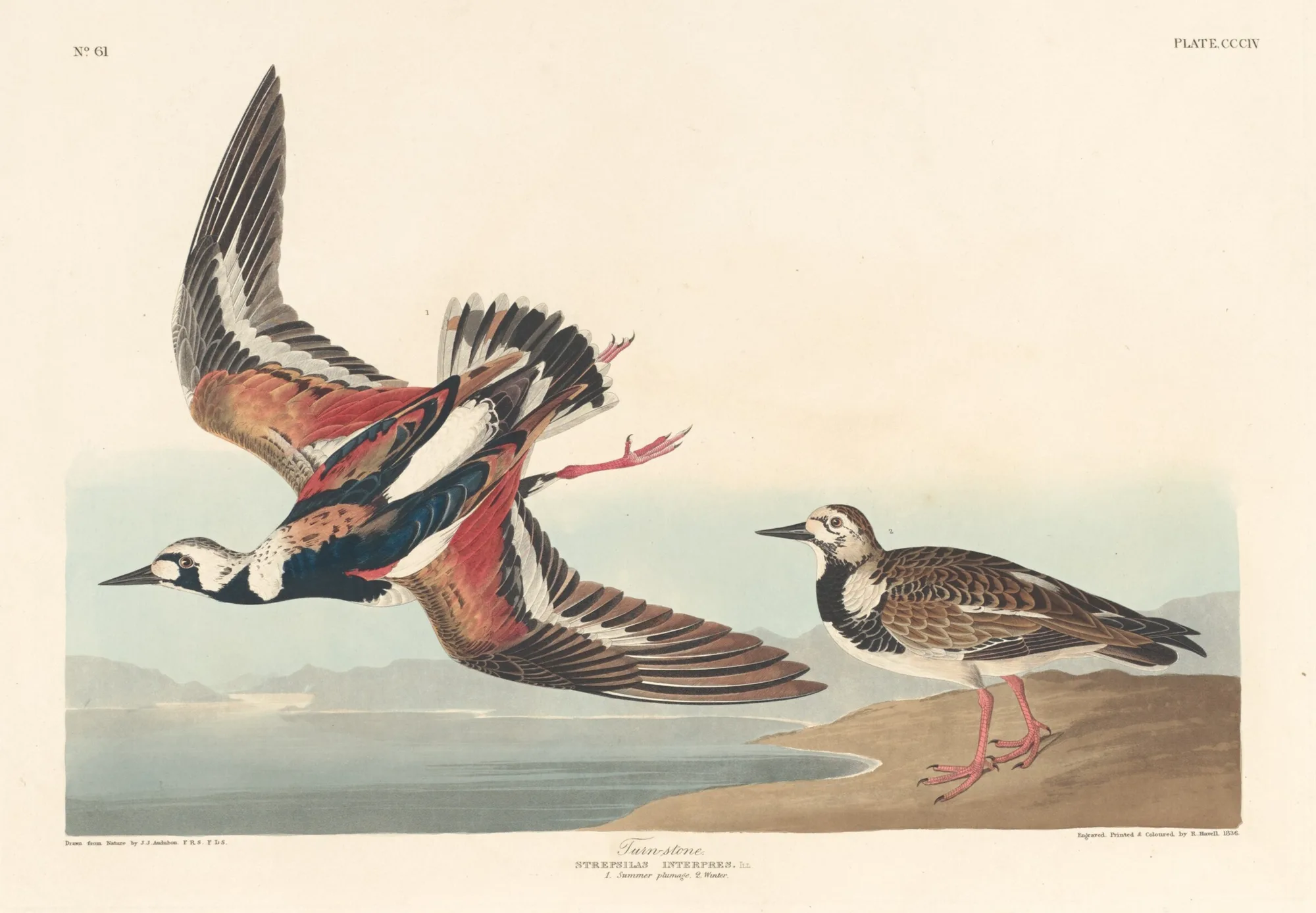
Audubon's “Turn-stone”, The Birds of America, plate CCCIV
Click or press Enter to enlarge
Open the full-resolution image (3002 px, National Gallery of Art)
| Plate | 304 (CCCIV) |
|---|---|
| Audubon's name | Turn-stone |
| Modern name | Ruddy Turnstone |
| Scientific name | Arenaria interpres |
| Status | Least Concern |
| Engraved by | Robert Havell, after Audubon's watercolor |
| Date | 1836 |
| Medium | Hand-colored engraving and aquatint on Whatman wove paper |
| Collections | Shorebirds, Rails and Cranes |
| This impression | National Gallery of Art, Washington, 1945.8.304; Gift of Mrs. Walter B. James |
About this plate
Plate 304 shows the Turnstone in two plumages, an adult in summer and one in winter. The summer bird has bright chestnut and black upperparts and a harlequin black and white face and breast. The winter bird is duller brown. Both have short orange legs and a short, slightly upturned, wedge-shaped bill.
Audubon's Strepsilas interpres is now Arenaria interpres, the Ruddy Turnstone. Both the old and new generic names refer to its feeding habit: it flips over stones, shells and seaweed with its bill to find the small animals underneath.
Ruddy Turnstones breed on Arctic tundra and rocky coasts around the pole. They winter on coasts across much of the world. In the Americas they reach from New England and California south to southern South America. In spring many stop on Delaware Bay to feed on horseshoe crab eggs. The IUCN lists the species as Least Concern, though counts in eastern North America have fallen.
Audubon collected many in the Florida Keys and near St Augustine, and saw flocks over the Grand Banks while crossing the Atlantic. In 1837, on Galveston Island, Texas, he stayed in camp to skin four deer while his son, Edward Harris and the others hunted. Four Turnstones fed within twenty yards of him. They turned over oyster shells and clods of mud, sometimes pushing with the breast when the bill was not enough.
In Audubon's words
None of them was more than fifteen or twenty yards distant, and I was delighted to see the ingenuity with which they turned over the oyster-shells, clods of mud, and other small bodies left exposed by the retiring tide. Whenever the object was not too large, the bird bent its legs to half their length, placed its bill beneath it, and with a sudden quick jerk of the head pushed it off, when it quickly picked up the food which was thus exposed to view, and walked deliberately to the next shell to perform the same operation. In several instances, when the clusters of oyster-shells or clods of mud were too heavy to be removed in the ordinary way, they would use not only the bill and head, but also the breast, pushing the object with all their strength, and reminding me of the labour which I have undergone in turning over a large turtle.
John James Audubon, Ornithological Biography, vol. 4 (1838), “Turnstone”. Read the full chapter.



