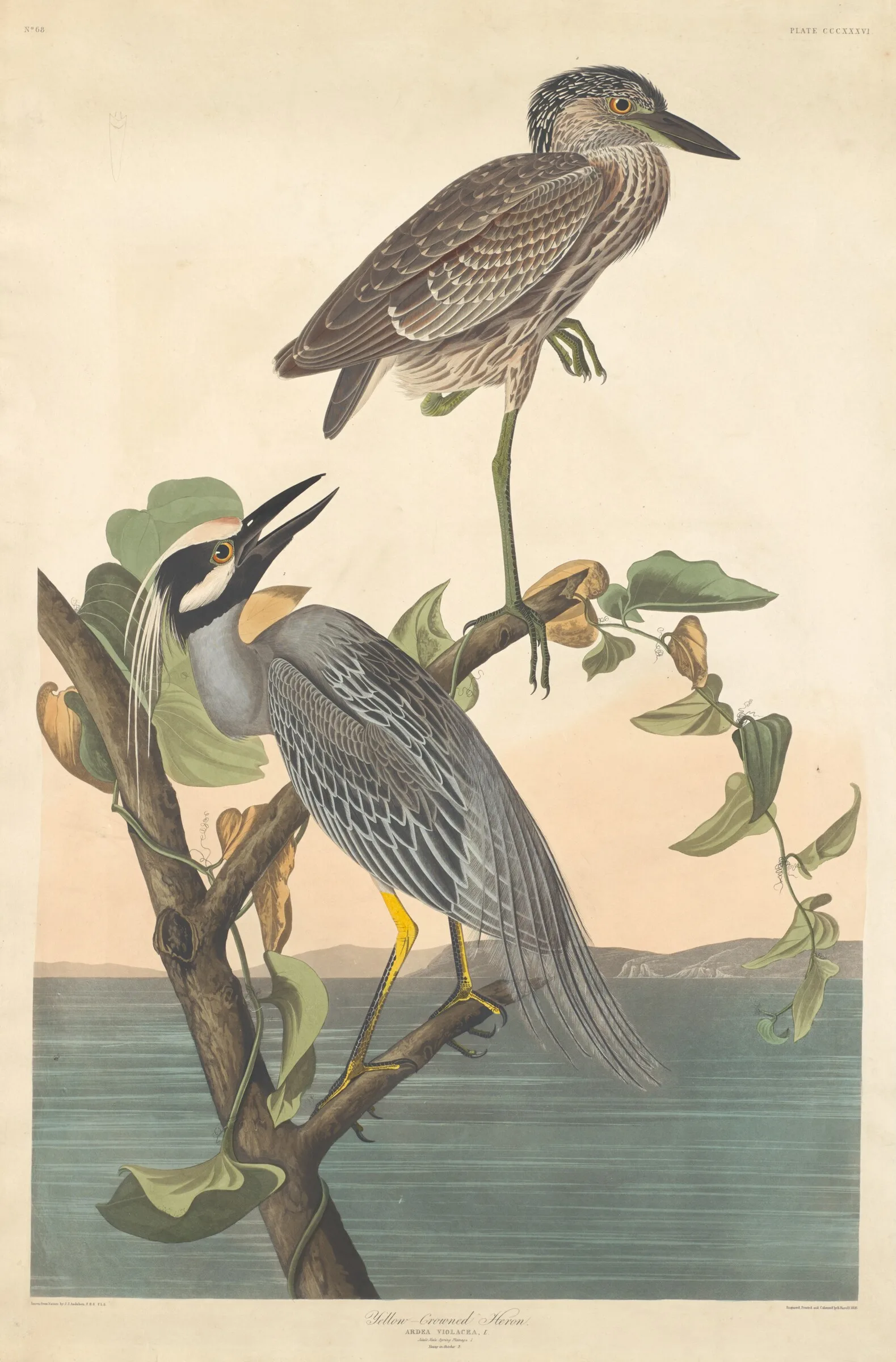
Yellow-crowned Night Heron (Plate 336)
Audubon's “Yellow-crowned Heron”, The Birds of America, plate CCCXXXVI
Click or press Enter to enlarge
Open the full-resolution image (5479 px, National Gallery of Art)
| Plate | 336 (CCCXXXVI) |
|---|---|
| Audubon's name | Yellow-crowned Heron |
| Modern name | Yellow-crowned Night Heron |
| Scientific name | Nyctanassa violacea |
| Status | Least Concern |
| Engraved by | Robert Havell, after Audubon's watercolor |
| Date | 1836 |
| Medium | Hand-colored engraving and aquatint on Whatman wove paper |
| Collections | Herons and Egrets, Florida and Wading Birds |
| This impression | National Gallery of Art, Washington, 1945.8.336; Gift of Mrs. Walter B. James |
About this plate
Plate 336 shows an adult Yellow-crowned Night Heron and a young bird. The adult is slate grey with a black face, a bold white cheek patch and a pale crown with long plumes. The young bird is brown with fine white spots, quite unlike its parent.
Audubon used Linnaeus's name Ardea violacea. The bird is now placed in its own genus as Nyctanassa violacea. Despite its name it feeds by day as well as by night, a point Audubon made himself after watching birds hunt among mangrove roots at all hours.
Yellow-crowned Night Herons live along the coasts and swamps of the southeastern United States, the Caribbean and Central and South America. They specialise in crabs and crayfish. The species is listed as Least Concern and has spread north in recent decades.
Audubon met the species in Louisiana, where Creoles called it Cap-cap and shot it for food. In Florida he found great numbers on a bayou near the Halifax River in winter and a breeding colony on one of the Keys on 22 May. On the 1837 Gulf voyage he found it plentiful on Galveston Island.
In Audubon's words
The Yellow-crowned Heron, which is one of the handsomest species of its tribe, is called “Cap-cap” by the Creoles of Lower Louisiana, in which country it is watched and shot with great eagerness, on account of the excellence of its flesh. It arrives about New Orleans toward the end of March, and departs in the middle of October. On arriving, they throw themselves among the thickets along the bayous, where they breed. Like the Night Heron, this species may be enticed near by imitating its cries, when it approaches, cutting many curious zigzags in the air, and alights close by. It is a curious circumstance that when passing over several gunners placed on the watch for them, they dive toward the ground if shot at and missed, and this they do several times in succession, according to the number of shots.
John James Audubon, Ornithological Biography, vol. 4 (1838), “Yellow-crowned Heron”. Read the full chapter.