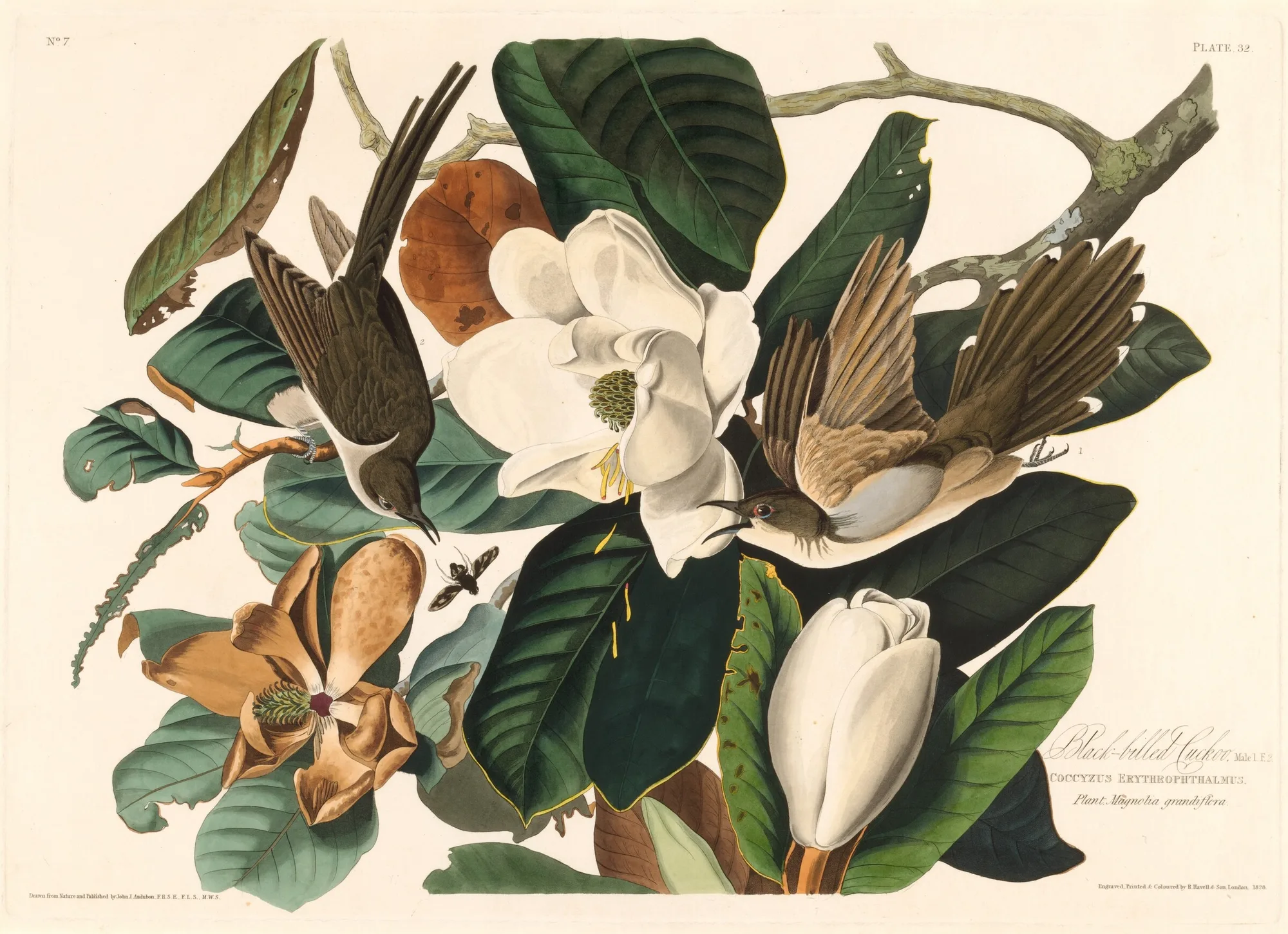
Black-billed Cuckoo (Plate 32)
Audubon's “Black-billed Cuckoo”, The Birds of America, plate XXXII
Click or press Enter to enlarge
Open the full-resolution image (4652 px, National Gallery of Art)
| Plate | 32 (XXXII) |
|---|---|
| Audubon's name | Black-billed Cuckoo |
| Modern name | Black-billed Cuckoo |
| Scientific name | Coccyzus erythropthalmus |
| Status | Least Concern |
| Engraved by | Robert Havell, after Audubon's watercolor |
| Date | 1828 |
| Medium | Hand-colored engraving and aquatint on Whatman wove paper |
| Size | plate: 47.7 x 67 cm (18 3/4 x 26 3/8 in.) sheet: 68 x 100.8 cm (26 3/4 x 39 11/16 in.) |
| Plants and setting | Southern Magnolia (Magnolia grandiflora) in bloom |
| Collections | Songbirds |
| This impression | National Gallery of Art, Washington, 1945.8.32; Gift of Mrs. Walter B. James |
About this plate
Plate 32 shows a male and female Black-billed Cuckoo on a branch of Southern Magnolia, Magnolia grandiflora, with large white flowers. Audubon admitted the birds were not shot on a magnolia but in a swamp nearby, where they were chasing flies of the kind shown in the plate. He chose the magnolia in bloom because the bird was rare in Louisiana. He had already shown the tree in fruit in Plate 5. The plate was engraved by Robert Havell in 1828.
Audubon wrote that he had seen the species in Louisiana only about half a dozen times and in the West only in Ohio. He described its migration along the Atlantic states from Florida to Maine. He said it flew faster than the Yellow-billed Cuckoo and kept to the edges of woods, creeks and damp places. He also claimed it fed mainly on freshwater shellfish and aquatic larvae. Modern studies show it lives mostly on caterpillars, especially hairy tent caterpillars.
The name is unchanged: Black-billed Cuckoo, Coccyzus erythropthalmus. Adults have a black bill and a narrow red ring around the eye. The Yellow-billed Cuckoo of Plate 2 has a yellow lower bill and large white tail spots.
The Black-billed Cuckoo breeds across southern Canada and the northern and eastern United States and winters in northwestern South America. Its numbers rise in years of caterpillar outbreaks. It has declined over recent decades but is listed as Least Concern.
In Audubon's words
The flight of this species is swifter than that of its near relative, the Yellow-billed Cuckoo, for which bird it is easily mistaken by ordinary observers. It does not so much frequent the interior of woods, but appears along their margins, on the edges of creeks and damp places. But the most remarkable distinction between this species and the Yellow-billed Cuckoo is, that the former, instead of feeding principally on insects and fruits, procures fresh-water shellfish and aquatic larvæ for its sustenance. It is therefore more frequently seen on the ground, near the edges of the water, or descending along the drooping branches of trees to their extremities, to seize the insects in the water beneath them.
John James Audubon, Ornithological Biography, vol. 1 (1831), “The Black-billed Cuckoo”. Read the full chapter.



