American Goldfinch (Plate 33)
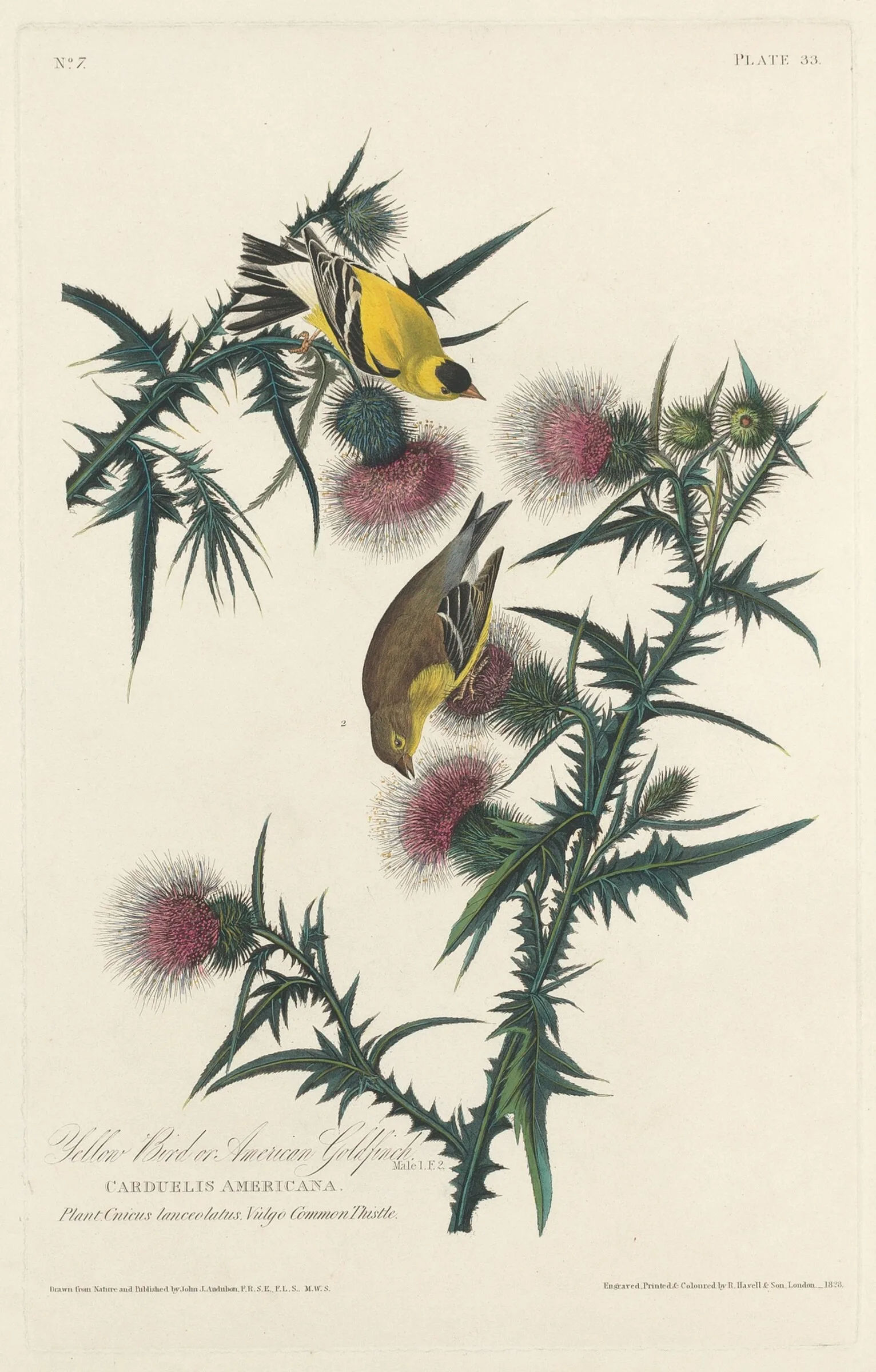
Audubon's “Yellow Bird or American Goldfinch”, The Birds of America, plate XXXIII
Click or press Enter to enlarge
Open the full-resolution image (2512 px, National Gallery of Art)
| Plate | 33 (XXXIII) |
|---|---|
| Audubon's name | Yellow Bird or American Goldfinch |
| Modern name | American Goldfinch |
| Scientific name | Spinus tristis |
| Status | Least Concern |
| Engraved by | Robert Havell, after Audubon's watercolor |
| Date | 1828 |
| Medium | Hand-colored engraving and aquatint on Whatman wove paper |
| Size | plate: 49.5 x 31.4 cm (19 1/2 x 12 3/8 in.) sheet: 100.3 x 67.3 cm (39 1/2 x 26 1/2 in.) |
| Plants and setting | Thistle in seed |
| Collections | Songbirds |
| This impression | National Gallery of Art, Washington, 1945.8.33; Gift of Mrs. Walter B. James |
About this plate
Plate 33 shows a male and female American Goldfinch on a thistle. The male, in summer plumage, is bright yellow with black cap, wings and tail. The female is olive yellow. Audubon wrote that the thistle was so well known it needed no description. The plate was engraved by Robert Havell in 1828.
Audubon wrote that the bird only passed through Louisiana for a few days in January and November. He described its habits as he saw them in New York, where it was abundant in summer. He noted that every thistle along the Mohawk River and the New York Canal in August seemed to carry a goldfinch, tearing open the seed heads and letting the down float away. He compared its looping flight, song and lichen-covered nest closely with those of the European Goldfinch.
The modern name is American Goldfinch, Spinus tristis. Audubon called it Fringilla tristis, and it was later placed in Carduelis before moving to Spinus. Yellow Bird and Wild Canary are old folk names still in use. It is the state bird of Iowa, New Jersey and Washington.
Audubon noted that adults lose their bright color in winter and look like the females, which is correct. The species nests late in summer, timed to the ripening of thistle and other seed plants, and lines its nest with thistle down. It breeds across southern Canada and much of the United States and is listed as Least Concern.
In Audubon's words
In ascending along the shores of the Mohawk river, in the month of August, I have met more of these pretty birds in the course of a day's walk than anywhere else; and whenever a thistle was to be seen along either bank of the New York Canal, it was ornamented with one or more Goldfinches. They tear up the down and withered petals of the ripening flowers with ease, leaning downwards upon them, eat off the seed, and allow the down to float in the air. The remarkable plumage of the male, as well as its song, are at this season very agreeable; and so familiar are these birds, that they suffer you to approach within a few yards, before they leave the plant on which they are seated. For a considerable space along the Gennessee river, the shores of Lake Erie, Lake Ontario, and even Lake Superior, I have always seen many of them in the latter part of summer. They have then a decided preference for the vicinity of water.
John James Audubon, Ornithological Biography, vol. 1 (1831), “The American Goldfinch”. Read the full chapter.



