Yellow Rail (Plate 329)
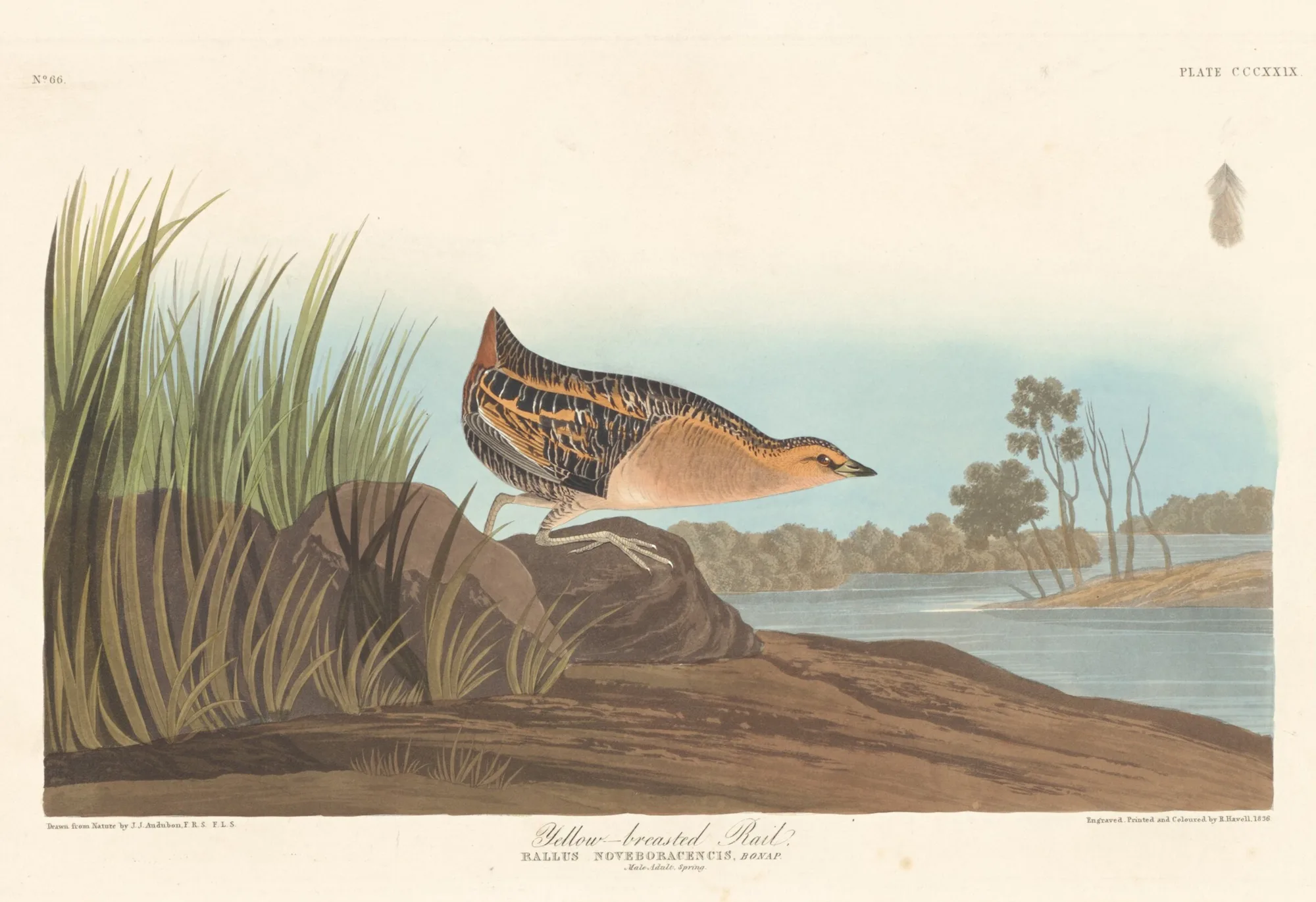
Audubon's “Yellow-breasted Rail”, The Birds of America, plate CCCXXIX
Click or press Enter to enlarge
Open the full-resolution image (2681 px, National Gallery of Art)
| Plate | 329 (CCCXXIX) |
|---|---|
| Audubon's name | Yellow-breasted Rail |
| Modern name | Yellow Rail |
| Scientific name | Coturnicops noveboracensis |
| Status | Least Concern |
| Engraved by | Robert Havell, after Audubon's watercolor |
| Date | 1836 |
| Medium | Hand-colored engraving and aquatint on Whatman wove paper |
| Collections | Shorebirds, Rails and Cranes |
| This impression | National Gallery of Art, Washington, 1945.8.329; Gift of Mrs. Walter B. James |
About this plate
Plate 329 shows one male Yellow Rail. It is a tiny rail, buff-yellow below and striped black and tawny above, with fine white bars on the back and a short yellowish bill. In flight it shows a white patch on the wing, which is often the only way to see it, since it rarely flies.
Audubon's Rallus noveboracensis is now Coturnicops noveboracensis. The species name means of New York, from the first described specimen. Bonaparte figured a bird bought in the New York market in February 1826. Audubon thought he had found it resident and breeding in Florida and Louisiana, but most of these southern breeding records are now thought to be errors. The Yellow Rail breeds far to the north and only winters on southern coastal marshes.
Yellow Rails breed in shallow sedge marshes and wet meadows in Canada and the northern United States, with a small separate population in Oregon. They winter in coastal marshes from the Carolinas to Texas. They are most active at night and give a clicking call like two pebbles tapped together. The species is hard to survey and is a conservation concern in several regions, but the IUCN lists it as Least Concern.
Audubon compared it to the Corn Crake of Europe for the way its calls seem to retreat as you walk toward them. He reported it on Sandy Island near Cape Sable in May 1832 and near Vincennes, Indiana.
In Audubon's words
In the neighbourhood of New Orleans, this species is found in all the deserted savannahs, covered with thick long grass, and pools of shallow water. There you hear its sharp and curious notes many times in the course of the day, just as you hear those of Rallus crepitans near the sea-shore, more especially after the report of a gun, when they are louder and more quickly repeated. These sounds come on the ear so as to induce you to believe that the bird is near; but whether this be the case or not is not easily determined, for when you move towards a spot in which you suppose it to be, the sounds recede at your approach, and you may think yourself fortunate if, after half an hour of search, you discover one on wing.
John James Audubon, Ornithological Biography, vol. 4 (1838), “Yellow-breasted Rail”. Read the full chapter.