Black-bellied Plover (Plate 334)
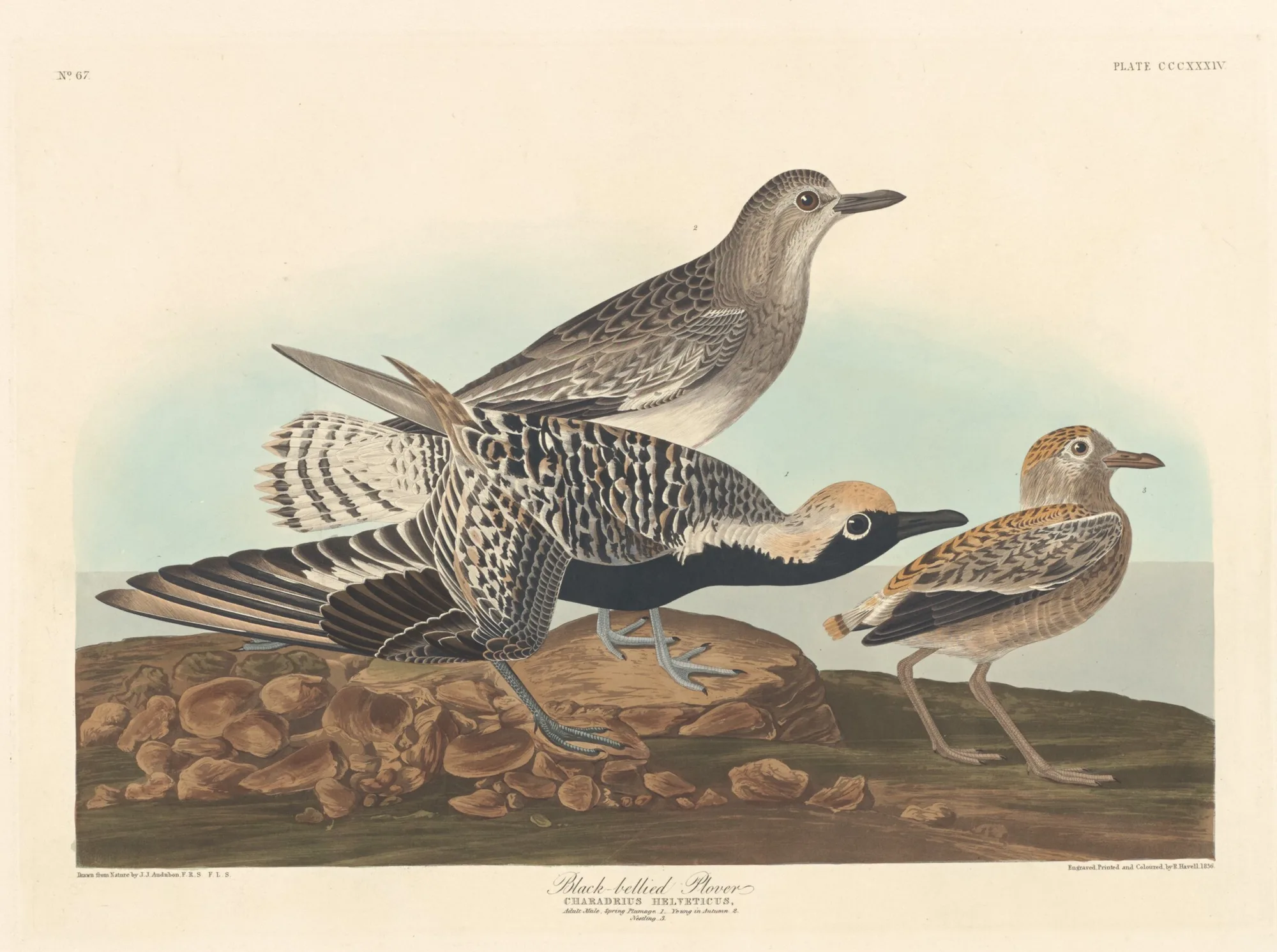
Audubon's “Black-bellied Plover”, The Birds of America, plate CCCXXXIV
Click or press Enter to enlarge
Open the full-resolution image (3031 px, National Gallery of Art)
| Plate | 334 (CCCXXXIV) |
|---|---|
| Audubon's name | Black-bellied Plover |
| Modern name | Black-bellied Plover |
| Scientific name | Pluvialis squatarola |
| Status | Least Concern |
| Engraved by | Robert Havell, after Audubon's watercolor |
| Date | 1836 |
| Medium | Hand-colored engraving and aquatint on Whatman wove paper |
| Collections | Shorebirds, Rails and Cranes |
| This impression | National Gallery of Art, Washington, 1945.8.334; Gift of Mrs. Walter B. James |
About this plate
Plate 334 shows three Black-bellied Plovers. One is a male in breeding plumage, black from face to belly and spangled black and white above. The others are a young bird and an adult in plain grey winter dress, which is how most Americans see the species on beaches.
The bird is Pluvialis squatarola, called Grey Plover in Britain. Audubon used Wilson's name Charadrius helveticus. It is the largest North American plover and can be told in flight from the golden-plovers by its black armpits.
Black-bellied Plovers breed on the high Arctic tundra of Alaska, Canada and Russia and winter on coasts worldwide. Audubon claimed to have found their nests in Pennsylvania near the Delaware and Perkiomen Creek. That cannot be right, since the species does not breed anywhere near Pennsylvania. He probably confused it with another ground-nesting bird. IUCN lists it as Least Concern.
Audubon watched spring migrants along the Gulf of Mexico in 1837. He described them arriving in small groups that formed an almost continuous line, travelling by night and resting on the beaches by day. His party also collected young birds in Labrador in August 1833.
In Audubon's words
This beautiful bird makes its appearance on our southern coasts in the beginning of April, as I had many opportunities of observing in the course of my journey along the shores of the Gulf of Mexico, in the spring of 1837. Instead of being congregated in large flocks, as is the case during their southward migration in autumn, they are seen coming in small numbers, but at short intervals, so as almost to form a continuous line. They travel chiefly by night, and rest for a great part of the day along the margins of the sea, either reposing on the sands in the sunshine, or searching the beaches for food. After dusk their well-known cries give note of their passage, but by day they remain silent, even when forced to betake themselves to flight. On such occasions they generally wheel over the waters, and not unfrequently return to the spot which they had at first selected.
John James Audubon, Ornithological Biography, vol. 4 (1838), “Black-bellied Plover”. Read the full chapter.



