Short-billed Dowitcher (Plate 335)
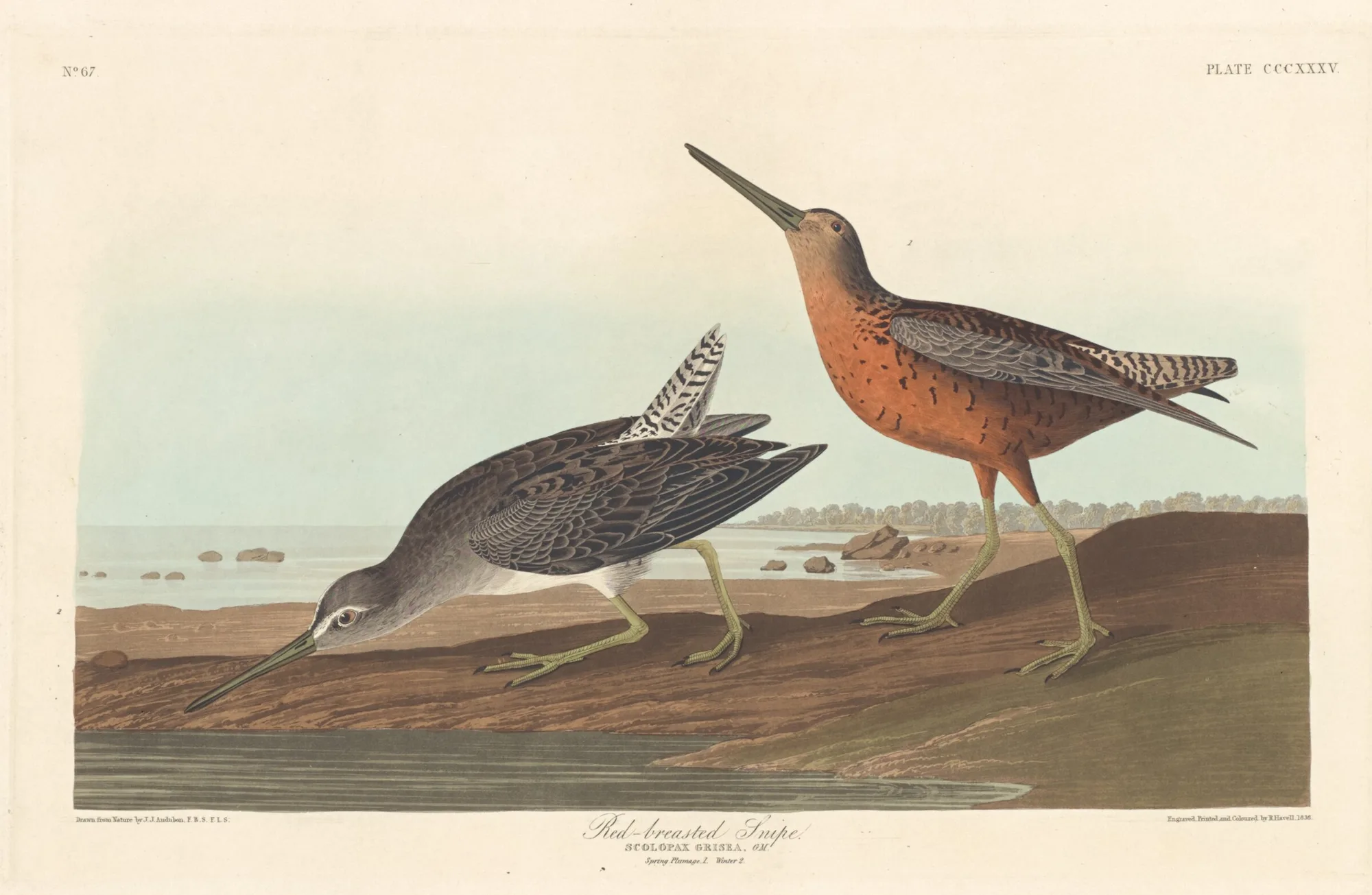
Audubon's “Red-breasted Snipe”, The Birds of America, plate CCCXXXV
Click or press Enter to enlarge
Open the full-resolution image (2779 px, National Gallery of Art)
| Plate | 335 (CCCXXXV) |
|---|---|
| Audubon's name | Red-breasted Snipe |
| Modern name | Short-billed Dowitcher |
| Scientific name | Limnodromus griseus |
| Status | Least Concern |
| Engraved by | Robert Havell, after Audubon's watercolor |
| Date | 1836 |
| Medium | Hand-colored engraving and aquatint on Whatman wove paper |
| Size | plate: 31.1 x 49.5 cm (12 1/4 x 19 1/2 in.) sheet: 67.9 x 101 cm (26 3/4 x 39 3/4 in.) |
| Collections | Shorebirds, Rails and Cranes |
| This impression | National Gallery of Art, Washington, 1945.8.335; Gift of Mrs. Walter B. James |
About this plate
Plate 335 shows two dowitchers, one in rusty-orange breeding plumage and one in grey winter plumage. Both have the long straight bill used to probe mud with a rapid sewing-machine motion.
Audubon's Red-breasted Snipe is the Short-billed Dowitcher, Limnodromus griseus. Dowitchers are sandpipers, not true snipes. A second species, the Long-billed Dowitcher, was not separated until the twentieth century, and the two are hard to tell apart in winter. Audubon's coastal birds and his descriptions fit the Short-billed.
Short-billed Dowitchers breed in muskeg bogs of Alaska and Canada and winter on coastal mudflats from the southern United States to South America. Many populations have declined, and the species is watched closely by shorebird biologists.
The Ornithological Biography gives an unusually exact diary. Audubon arrived at the mouths of the Mississippi on 1 April 1837 and saw large flocks still in winter plumage. He tracked their moult at Grande Terre, Cayo Island and Derniere Isle, where birds as bright as the one on the plate were shot on 16 April. The flocks continued to Galveston Bay. He also watched them feed at Grande Terre, probing like a snipe while the water was shallow.
In Audubon's words
On our arrival at the mouths of the Mississippi, on the first of April 1837, I observed large flocks of this species on their way eastward. They were still in their winter plumage, and it was pleasing to see in how short a period that garb was changed, as we had opportunities of observing during our progress. At Grande Terre, on the 4th, several having reddish feathers scattered over their lower parts were procured. On the 13th, at Cayo Island, the change of colour was very considerable in some specimens, which I found to be old birds, while the younger were quite grey above, and white beneath. At Derniere Isle on the 16th, several were shot in as fine plumage as that represented in my plate, and few, even of the younger birds, were without some of the markings peculiar to the summer dress.
John James Audubon, Ornithological Biography, vol. 4 (1838), “Red-breasted Snipe”. Read the full chapter.



