Chestnut-backed Chickadee, Black-capped Chickadee and Bushtit (Plate 353)
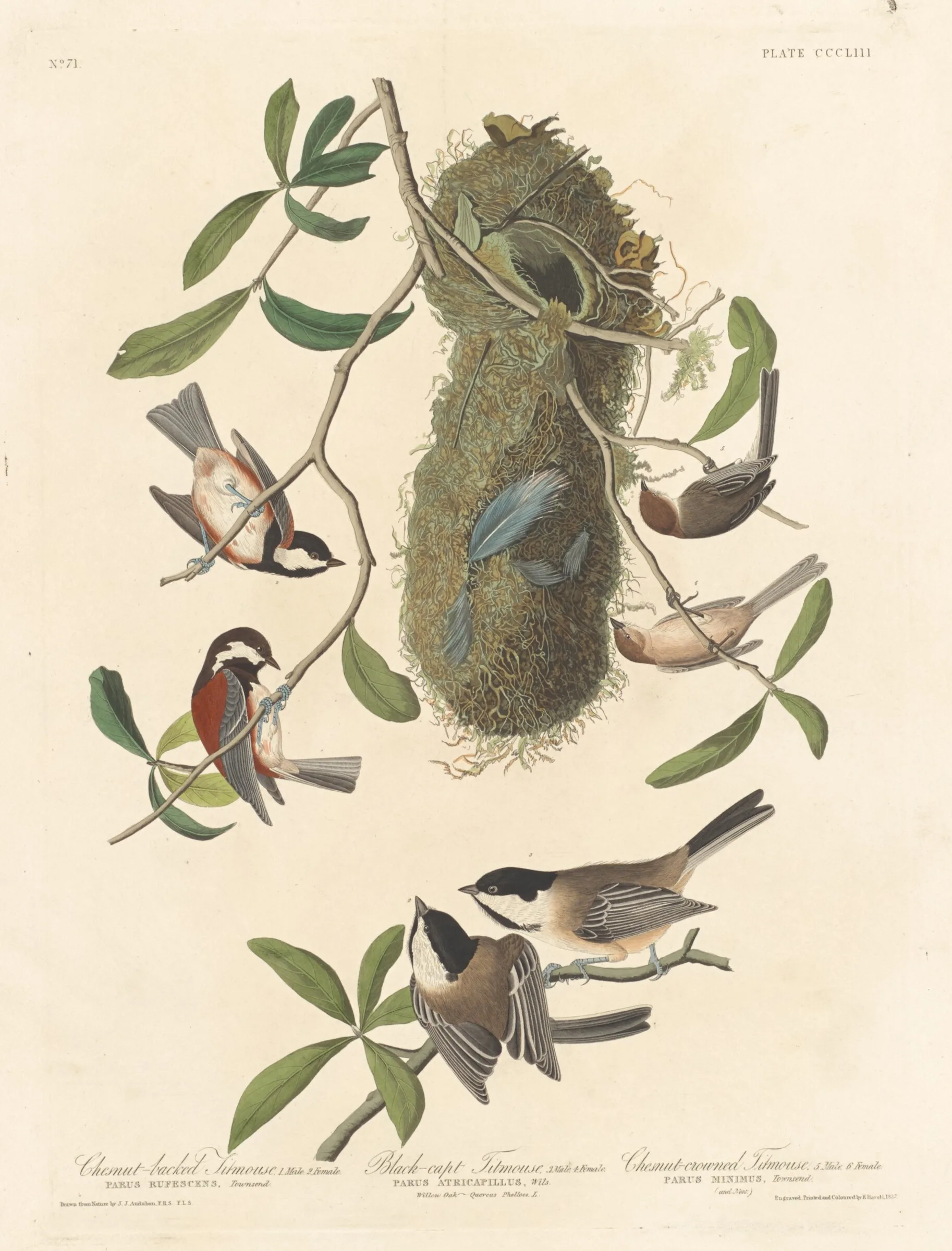
Audubon's “Chestnut-backed Titmouse, Black-capped Titmouse and Chestnut-crowned Titmouse”, The Birds of America, plate CCCLIII
Click or press Enter to enlarge
Open the full-resolution image (2911 px, National Gallery of Art)
| Plate | 353 (CCCLIII) |
|---|---|
| Audubon's name | Chestnut-backed Titmouse, Black-capped Titmouse and Chestnut-crowned Titmouse |
| Modern names | Chestnut-backed Chickadee, Black-capped Chickadee, Bushtit |
| Scientific names | Poecile rufescens, Poecile atricapillus, Psaltriparus minimus |
| Status | Least Concern |
| Engraved by | Robert Havell, after Audubon's watercolor |
| Date | 1837 |
| Medium | Hand-colored engraving and aquatint on Whatman wove paper |
| Collections | Songbirds |
| This impression | National Gallery of Art, Washington, 1945.8.353; Gift of Mrs. Walter B. James |
About this plate
Plate 353 shows three pairs of small birds on one sheet. The Chestnut-backed Chickadee has a black cap and bib and a rich chestnut back. The Black-capped Chickadee is the familiar grey, black and white bird of northern woods. The Chestnut-crowned Titmouse is a tiny, long-tailed grey bird now called the Bushtit.
Audubon wrote that two of the three were new to science. He obtained them when he bought part of John Kirk Townsend's collection from the 1834 to 1836 expedition across the Rockies to the Columbia River. Townsend described the Chestnut-backed as Parus rufescens and the Bushtit as Parus minimus. The chickadees are now in the genus Poecile. The Bushtit is not a titmouse at all; it belongs to the long-tailed tit family and is placed in Psaltriparus.
Chestnut-backed Chickadees live in the humid conifer forests of the Pacific coast. Black-capped Chickadees range across the northern United States and Canada. Audubon took care to separate them from the similar Carolina Chickadee, which Edward Harris had found breeding in New Jersey. Bushtits travel in busy flocks through scrub and open woodland in the West. All three are listed as Least Concern.
For the western birds Audubon relied on Thomas Nuttall, who found a Bushtit nest near the Willamette River in May. He described it as a long purse of moss and plant down hung from a low bush, with an entrance near the top.
Birds on this plate
- Chestnut-backed Chickadee Poecile rufescens: Audubon's Chesnut-backed Titmouse (male and female). Least Concern
- Black-capped Chickadee Poecile atricapillus: Audubon's Black-capt Titmouse (male and female). Least Concern
- Bushtit Psaltriparus minimus: Audubon's Chesnut-crowned Titmouse (male and female). Least Concern
In Audubon's words
The following day I heard the males utter a sort of weak monotonous short and quaint song, and about a week afterwards I had the good fortune to find the nest, about which the male was so particularly solicitous as almost unerringly to draw me to the spot, where hung from a low bush, about 4 feet from the ground, his little curious mansion, formed like a long purse, with a round hole for entrance near the summit. It was made chiefly of moss, down, lint of plants, and lined with some feathers. The eggs, six in number, were pure white, and already far gone towards being hatched.
John James Audubon, Ornithological Biography, vol. 4 (1838), “Chestnut-crowned Titmouse”. Read the full chapter.



