Western Tanager and Scarlet Tanager (Plate 354)
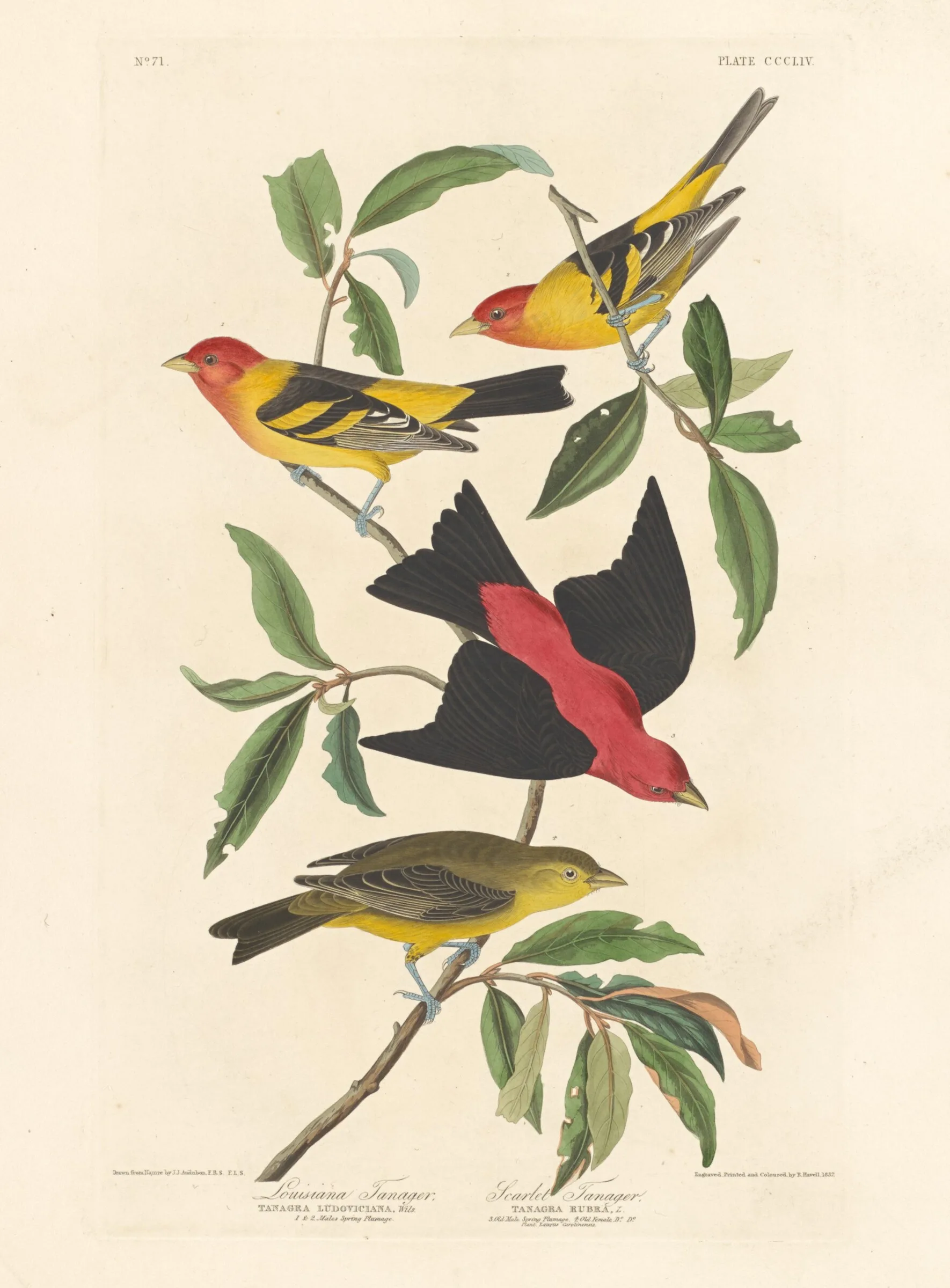
Audubon's “Louisiana Tanager and Scarlet Tanager”, The Birds of America, plate CCCLIV
Click or press Enter to enlarge
Open the full-resolution image (2992 px, National Gallery of Art)
| Plate | 354 (CCCLIV) |
|---|---|
| Audubon's name | Louisiana Tanager and Scarlet Tanager |
| Modern names | Western Tanager, Scarlet Tanager |
| Scientific names | Piranga ludoviciana, Piranga olivacea |
| Status | Least Concern |
| Engraved by | Robert Havell, after Audubon's watercolor |
| Date | 1837 |
| Medium | Hand-colored engraving and aquatint on Whatman wove paper |
| Size | plate: 49.9 x 31.8 cm (19 5/8 x 12 1/2 in.) sheet: 100 x 67.3 cm (39 3/8 x 26 1/2 in.) |
| Collections | Songbirds |
| This impression | National Gallery of Art, Washington, 1945.8.354; Gift of Mrs. Walter B. James |
About this plate
Plate 354 shows two species of tanager. The Louisiana Tanager is a male Western Tanager, with a red face, yellow body and black wings and back. Beside it are a male Scarlet Tanager, bright red with black wings, and a yellowish-olive female.
The name Louisiana Tanager comes from the Louisiana Purchase territory, where Lewis and Clark first collected the species. Alexander Wilson figured it from their specimens. Audubon bought better males from John Kirk Townsend, and later received a female from Dr Trudeau, which he figured on plate 400. Both tanagers are in the genus Piranga, which is now placed in the cardinal family, not with the true tanagers.
Western Tanagers breed in conifer and mixed forests of the western United States and Canada and winter in Mexico and Central America. Scarlet Tanagers breed in deciduous forests of the East and winter in northwestern South America. Both are listed as Least Concern.
Audubon's Scarlet Tanager chapter describes spring migrants he met on islands in the Gulf of Mexico in 1837, held back by cold weather. He found that the dull birds arriving first were young males, not females. For the Western Tanager he printed Nuttall's account of males singing from the tops of firs along the Columbia.
Birds on this plate
- Western Tanager Piranga ludoviciana: Audubon's Louisiana Tanager (male). Least Concern
- Scarlet Tanager Piranga olivacea (male and female). Least Concern
In Audubon's words
About the middle of May we observed the males in small numbers scattered through the dark pine forests of the Columbia, restless, shy, and flitting when approached, but at length more sedentary when mated. We frequently traced them out by their song, which is a loud, short, slow, but pleasing warble, not much unlike the song of the Common Robin, delivered from the tops of the lofty fir-trees. This music continues at short intervals throughout the whole forenoon, during which time our songster is busily engaged in quest of such coleopterous insects and larvæ as are to be found on the young branches of the trees he frequents, and which require an assiduous and long-continued search to gratify his wants.
John James Audubon, Ornithological Biography, vol. 4 (1838), “Louisiana Tanager”. Read the full chapter.



