Seaside Sparrow (Plate 355)
Audubon's “MacGillivray's Finch”, The Birds of America, plate CCCLV
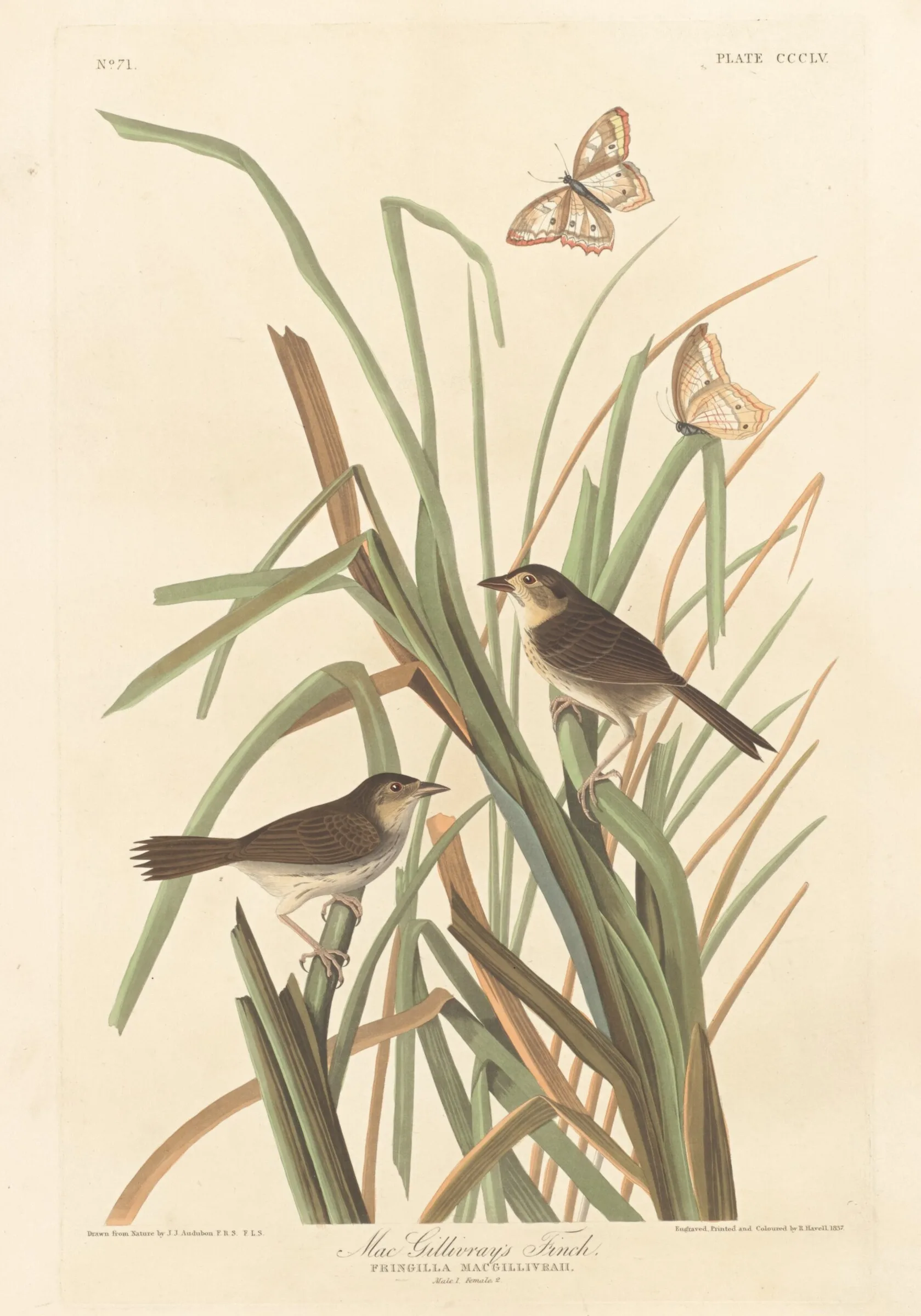
Click or press Enter to enlarge
Open the full-resolution image (2841 px, National Gallery of Art)
| Plate | 355 (CCCLV) |
|---|---|
| Audubon's name | MacGillivray's Finch |
| Modern name | Seaside Sparrow |
| Scientific name | Ammospiza maritima |
| Status | Least Concern |
| Engraved by | Robert Havell, after Audubon's watercolor |
| Date | 1837 |
| Medium | Hand-colored engraving and aquatint on Whatman wove paper |
| Collections | Songbirds |
| This impression | National Gallery of Art, Washington, 1945.8.355; Gift of Mrs. Walter B. James |
About this plate
Plate 355 shows a male and a female of a dark, greyish sparrow with a long bill and a yellow spot in front of the eye. Audubon named it MacGillivray's Finch, Fringilla macgillivraii, after his Scottish collaborator William MacGillivray, who helped write the Ornithological Biography.
The bird is a form of the Seaside Sparrow, Ammospiza maritima. Seaside Sparrows vary from place to place, and Audubon's birds from Texas and South Carolina differ in tone from the Seaside Finch of the northern Atlantic coast that Wilson had described. They are now treated as subspecies of one species. The genus Ammospiza has recently been revived for the Seaside and saltmarsh sparrows; older books use Ammodramus.
Seaside Sparrows live only in coastal salt marshes from Massachusetts to Texas. Rising seas and marsh loss threaten many populations. One subspecies, the Dusky Seaside Sparrow of Florida, became extinct in 1987. The species as a whole is listed as Least Concern.
Audubon wrote that the bird was rare east of Sullivan's Island near Charleston but abundant on the low, bayou-cut islands of Texas. There he watched birds run through the weeds and escape dogs with ease. John Bachman told him that the South Carolina birds left in early November.
In Audubon's words
They run among the rankest weeds with uncommon celerity, and do not seem to mind being followed by a dog, which they very easily elude amongst the thick grass. Whilst breeding they often start from a little distance, and pursue a singularly irregular or zigzag flight, much resembling that of the Jack Snipe of Europe, and yet performed with apparently slow beats of the wings. They fall as it were among the grass as suddenly as they rise from it, and by these manoeuvres save their nests from the searching eye of the keenest student of nature.
John James Audubon, Ornithological Biography, vol. 4 (1838), “MacGillivray's Finch”. Read the full chapter.



