Black-billed Magpie (Plate 357)
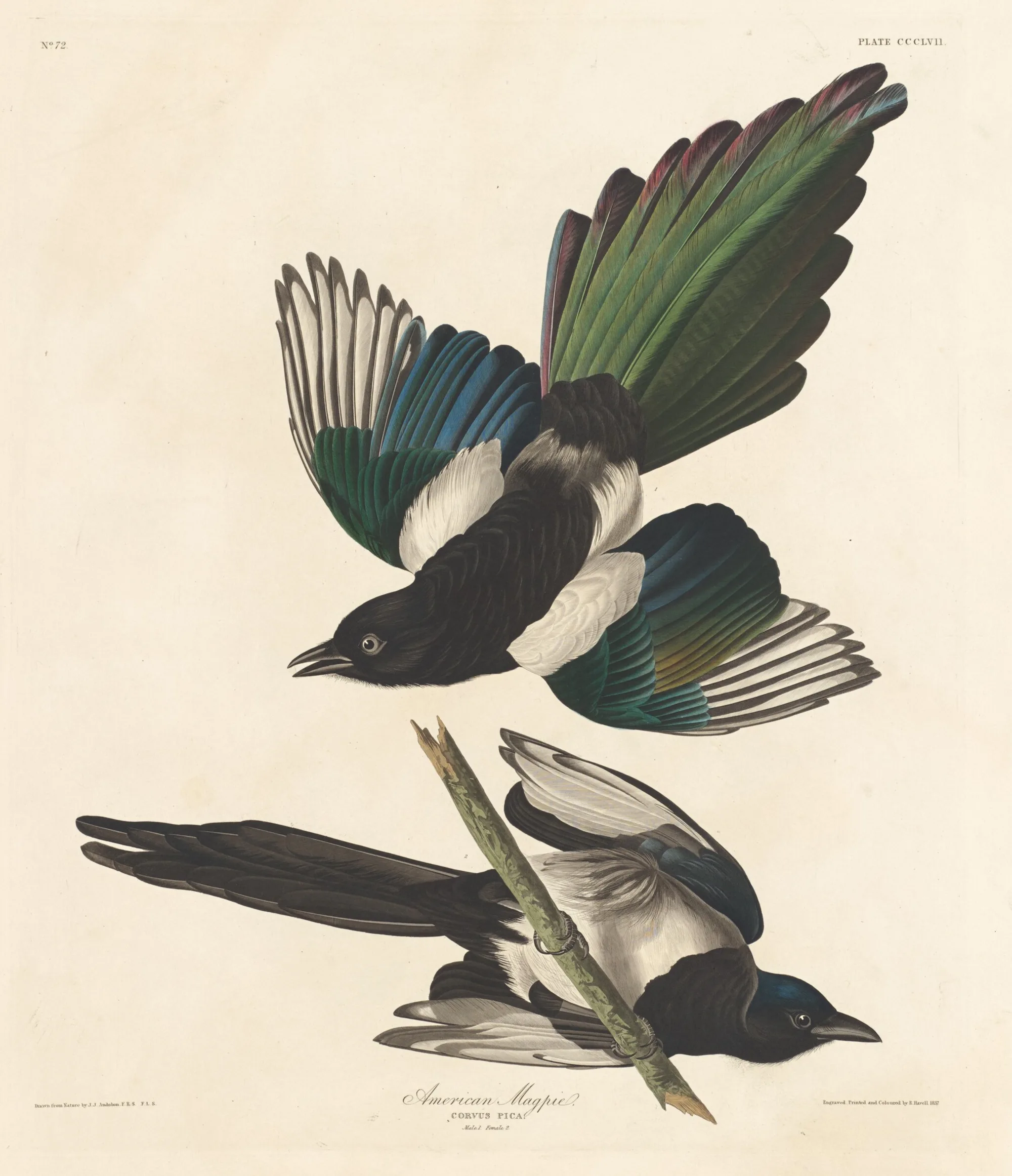
Audubon's “American Magpie”, The Birds of America, plate CCCLVII
Click or press Enter to enlarge
Open the full-resolution image (3770 px, National Gallery of Art)
| Plate | 357 (CCCLVII) |
|---|---|
| Audubon's name | American Magpie |
| Modern name | Black-billed Magpie |
| Scientific name | Pica hudsonia |
| Status | Least Concern |
| Engraved by | Robert Havell, after Audubon's watercolor |
| Date | 1837 |
| Medium | Hand-colored engraving and aquatint on Whatman wove paper |
| Collections | Songbirds |
| This impression | National Gallery of Art, Washington, 1945.8.357; Gift of Mrs. Walter B. James |
About this plate
Plate 357 shows a male and a female Black-billed Magpie. They are long-tailed black and white crows. The wings and tail shine green and blue in good light.
Audubon treated the American bird as the same species as the European Magpie, Corvus pica, and called his chapter The Common Magpie. Nuttall agreed, while Sabine thought them different. In 2000 the American Ornithologists' Union separated the North American bird as the Black-billed Magpie, Pica hudsonia, on the basis of its voice and DNA.
Black-billed Magpies live in open country with scattered trees and thickets across the western United States and Canada, from Alaska to New Mexico. They build large domed nests of sticks. They eat insects, carrion, grain and eggs, and they often pick ticks and scabs from livestock. The species is listed as Least Concern.
Audubon had no first-hand account and drew on Lewis and Clark, who first recorded it on the Missouri, and on Zebulon Pike. Pike described starving magpies that pecked at the sore backs of his expedition's horses and took meat from his men's hands. The plate was drawn from western specimens, most likely from the Townsend and Nuttall collections.
In Audubon's words
Although Magpies are abundant in the north-western portions of the United States, and are met with as far north as the Saskatchewan River, where, according to Dr Richardson, some of them spend the winter, none have yet been seen nearer the shores of the Atlantic than the head waters of the Red River in Louisiana, where they were seen in abundance by the lamented Colonel Pike, then a lieutenant in the United States’ army. His notice, although already published by Wilson, so well describes the habits of this species, that I repeat it here with pleasure. “Our horses,” he says, “were obliged to scrape the snow away to obtain their miserable pittance; and, to increase their misfortune, the poor animals were attacked by the Magpies, who, attracted by the scent of their sore backs, alighted on them, and, in defiance of their wincing and kicking, picked many places quite raw; the difficulty of procuring food rendering those birds so bold as to alight on our men’s arms, and eat meat out of their hands.”
John James Audubon, Ornithological Biography, vol. 4 (1838), “The Common Magpie”. Read the full chapter.



