Pine Grosbeak (Plate 358)
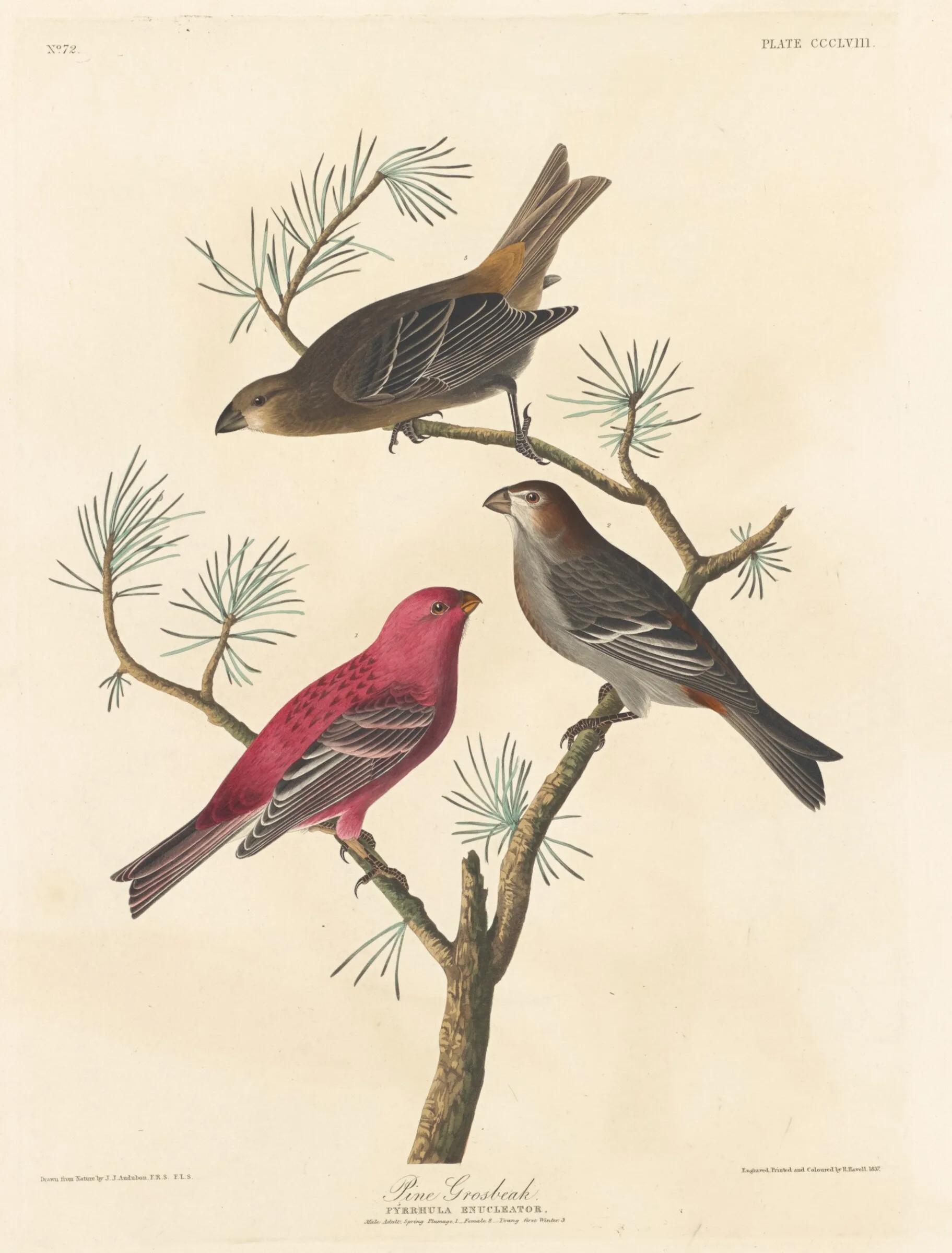
Audubon's “Pine Grosbeak”, The Birds of America, plate CCCLVIII
Click or press Enter to enlarge
Open the full-resolution image (2965 px, National Gallery of Art)
| Plate | 358 (CCCLVIII) |
|---|---|
| Audubon's name | Pine Grosbeak |
| Modern name | Pine Grosbeak |
| Scientific name | Pinicola enucleator |
| Status | Least Concern |
| Engraved by | Robert Havell, after Audubon's watercolor |
| Date | 1837 |
| Medium | Hand-colored engraving and aquatint on Whatman wove paper |
| Collections | Songbirds |
| This impression | National Gallery of Art, Washington, 1945.8.358; Gift of Mrs. Walter B. James |
About this plate
Plate 358 shows a male and a female Pine Grosbeak. The male is rosy red with grey flanks and two white wing bars. The female is grey with an olive-yellow head and rump. Both are large, plump finches with stubby black bills.
Audubon used Temminck's name Pyrrhula enucleator, placing it with the bullfinches. It is now Pinicola enucleator. DNA studies show it is indeed closely related to the bullfinches.
Pine Grosbeaks breed in the boreal forests of North America and Eurasia and in high mountain forests of the West. In some winters, when cone and berry crops fail, flocks move south into the northern United States. These irruptions explain why Audubon's friend Dr Trudeau could collect several near Philadelphia in the winter of 1836. The birds are famously tame. The species is listed as Least Concern.
Audubon called it a charming songster. In the Ornithological Biography he recalled lying on the mossy rocks near St George's Bay, Newfoundland, in mid August 1833, listening to its song at sunset. He also recorded it as a year-round resident in Maine and on islands in the Bay of Fundy.
In Audubon's words
The Pine Grosbeak is a charming songster. Well do I remember how delighted I felt, while lying on the moss-clad rocks of Newfoundland, near St George’s Bay, I listened to its continuous lay, so late as the middle of August, particularly about sunset. I was reminded of the pleasure I had formerly enjoyed on the banks of the clear Mohawk, under nearly similar circumstances, when lending an attentive ear to the mellow notes of another Grosbeak. But, Reader, at Newfoundland I was still farther removed from my beloved family; the scenery around was thrice wilder and more magnificent. The stupendous dark granite rocks, fronting the north, as if bidding defiance to the wintry tempests, brought a chillness to my heart, as I thought of the hardships endured by those intrepid travellers who, for the advancement of science, had braved the horrors of the polar winter.
John James Audubon, Ornithological Biography, vol. 4 (1838), “Pine Grosbeak”. Read the full chapter.



