Western Kingbird, Scissor-tailed Flycatcher and Say's Phoebe (Plate 359)
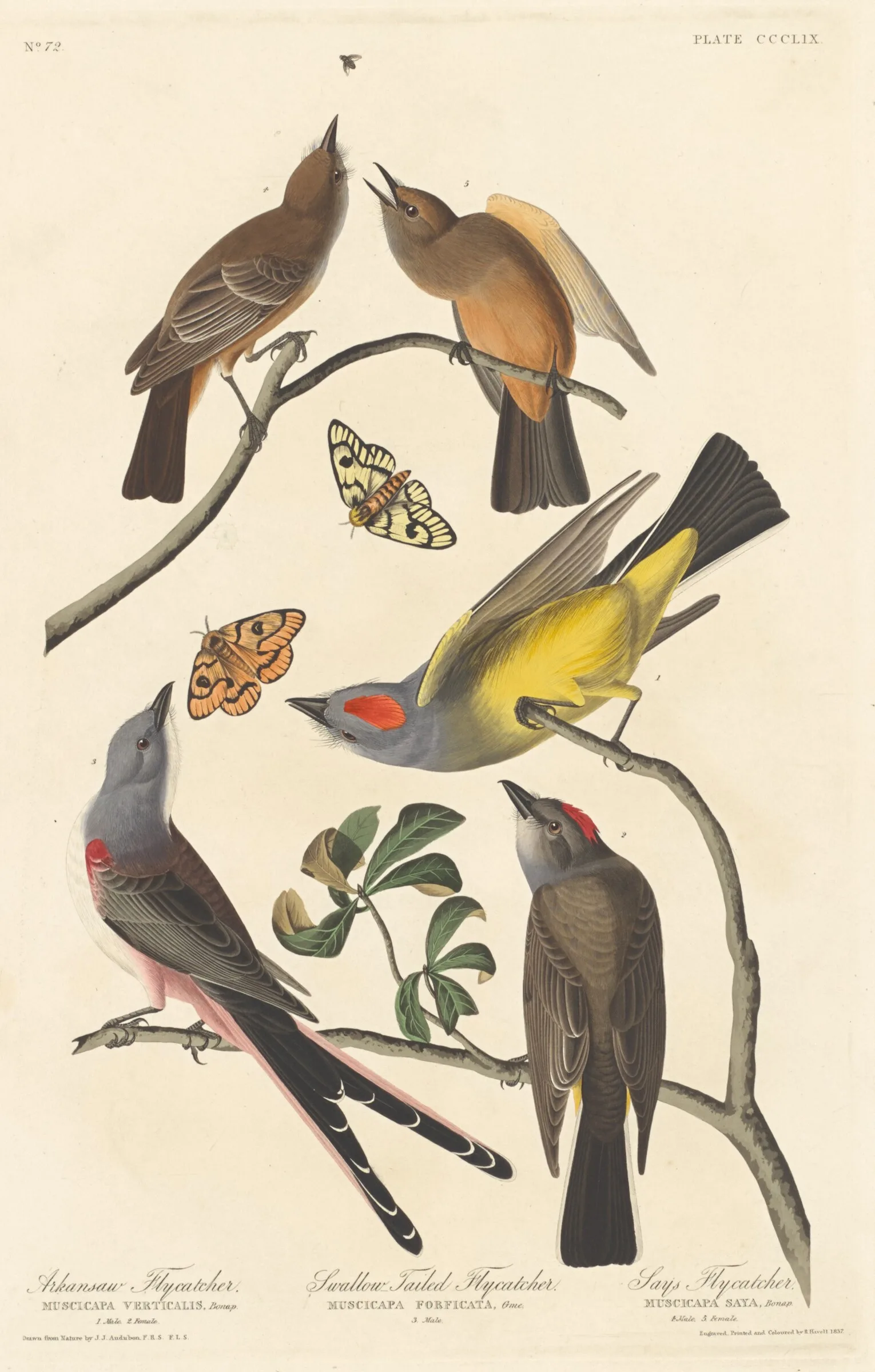
Audubon's “Arkansaw Flycatcher, Swallow-tailed Flycatcher and Says Flycatcher”, The Birds of America, plate CCCLIX
Click or press Enter to enlarge
Open the full-resolution image (3121 px, National Gallery of Art)
| Plate | 359 (CCCLIX) |
|---|---|
| Audubon's name | Arkansaw Flycatcher, Swallow-tailed Flycatcher and Says Flycatcher |
| Modern names | Western Kingbird, Scissor-tailed Flycatcher, Say's Phoebe |
| Scientific names | Tyrannus verticalis, Tyrannus forficatus, Sayornis saya |
| Status | Least Concern |
| Engraved by | Robert Havell, after Audubon's watercolor |
| Date | 1837 |
| Medium | Hand-colored engraving and aquatint on Whatman wove paper |
| Collections | Songbirds |
| This impression | National Gallery of Art, Washington, 1945.8.359; Gift of Mrs. Walter B. James |
About this plate
Plate 359 puts three western tyrant flycatchers on one sheet. The Arkansaw Flycatcher, a pair of Western Kingbirds, is grey and yellow with a black tail edged in white. The Swallow-tailed Flycatcher is a male Scissor-tailed Flycatcher, pale grey with salmon-pink flanks and a very long forked tail. Say's Flycatcher, a pair of Say's Phoebes, is a soft grey-brown bird with a cinnamon belly.
All three keep their old scientific species names in new genera: Tyrannus verticalis, Tyrannus forficatus and Sayornis saya. Thomas Say introduced the Western Kingbird. Say's Phoebe was discovered by Titian Peale on Long's expedition and named for Say by Bonaparte.
Western Kingbirds breed in open country across the western United States and winter mostly in Mexico and Central America. Scissor-tailed Flycatchers breed on the southern Great Plains, mainly Texas and Oklahoma. Say's Phoebes live in dry open country and canyons and often nest on cliffs and buildings. All are listed as Least Concern.
Audubon never saw the Scissor-tail alive and quoted Nuttall's account from the Red River and the Arkansas. On 10 April 1837 he found a Western Kingbird dead at the door of a salt-makers' hut on Cayo Island in the Gulf of Mexico, probably killed by a cold night. His other figures were drawn from John Kirk Townsend's skins.
Birds on this plate
- Western Kingbird Tyrannus verticalis: Audubon's Arkansaw Flycatcher (male and female). Least Concern
- Scissor-tailed Flycatcher Tyrannus forficatus: Audubon's Swallow-tailed Flycatcher (male). Least Concern
- Say's Phoebe Sayornis saya: Audubon's Say's Flycatcher (male and female). Least Concern
In Audubon's words
On the 10th of April 1837, whilst on Cayo Island, in the Bay of Mexico, I found a specimen of this bird dead at the door of a deserted house, which had recently been occupied by some salt-makers. From its freshness I supposed that it had sought refuge in the house on the preceding evening, which had been very cold for the season. Birds of several other species we also found dead on the beaches. The individual thus met with was emaciated, probably in consequence of a long journey and scanty fare; but I was not the less pleased with it, as it afforded me the means of taking measurements of a species not previously described in full.
John James Audubon, Ornithological Biography, vol. 4 (1838), “Arkansaw Flycatcher”. Read the full chapter.



