Lapland Longspur (Plate 365)
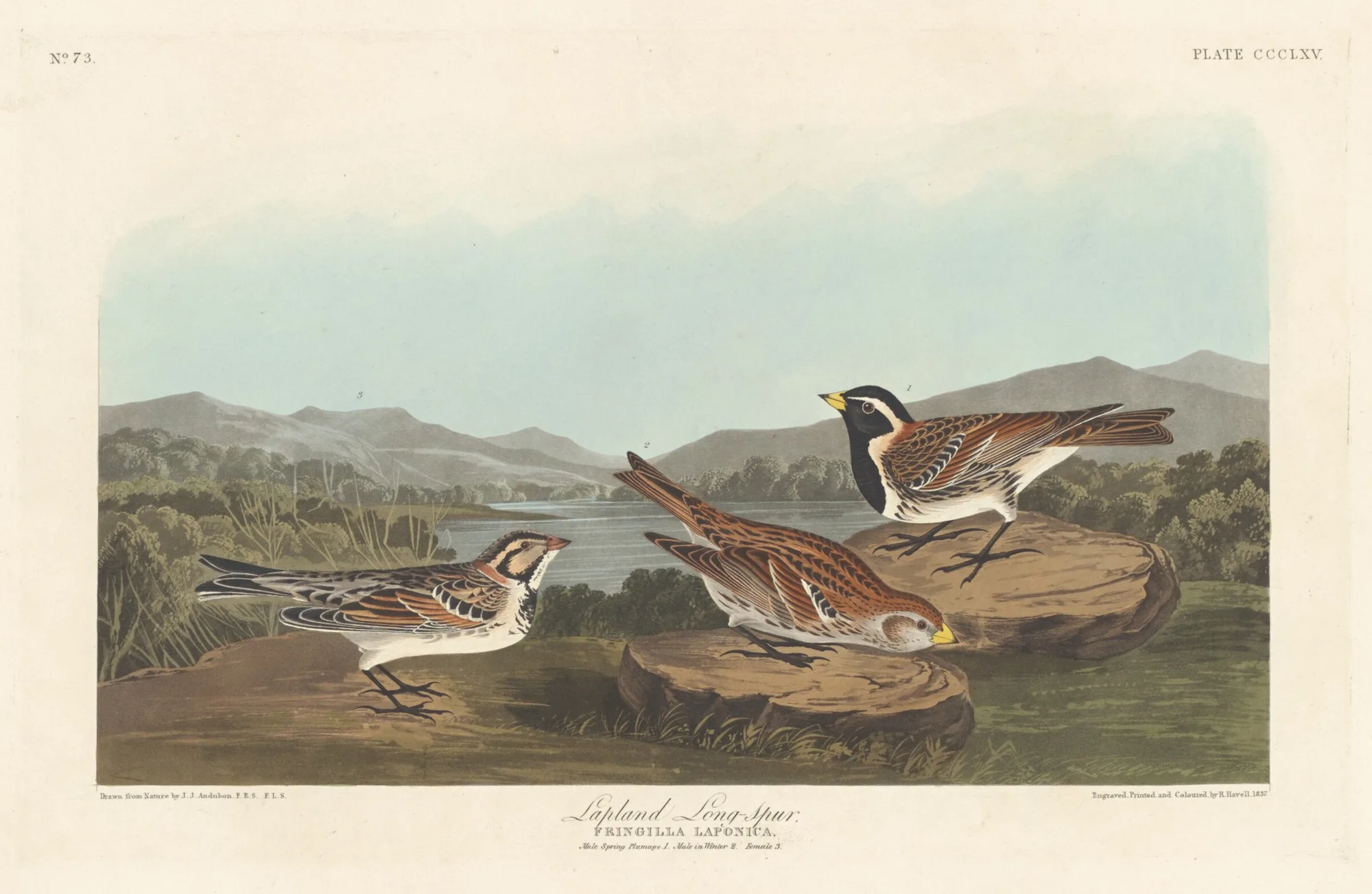
Audubon's “Lapland Longspur”, The Birds of America, plate CCCLXV
Click or press Enter to enlarge
Open the full-resolution image (2846 px, National Gallery of Art)
| Plate | 365 (CCCLXV) |
|---|---|
| Audubon's name | Lapland Longspur |
| Modern name | Lapland Longspur |
| Scientific name | Calcarius lapponicus |
| Status | Least Concern |
| Engraved by | Robert Havell, after Audubon's watercolor |
| Date | 1837 |
| Medium | Hand-colored engraving and aquatint on Whatman wove paper |
| Collections | Songbirds |
| This impression | National Gallery of Art, Washington, 1945.8.365; Gift of Mrs. Walter B. James |
About this plate
Plate 365 shows a male and a female Lapland Longspur. Audubon wrote that none of the birds he collected in Kentucky were in full summer plumage and that most resembled the second figure on the plate. Breeding males have a black face and breast, a chestnut nape and a white stripe behind the eye. Winter birds are streaked brown with a rusty wing panel. All have a long hind claw, the long spur of the name.
Audubon used Nilsson's name Emberiza lapponica. It is now Calcarius lapponicus. In Britain it is called the Lapland Bunting. Longspurs and snow buntings were moved from the true buntings into their own family, Calcariidae, in 2010.
Lapland Longspurs breed on Arctic tundra around the world and winter in open fields and prairies. In North America they winter across the Great Plains and Midwest, often in enormous flocks with Horned Larks and Snow Buntings. The species is listed as Least Concern.
Audubon's first meeting with it was on 15 February 1819, while walking with his wife Lucy near Henderson, Kentucky. He shot more than sixty in a few minutes, and a relative killed about six hundred the next day. Three days later the flocks were gone. He also found the birds on the commons at Shippingport near Louisville.
In Audubon's words
My first acquaintance with this species took place on the 15th of February 1819. Walking with my wife, on the afternoon of that day, in the neighbourhood of Henderson, in Kentucky, I saw immense flocks scattered over the open grounds on the elevated grassy banks of the Ohio. Having my gun with me, as usual, I procured more than sixty in a few minutes. All the youths of the village turned out on this occasion, and a relative of mine, in the course of the next day killed about six hundred. Although in rather poor condition, we found them excellent eating. Three days after they disappeared as suddenly as they had arrived, for although on the previous evening they seemed as numerous as ever, none but wounded birds were to be seen in the morning.
John James Audubon, Ornithological Biography, vol. 4 (1838), “Lapland Longspur”. Read the full chapter.



