Evening Grosbeak and Black-headed Grosbeak (Plate 373)
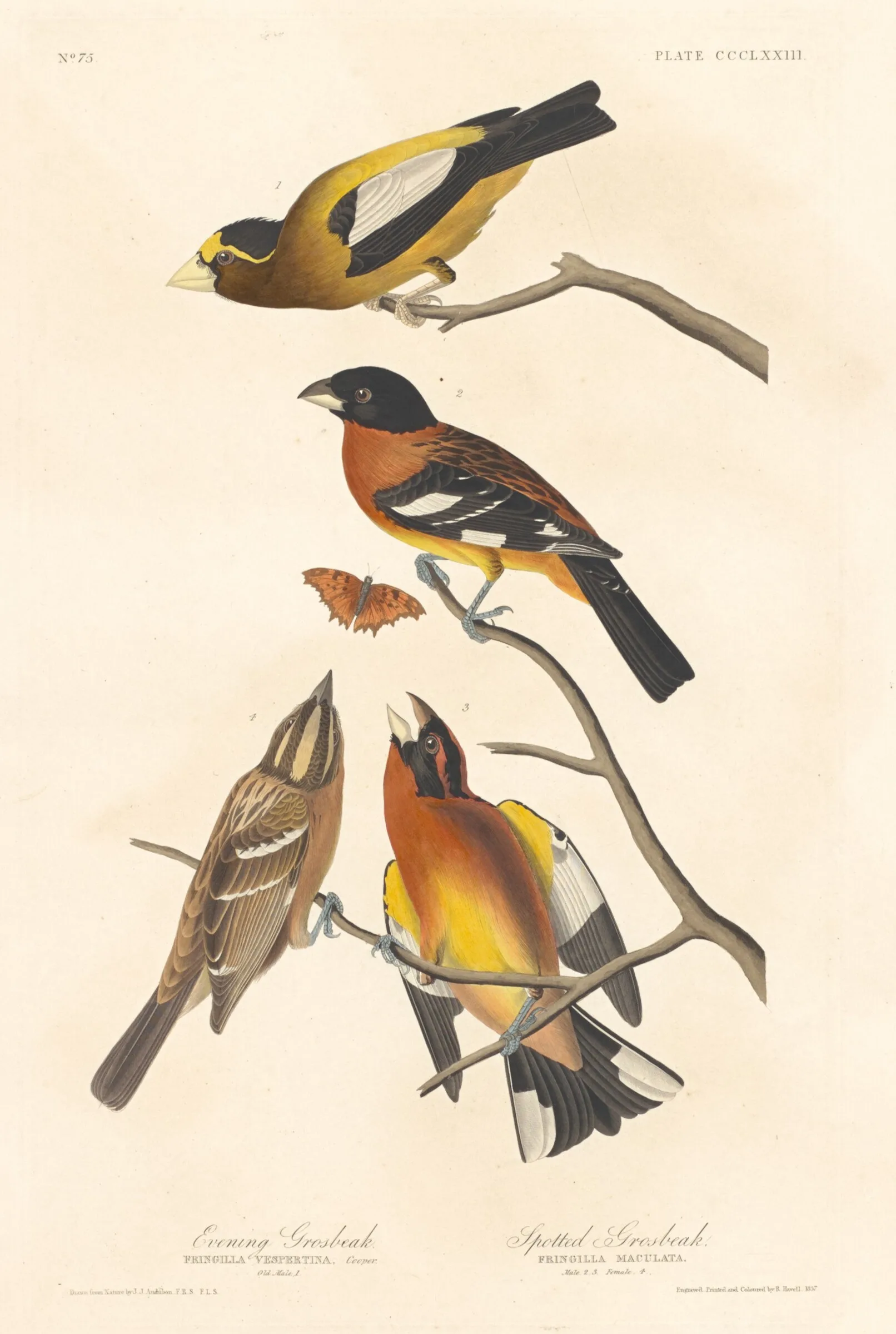
Audubon's “Evening Grosbeak and Spotted Grosbeak”, The Birds of America, plate CCCLXXIII
Click or press Enter to enlarge
Open the full-resolution image (2858 px, National Gallery of Art)
| Plate | 373 (CCCLXXIII) |
|---|---|
| Audubon's name | Evening Grosbeak and Spotted Grosbeak |
| Modern names | Evening Grosbeak, Black-headed Grosbeak |
| Scientific names | Coccothraustes vespertinus, Pheucticus melanocephalus |
| Status | Least Concern, Vulnerable |
| Engraved by | Robert Havell, after Audubon's watercolor |
| Date | 1837 |
| Medium | Hand-colored engraving and aquatint on Whatman wove paper |
| Collections | Songbirds |
| This impression | National Gallery of Art, Washington, 1945.8.373; Gift of Mrs. Walter B. James |
About this plate
Plate 373 shows two western grosbeaks. The Evening Grosbeak is a heavy finch with a huge pale bill, a yellow forehead and eyebrow, a dark head, a yellow body and black and white wings. The Spotted Grosbeak is the Black-headed Grosbeak: the male is orange-cinnamon with a black head and white wing spots, and the female is streaked brown with a buff breast.
The plate calls the second bird the Spotted Grosbeak, while the Ornithological Biography calls it the Black-headed Grosbeak, Fringilla melanocephala. It is now Pheucticus melanocephalus, a western relative of the Rose-breasted Grosbeak in the cardinal family. The Evening Grosbeak, first described by William Cooper from a bird seen near Sault Ste Marie in 1823, is now Coccothraustes vespertinus.
Evening Grosbeaks breed in conifer forests across Canada and the western mountains. They spread east in the nineteenth century, but numbers have fallen steeply since the 1980s, and IUCN lists the species as Vulnerable. Black-headed Grosbeaks breed in western woodlands and winter in Mexico. They are listed as Least Concern.
Audubon used specimens from John Kirk Townsend, who found Evening Grosbeaks abundant in the Columbia River pine woods in May 1836. Townsend reported that they were noisy all day, contrary to the belief that they sang only at evening. Nuttall supplied a lyrical account of the Black-headed Grosbeak's song.
Birds on this plate
- Evening Grosbeak Coccothraustes vespertinus (male). Vulnerable
- Black-headed Grosbeak Pheucticus melanocephalus: Audubon's Spotted Grosbeak (male and female). Least Concern
In Audubon's words
Columbia River, May 27, 1836.—The Evening Grosbeak, Fringilla vespertina, is very numerous in the pine-woods at this time. You can scarcely enter a grove of pines at any hour in the day without seeing numbers of them. They are very unsuspicious and tame, and I have, in consequence, been enabled to procure a fine suite of specimens. The accounts that have been published respecting them by the only two authors to whom I have access, Mr Nuttall and Prince Bonaparte, are, I think, in many respects incorrect. In the first place, it is stated that they are retiring and silent during the day, and sing only on the approach of evening. Here they are remarkably noisy during the whole of the day, from sunrise to sunset. They then retire quietly to their roosts in the summits of the tall pines, and are not aroused until daylight streaks the east, when they come forth to feed as before.
John James Audubon, Ornithological Biography, vol. 4 (1838), “Evening Grosbeak”. Read the full chapter.



