Sharp-shinned Hawk (Plate 374)
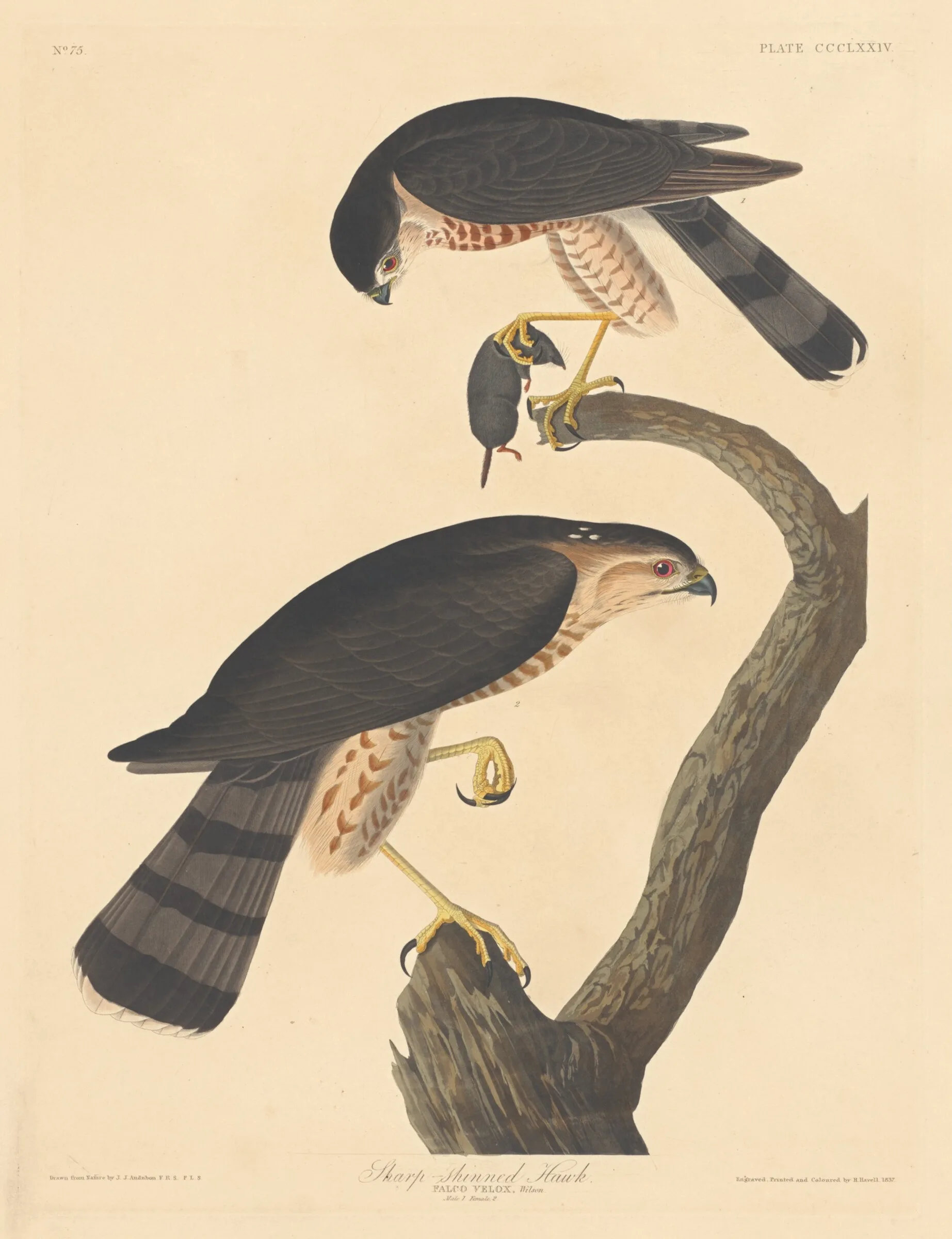
Audubon's “Sharp-shinned Hawk”, The Birds of America, plate CCCLXXIV
Click or press Enter to enlarge
Open the full-resolution image (2870 px, National Gallery of Art)
| Plate | 374 (CCCLXXIV) |
|---|---|
| Audubon's name | Sharp-shinned Hawk |
| Modern name | Sharp-shinned Hawk |
| Scientific name | Accipiter striatus |
| Status | Least Concern |
| Engraved by | Robert Havell, after Audubon's watercolor |
| Date | 1837 |
| Medium | Hand-colored engraving and aquatint on Whatman wove paper |
| Collections | Hawks, Eagles and Falcons |
| This impression | National Gallery of Art, Washington, 1945.8.374; Gift of Mrs. Walter B. James |
About this plate
Plate 374 shows a male and a female Sharp-shinned Hawk. Adults are slate blue-grey above with fine rusty barring below, red eyes, short rounded wings and a long, square-tipped tail. The male is much smaller than the female, as in most hawks.
The Ornithological Biography heads the chapter Sharp-shinned or Slate-coloured Hawk, combining two names Alexander Wilson had given to what proved to be one species. Audubon used Gmelin's Falco fuscus. The bird is now Accipiter striatus. Audubon wondered at length whether it was distinct from the European Sparrowhawk, which it closely resembles. It is a separate species, though in the same genus.
Sharp-shinned Hawks breed in forests across Canada and the United States and winter south to Central America. They hunt small birds by ambush and short, fast chases through cover, and often visit bird feeders. Thousands pass hawk-watch sites such as Hawk Mountain each autumn. Numbers fell in the mid-twentieth century from DDT and have since recovered. The species is listed as Least Concern.
Audubon wrote that he had met it in every state and territory he visited. In spring 1837 he found it abundant in Texas, moving east. He also had a specimen from Townsend's Columbia River collection.
In Audubon's words
There is a pleasure which that ornithologist only can feel who spends his days in searching for the materials best adapted for his purpose, and which arises from the contemplation of the objects he is anxious to portray and describe, as they roam in freedom over Nature’s wild domains. Another pleasure is derived from finding in different countries birds so much alike in form, colour, and habits, that they seem as if formed for the purpose of exercising our faculties of observation and comparison. But this pleasure passes into pain, or at least perplexity, when, as in the present instance, two species differ so slightly that you cannot clearly define their characters, although they yet seem to be distinct.
John James Audubon, Ornithological Biography, vol. 4 (1838), “Sharp-shinned or Slate-coloured Hawk”. Read the full chapter.