Tufted Titmouse (Plate 39)
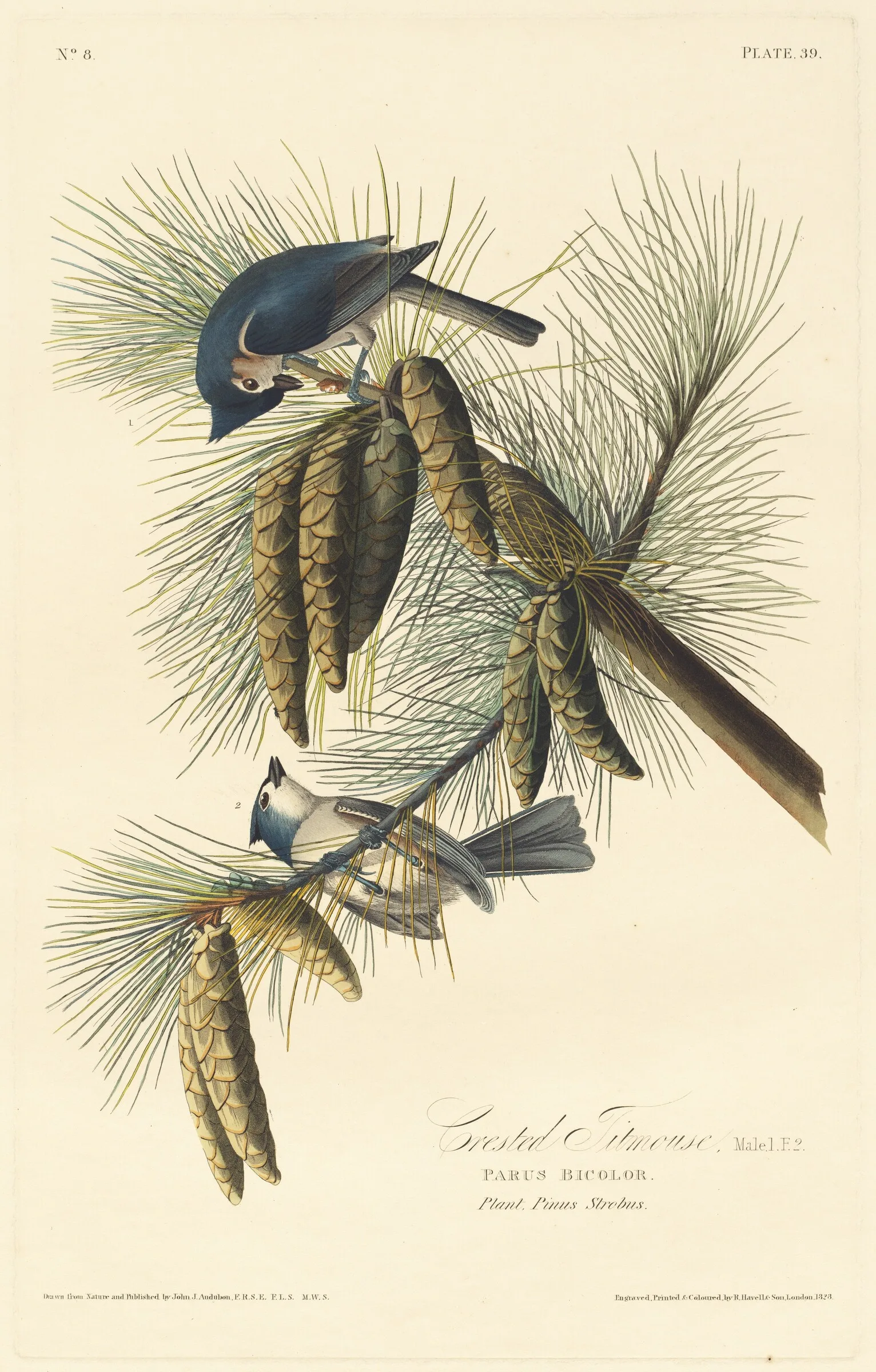
Audubon's “Crested Titmouse”, The Birds of America, plate XXXIX
Click or press Enter to enlarge
Open the full-resolution image (7693 px, National Gallery of Art)
| Plate | 39 (XXXIX) |
|---|---|
| Audubon's name | Crested Titmouse |
| Modern name | Tufted Titmouse |
| Scientific name | Baeolophus bicolor |
| Status | Least Concern |
| Engraved by | Robert Havell, after Audubon's watercolor |
| Date | 1828 |
| Medium | Hand-colored engraving and aquatint on Whatman wove paper |
| Size | overall: 100.2 x 67.3 cm (39 7/16 x 26 1/2 in.) |
| Plants and setting | Eastern White Pine (Pinus strobus) |
| Collections | Songbirds |
| This impression | National Gallery of Art, Washington, 1945.8.39; Gift of Mrs. Walter B. James |
About this plate
Plate 39 shows a pair of Tufted Titmice, grey birds with a pointed crest and rusty flanks, on a twig of Eastern White Pine, Pinus strobus, with cones. Audubon wrote that white pines had been measured at 180 feet tall and that the tree gave perhaps the most valuable wood in the United States. He also noted it was called Weymouth Pine in Britain. The plate was engraved by Robert Havell in 1828.
Audubon described the titmouse's short, rustling flight and its habit of hanging from twigs to pull off beech nuts, acorns and chinquapins. It carried each nut to a large branch, wedged it in a crevice, held it with both feet and broke the shell with blows of its bill. He wrote that in autumn it came to plantations and even to granaries for corn. He met it everywhere he travelled in the United States.
Audubon called it the Crested Titmouse, Parus bicolor. The modern name is Tufted Titmouse, Baeolophus bicolor. The titmice of North America were moved from Parus to Baeolophus in 1998. In 2002 the black-crested birds of Texas were split off as the Black-crested Titmouse.
The Tufted Titmouse is resident in deciduous and mixed woods across the eastern United States. It has spread north into New England and southern Canada since the mid twentieth century, helped by bird feeders and maturing forests. It is listed as Least Concern.
In Audubon's words
Its flight is short, the bird being seldom seen on the wing long enough to cross a field of moderate extent. It is performed by repeated flaps of the wings, accompanied by jerks of the body and tail, and occasions a rustling noise, as it takes place from one tree to another. It moves along the branches, searches in the chinks, flies to the end of twigs and hangs to them by its feet, whilst the bill is engaged in detaching a beech or hazel nut, an acorn or a chinquapin, upon all of which it feeds, removing them to a large branch, where, having secured them in a crevice, it holds them with both feet, and breaks the shell by repeated blows of its bill. They are to be seen thus employed for many minutes at a time.
John James Audubon, Ornithological Biography, vol. 1 (1831), “The Crested Titmouse”. Read the full chapter.



