Dickcissel (Plate 384)
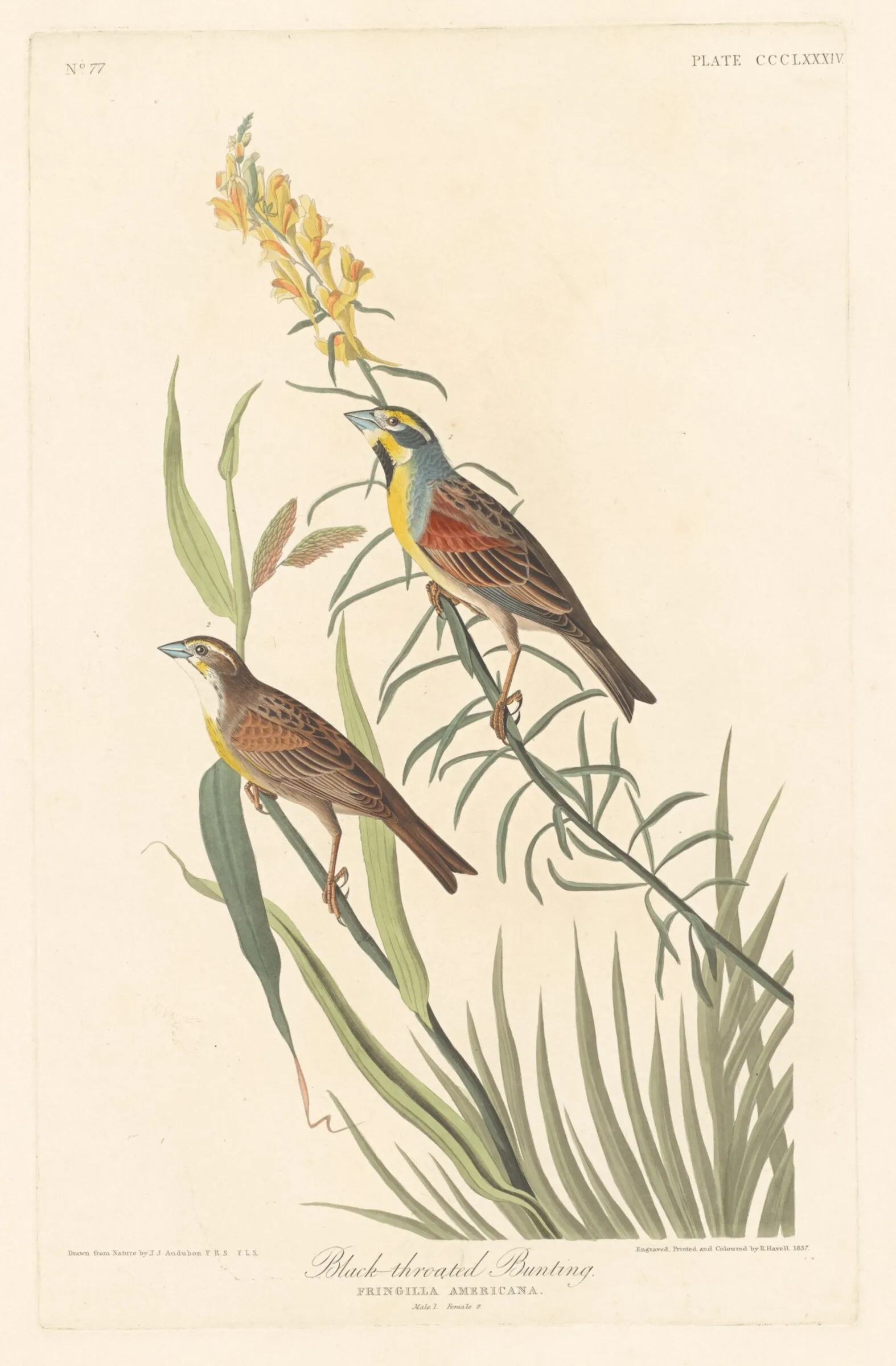
Audubon's “Black-throated Bunting”, The Birds of America, plate CCCLXXXIV
Click or press Enter to enlarge
Open the full-resolution image (2910 px, National Gallery of Art)
| Plate | 384 (CCCLXXXIV) |
|---|---|
| Audubon's name | Black-throated Bunting |
| Modern name | Dickcissel |
| Scientific name | Spiza americana |
| Status | Least Concern |
| Engraved by | Robert Havell, after Audubon's watercolor |
| Date | 1837 |
| Medium | Hand-colored engraving and aquatint on Whatman wove paper |
| Collections | Songbirds |
| This impression | National Gallery of Art, Washington, 1945.8.384; Gift of Mrs. Walter B. James |
About this plate
Plate 384 shows a male and a female Dickcissel. The male has a yellow breast, a black V on the throat, a grey head with a yellow eyebrow and rufous shoulders, looking like a small meadowlark. The female is plainer and sparrow-like, with a hint of yellow on the breast.
Audubon's Black-throated Bunting, Emberiza americana, is the Dickcissel, Spiza americana, named for its dry 'dick-dick-cissel' song. It is not a true bunting but a member of the cardinal family.
Dickcissels breed in grasslands, hayfields and weedy fields of the central United States, especially the Great Plains, and winter mostly in the llanos of Venezuela in huge roosting flocks. In Audubon's day they bred commonly in the eastern states, as he describes for Pennsylvania and New Jersey. They largely disappeared from the East during the nineteenth century. The species is listed as Least Concern.
Audubon found them very numerous in Texas in 1837, on the way back from Houston, the young republic's capital. One late July he went from Philadelphia to Salem, New Jersey, with Edward Harris and his son John Woodhouse to watch a large gathering of birds preparing to migrate.
In Audubon's words
At the approach of the period of their removal from our Middle States southward, the Black-throated Buntings congregate in particular localities, as if to consult regarding their future proceedings. At this season I once went from Philadelphia in search of them, accompanied by my friend Edward Harris, and my son John Woodhouse. Having reached Salem in New Jersey, we rambled some time in the neighbourhood, and found an elevated piece of ground, closely covered with high rank weeds, among which a great number of these birds had assembled. It being late in July, the males were moulting, or had already acquired their new plumage; the young, although full grown, had not yet assumed their second clothing, in which the sexes are distinguished; and the females were generally ragged. The birds were at first quite gentle, but after we had fired a few times they all flew off to a considerable distance, from which, however, they soon returned.
John James Audubon, Ornithological Biography, vol. 4 (1838), “Black-throated Bunting”. Read the full chapter.



