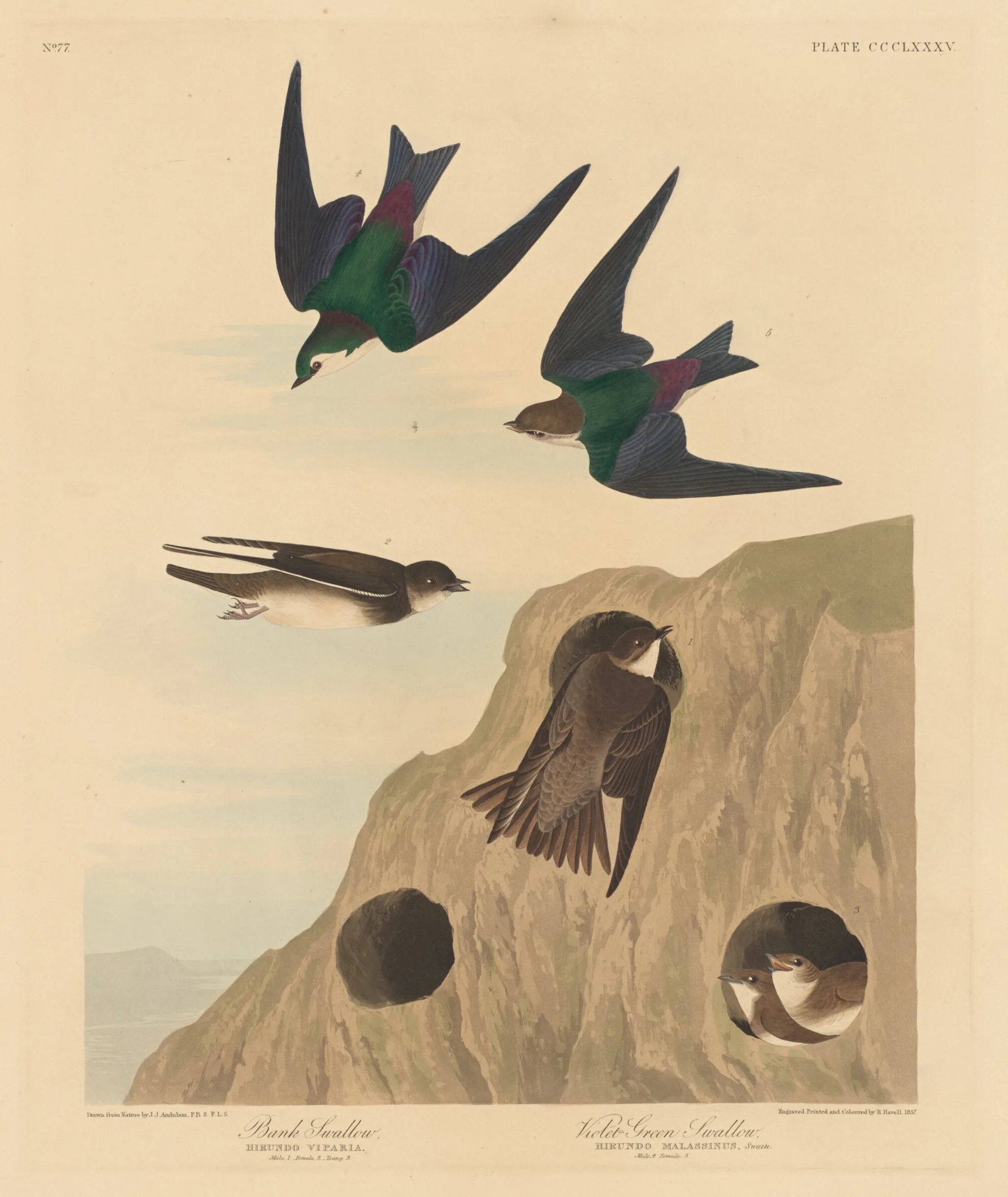
Bank Swallow and Violet-green Swallow (Plate 385)
Audubon's “Bank Swallow and Violet-green Swallow”, The Birds of America, plate CCCLXXXV
Click or press Enter to enlarge
Open the full-resolution image (2784 px, National Gallery of Art)
| Plate | 385 (CCCLXXXV) |
|---|---|
| Audubon's name | Bank Swallow and Violet-green Swallow |
| Modern names | Bank Swallow, Violet-green Swallow |
| Scientific names | Riparia riparia, Tachycineta thalassina |
| Status | Least Concern |
| Engraved by | Robert Havell, after Audubon's watercolor |
| Date | 1837 |
| Medium | Hand-colored engraving and aquatint on Whatman wove paper |
| Collections | Songbirds |
| This impression | National Gallery of Art, Washington, 1945.8.385; Gift of Mrs. Walter B. James |
About this plate
Plate 385 shows two swallows. The Bank Swallow figures, males, a female and young, are small brown swallows with white underparts and a brown band across the chest. The Violet-green Swallows, a male and a female, are green above with a violet rump, white below, with white on the cheek reaching above the eye.
Audubon's chapter title is Bank Swallow or Sand Martin, Hirundo riparia. The bird is now Riparia riparia, called Bank Swallow in North America and Sand Martin in Britain. Swainson described the Violet-green Swallow as Hirundo thalassina. It is now Tachycineta thalassina, a close relative of the Tree Swallow. Audubon called it the most beautiful swallow yet found in the United States.
Bank Swallows breed in colonies in burrows dug into riverbanks, sand pits and sea cliffs across North America and Eurasia, and winter in South America, Africa and southern Asia. Violet-green Swallows breed in the West, from Alaska to Mexico, nesting in tree holes and cliff crevices. Both species are listed as Least Concern.
Audubon described seeing hundreds of thousands of Bank Swallows pass his ship before sunrise off St Augustine, Florida, in the winter of 1831, from the deck of the navy schooner Spark with Lieutenant Percy. The Violet-green Swallows came from Townsend's collection, with notes by Nuttall.
Birds on this plate
- Bank Swallow Riparia riparia (males, female and young). Least Concern
- Violet-green Swallow Tachycineta thalassina (male and female). Least Concern
In Audubon's words
Imagine, Reader, how delighted I was when, in East Florida, in the winter of 1831, I found thousands of Bank Swallows gaily skimming over the waters, and along the shores of the rivers and inlets. So numerous indeed were they that I felt inclined to think that the greater part of those which are in summer dispersed over the United States, and the regions still farther north, must have congregated to form those vast swarms. The first time I saw them was before sunrise, when I stood by the side of Lieutenant Percy of our Navy, on the deck of the United States’ schooner the Spark, then at anchor opposite St Augustine. The weather though warm, was thick and drizzly, so that we could not see to a great distance; but as probably some hundreds of thousands passed close to the vessel, in long and rather close flocks, I was well enabled to assure myself that the birds were of this species.
John James Audubon, Ornithological Biography, vol. 4 (1838), “Bank Swallow or Sand Martin”. Read the full chapter.



