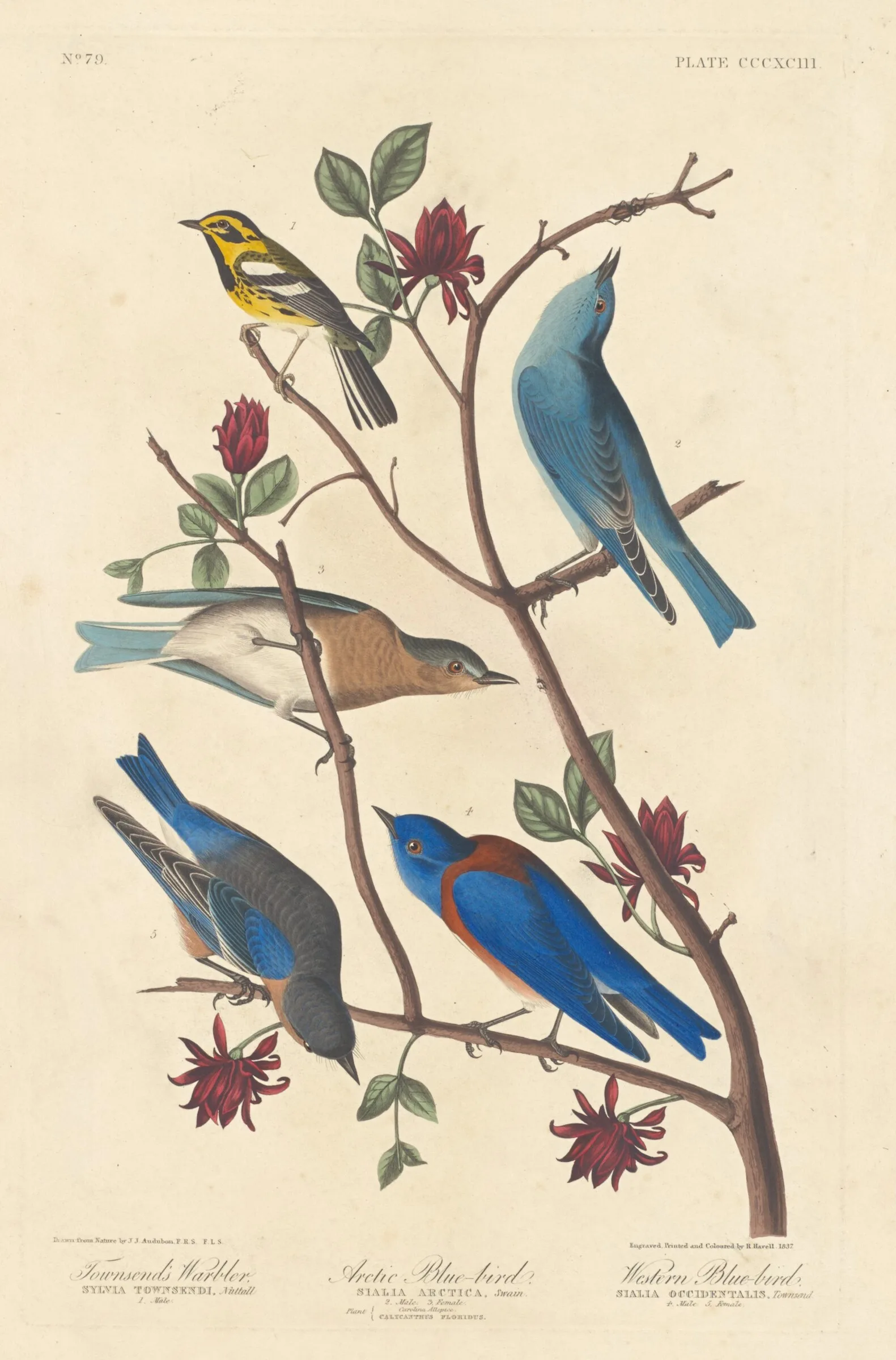
Townsend's Warbler, Mountain Bluebird and Western Bluebird (Plate 393)
Audubon's “Townsend's Warbler, Arctic Blue Bird and Western Blue Bird”, The Birds of America, plate CCCXCIII
Click or press Enter to enlarge
Open the full-resolution image (2888 px, National Gallery of Art)
| Plate | 393 (CCCXCIII) |
|---|---|
| Audubon's name | Townsend's Warbler, Arctic Blue Bird and Western Blue Bird |
| Modern names | Townsend's Warbler, Mountain Bluebird, Western Bluebird |
| Scientific names | Setophaga townsendi, Sialia currucoides, Sialia mexicana |
| Status | Least Concern |
| Engraved by | Robert Havell, after Audubon's watercolor |
| Date | 1837 |
| Medium | Hand-colored engraving and aquatint on Whatman wove paper |
| Plants and setting | Carolina allspice (Calycanthus floridus) |
| Collections | Songbirds |
| This impression | National Gallery of Art, Washington, 1945.8.393; Gift of Mrs. Walter B. James |
About this plate
Plate 393 shows five birds on a flowering branch of Carolina allspice. There is one male Townsend's Warbler, a male and female Mountain Bluebird and a male and female Western Bluebird. The birds were drawn from skins that John Kirk Townsend collected on the Columbia River in 1835. The warbler was shot on 28 October 1835.
The Arctic Blue Bird is the Mountain Bluebird, Sialia currucoides. John Richardson had collected one at Fort Franklin in 1825 under the name Sylvia arctica. Audubon believed his plate was the first to show the female. The Western Blue Bird was described by Townsend as Sialia occidentalis and is now Sialia mexicana. Townsend's Warbler was named by Nuttall for his travelling companion.
The Mountain Bluebird breeds in open country across the West, nesting in tree holes, cliffs and nest boxes, and the male is entirely sky blue. The Western Bluebird has a rusty breast and prefers open pine and oak woodland. Townsend's Warbler breeds in tall conifer forests from Alaska to Oregon and winters south to Central America. All three are listed as Least Concern.
Nuttall supplied the field notes. He found Mountain Bluebirds nesting in clay cliffs and hollow cedars beyond Laramie's Fork in June, and described the Western Bluebird singing from oak and pine branches near the Pacific coast. The plant is the Carolina allspice, Calycanthus floridus, a fragrant shrub of southern swamp margins.
Birds on this plate
- Townsend's Warbler Setophaga townsendi (male). Least Concern
- Mountain Bluebird Sialia currucoides: Audubon's Arctic Blue Bird (male and female). Least Concern
- Western Bluebird Sialia mexicana: Audubon's Western Blue Bird (male and female). Least Concern
In Audubon's words
The Western Blue Bird possesses many of the habits of our common kind. The male is equally tuneful throughout the breeding season. Mounting some projecting branch of an oak or low pine, he delivers his delightful ditty with great energy, extending his wings, and exerting all his powers as it were to amuse his sitting mate, or to allure attention to his short, often-repeated, but thrilling lay. In the midst of all this charming employment economy is rarely forgotten, and a crawling beetle or busy insect is no sooner seen than snatched up by our still watchful songster, who resumes his wonted perch, to be again interrupted by the cares of providing a subsistence; or, reiterating his melody, strives to drown the song of some neighbouring rival by tender strains and more earnest endeavours.
John James Audubon, Ornithological Biography, vol. 5 (1839), “Western Blue Bird”. Read the full chapter.



