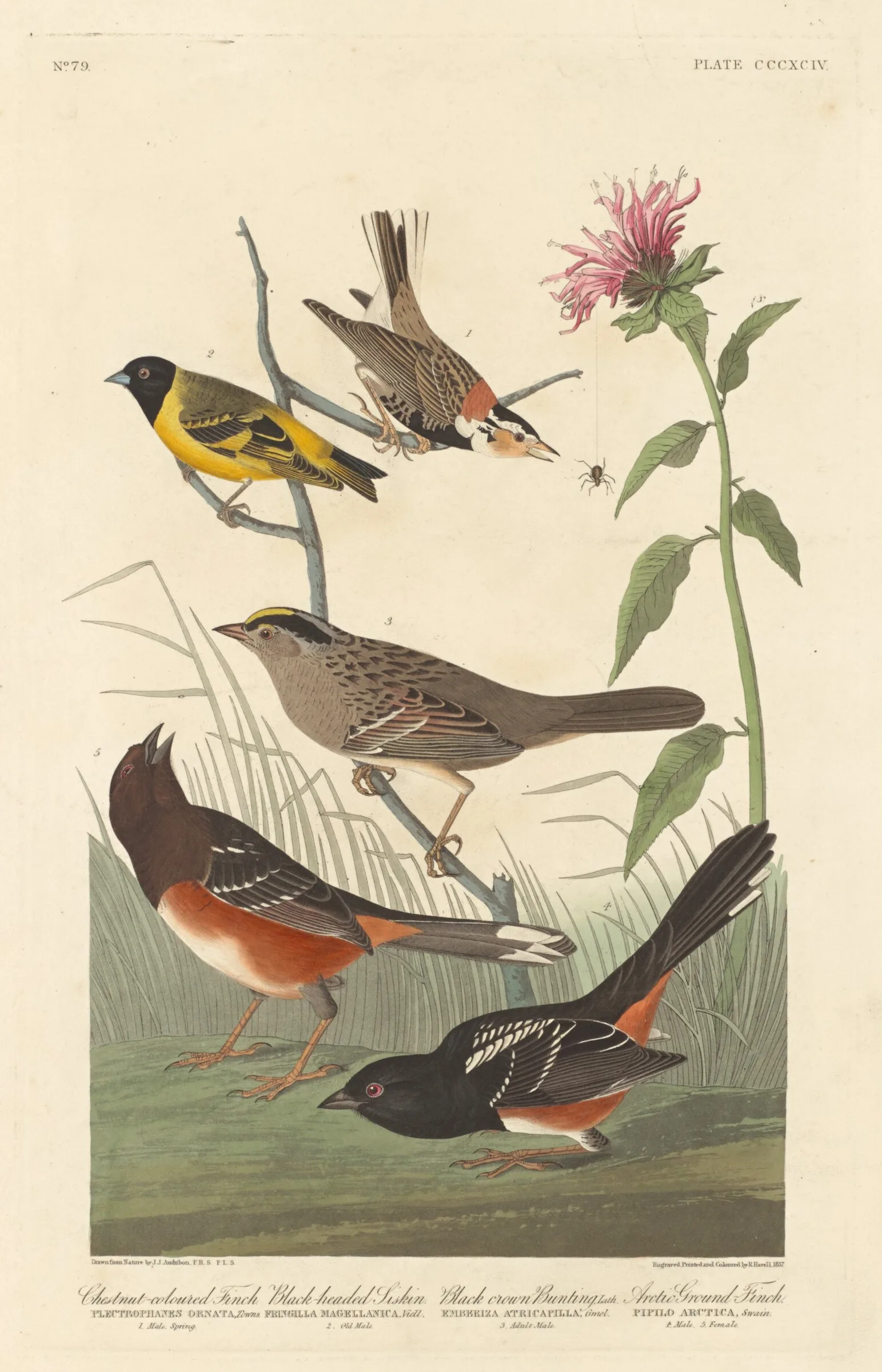
Chestnut-collared Longspur, Hooded Siskin, Golden-crowned Sparrow and Spotted Towhee (Plate 394)
Audubon's “Chestnut-colored Finch, Black-headed Siskin, Black Crown Bunting and Arctic Ground Finch”, The Birds of America, plate CCCXCIV
Click or press Enter to enlarge
Open the full-resolution image (2869 px, National Gallery of Art)
| Plate | 394 (CCCXCIV) |
|---|---|
| Audubon's name | Chestnut-colored Finch, Black-headed Siskin, Black Crown Bunting and Arctic Ground Finch |
| Modern names | Chestnut-collared Longspur, Hooded Siskin, Golden-crowned Sparrow, Spotted Towhee |
| Scientific names | Calcarius ornatus, Spinus magellanicus, Zonotrichia atricapilla, Pipilo maculatus |
| Status | Least Concern, Vulnerable |
| Engraved by | Robert Havell, after Audubon's watercolor |
| Date | 1837 |
| Medium | Hand-colored engraving and aquatint on Whatman wove paper |
| Collections | Songbirds |
| This impression | National Gallery of Art, Washington, 1945.8.394; Gift of Mrs. Walter B. James |
About this plate
Plate 394 holds five figures of four species. Audubon shows a male Chestnut-collared Longspur, a male Black-headed Siskin, a male Golden-crowned Sparrow, and a male and female Spotted Towhee. Except for the siskin, he drew them from western skins collected by Townsend and Nuttall or described by John Richardson.
The Black-headed Siskin is the puzzle of the plate. Audubon says he shot two males on sunflowers in his garden at Henderson, Kentucky, one December, and never saw the species again. He called it Fringilla magellanica, the Hooded Siskin of South America. That species is not known to occur naturally in the United States, so his record is usually treated as doubtful.
The Chestnut-collared Longspur breeds on the shortgrass prairies of the northern Great Plains. Loss of native grassland has cut its numbers deeply, and the IUCN lists it as Vulnerable. The Golden-crowned Sparrow breeds in Alaska and western Canada and winters along the Pacific coast. Audubon's Arctic Ground Finch is the Spotted Towhee, the western counterpart of the Eastern Towhee, long merged with it as the Rufous-sided Towhee.
Townsend collected the single longspur but did not say where, which Audubon regretted. Nuttall found the Golden-crowned Sparrow with White-crowned Sparrows near Fort Vancouver in early winter. He described the towhee scratching in leaf litter in thickets west of the Rockies.
Birds on this plate
- Chestnut-collared Longspur Calcarius ornatus: Audubon's Chestnut-coloured Finch (Chestnut-collared Lark-Bunting) (male). Vulnerable
- Hooded Siskin Spinus magellanicus: Audubon's Black-headed Siskin (male). Least Concern
- Golden-crowned Sparrow Zonotrichia atricapilla: Audubon's Black Crown Bunting (Black-and-yellow-crowned Finch) (male). Least Concern
- Spotted Towhee Pipilo maculatus: Audubon's Arctic Ground Finch (male and female). Least Concern
In Audubon's words
While residing at Henderson, on the Ohio, I, one cold morning in December, observed five males of this species on the heads of some sunflowers in my garden, and, after watching them for a little time, shot two of them. The rest rose high in the air, and were soon out of sight. Considering the birds very nearly allied to our Common American Goldfinch, I was surprised to find the head black at that season. Their notes resembled those of the Pine Finch, Fringilla pinus, but in their manner of feeding, as well as in their flight, they precisely resembled the American Goldfinch, Fringilla tristis. All my subsequent endeavours to meet with this species failed, and I am unacquainted with the female.
John James Audubon, Ornithological Biography, vol. 5 (1839), “Black-Headed Siskin”. Read the full chapter.



