Cedar Waxwing (Plate 43)
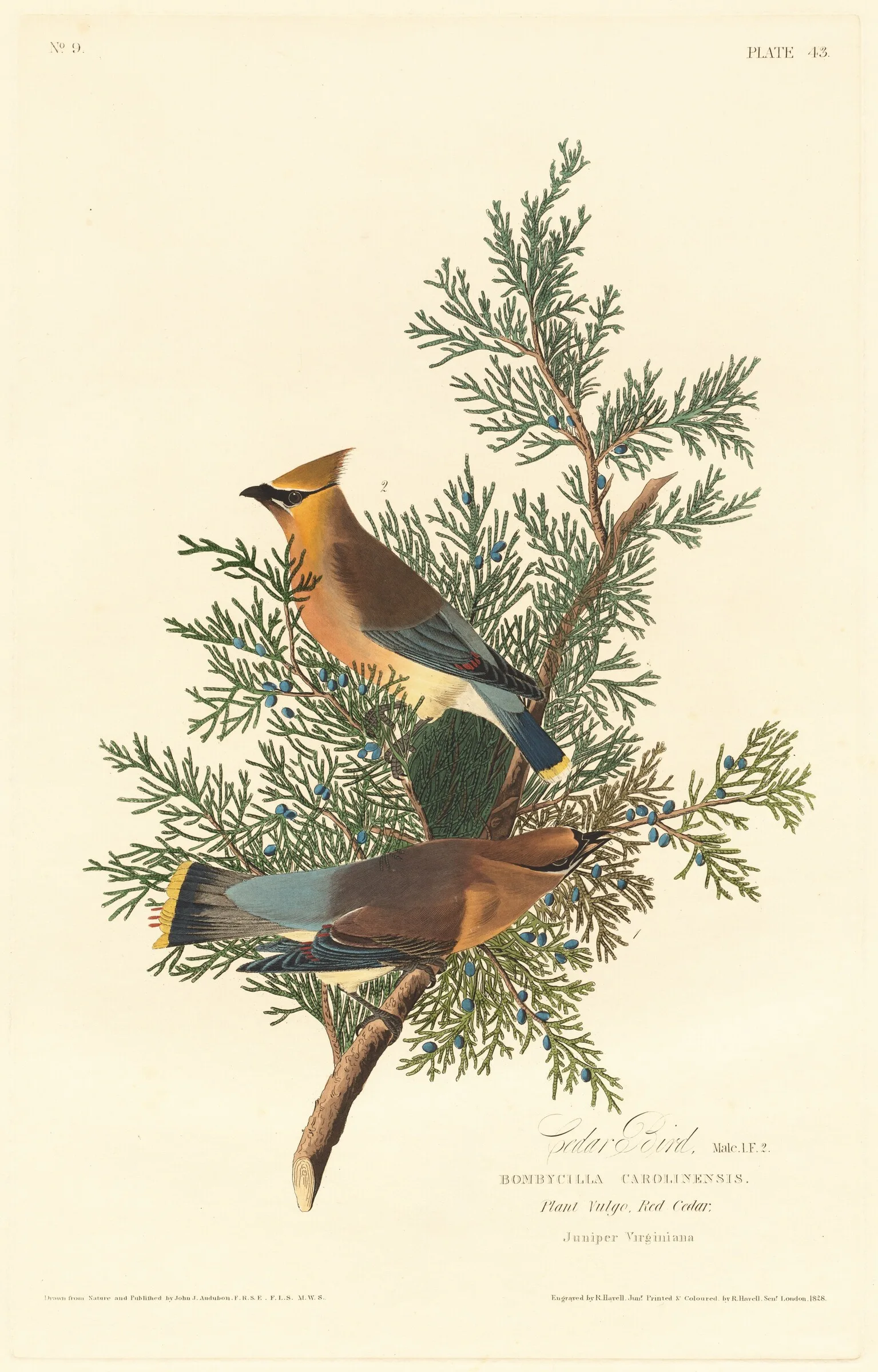
Audubon's “Cedar Bird”, The Birds of America, plate XLIII
Click or press Enter to enlarge
Open the full-resolution image (7656 px, National Gallery of Art)
| Plate | 43 (XLIII) |
|---|---|
| Audubon's name | Cedar Bird |
| Modern name | Cedar Waxwing |
| Scientific name | Bombycilla cedrorum |
| Status | Least Concern |
| Engraved by | Robert Havell, after Audubon's watercolor |
| Date | 1828 |
| Medium | Hand-colored engraving and aquatint on Whatman wove paper |
| Size | plate: 49.9 x 31.1 cm (19 5/8 x 12 1/4 in.) sheet: 100.3 x 67.3 cm (39 1/2 x 26 1/2 in.) |
| Plants and setting | Red Cedar (Juniperus virginiana) with berries |
| Collections | Songbirds |
| This impression | National Gallery of Art, Washington, 1945.8.43; Gift of Mrs. Walter B. James |
About this plate
Plate 43 shows a male and female Cedar Waxwing on a branch of Red Cedar, Juniperus virginiana, with its berries. The birds are sleek and brown with a pointed crest, a black mask, a yellow tail tip and small red waxy tips on the secondary feathers. Audubon wrote that the waxy tips appear on both sexes and do not show sex. The plate was engraved by Robert Havell in 1828.
Audubon described the bird as a winter visitor to Louisiana from early November to early March, feeding on holly, persimmon, Pride-of-China and grapes. He wrote that the birds could gorge until they were unable to fly and could be caught by hand. He also told of a basket of waxwings sent to New Orleans as a Christmas present that the steamboat steward baked into pies for the passengers.
The modern name is Cedar Waxwing, Bombycilla cedrorum. Audubon used Brisson's name Bombycilla carolinensis. He also asked why the species nests so late in summer. The answer is that the young are raised mainly on fruit, and the birds time their nesting to the ripening of summer berries.
Cedar Waxwings breed across southern Canada and the northern United States and wander widely in winter in flocks that follow fruit crops. Birds that eat the fruit of introduced honeysuckles can have orange rather than yellow tail tips. The species is listed as Least Concern.
In Audubon's words
Louisiana affords abundance of food and pleasant weather to this species, for nearly four months of the year, as the Cedar Birds reach that State about the beginning of November, and retire towards the Middle Districts in the beginning of March. The Holly, the Vines, the Persimon, the Pride-of-China, and various other trees, supply them with plenty of berries and fruits, on which they fatten, and become so tender and juicy as to be sought by every epicure for the table. I have known an instance of a basketful of these little birds having been forwarded to New Orleans as a Christmas present. The donor, however, was disappointed in his desire to please his friend in that city, for it was afterwards discovered that the steward of the steamer, in which they were shipped, made pies of them for the benefit of the passengers.
John James Audubon, Ornithological Biography, vol. 1 (1831), “The Cedar Bird”. Read the full chapter.



