Summer Tanager (Plate 44)
Audubon's “Summer Red Bird”, The Birds of America, plate XLIV
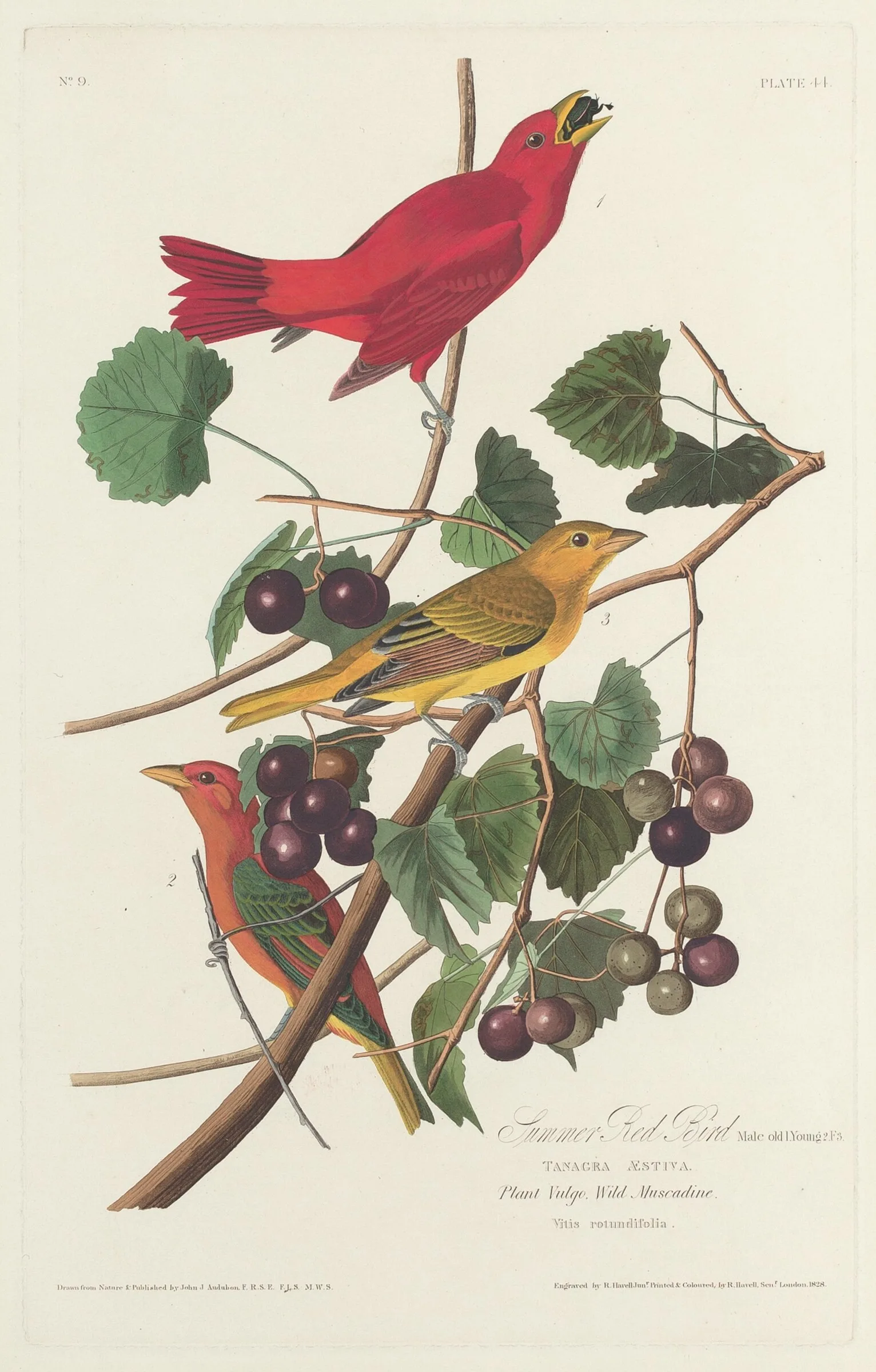
Click or press Enter to enlarge
Open the full-resolution image (2515 px, National Gallery of Art)
| Plate | 44 (XLIV) |
|---|---|
| Audubon's name | Summer Red Bird |
| Modern name | Summer Tanager |
| Scientific name | Piranga rubra |
| Status | Least Concern |
| Engraved by | Robert Havell, after Audubon's watercolor |
| Date | 1828 |
| Medium | Hand-colored engraving and aquatint on Whatman wove paper |
| Size | plate: 49.5 x 31.1 cm (19 1/2 x 12 1/4 in.) sheet: 97.2 x 67.3 cm (38 1/4 x 26 1/2 in.) |
| Plants and setting | Wild grape vine with fruit |
| Collections | Songbirds |
| This impression | National Gallery of Art, Washington, 1945.8.44; Gift of Mrs. Walter B. James |
About this plate
Plate 44 shows a family of Summer Tanagers on a wild grape vine with clusters of fruit. Audubon wrote that he drew an adult male, his mate and a young male in its patchy plumage, to show how different one family can look. The adult male is rosy red all over. The female is mustard yellow. The young male is blotched red and yellow. The plate was engraved by Robert Havell in 1828.
Audubon described the bird as solitary, living inside open forests, especially woods with scrubby hickories and stunted oaks. He wrote that it stayed in the United States only about four months and left Louisiana by mid September. He also wrote that it had no song, which is wrong. The male has a robin-like song of short phrases. Audubon spent much of the plant note praising the grapes, which he ate freely despite a belief in Lower Louisiana that they caused bilious fevers.
The modern name is Summer Tanager, Piranga rubra. Audubon called it Tanagra aestiva. Tanagers in Piranga were long grouped with the true tanagers of the tropics. They are now placed in the cardinal family, Cardinalidae.
The species breeds in open pine and oak woods across the southern United States and along rivers in the Southwest, and winters from Mexico to South America. It specializes in bees and wasps, catching them in flight and rubbing off the stinger on a branch. It is listed as Least Concern.
In Audubon's words
This beautiful species is destitute of song, and is of solitary habits, preferring at all times the interior of the forests, but not the densest parts of them. I have observed that woods interspersed with what are called scrubby hickories or stunted oaks, are favourite resorts of the Summer Red Birds.
Their residence in the United States scarcely exceeds four months. None remain in any of the more southern parts of our districts. Indeed, by the middle of September, it would be difficult to see a single pair in the forests of Louisiana. So very tender do they seem to be in regard to cold, or even temperate weather, that they seldom go farther north than Boston, or the shores of Lake Erie, but prefer the sandy woodlands all along the eastern shores, as far as Massachusets.
John James Audubon, Ornithological Biography, vol. 1 (1831), “The Summer Red Bird”. Read the full chapter.



