Willow Flycatcher (Plate 45)
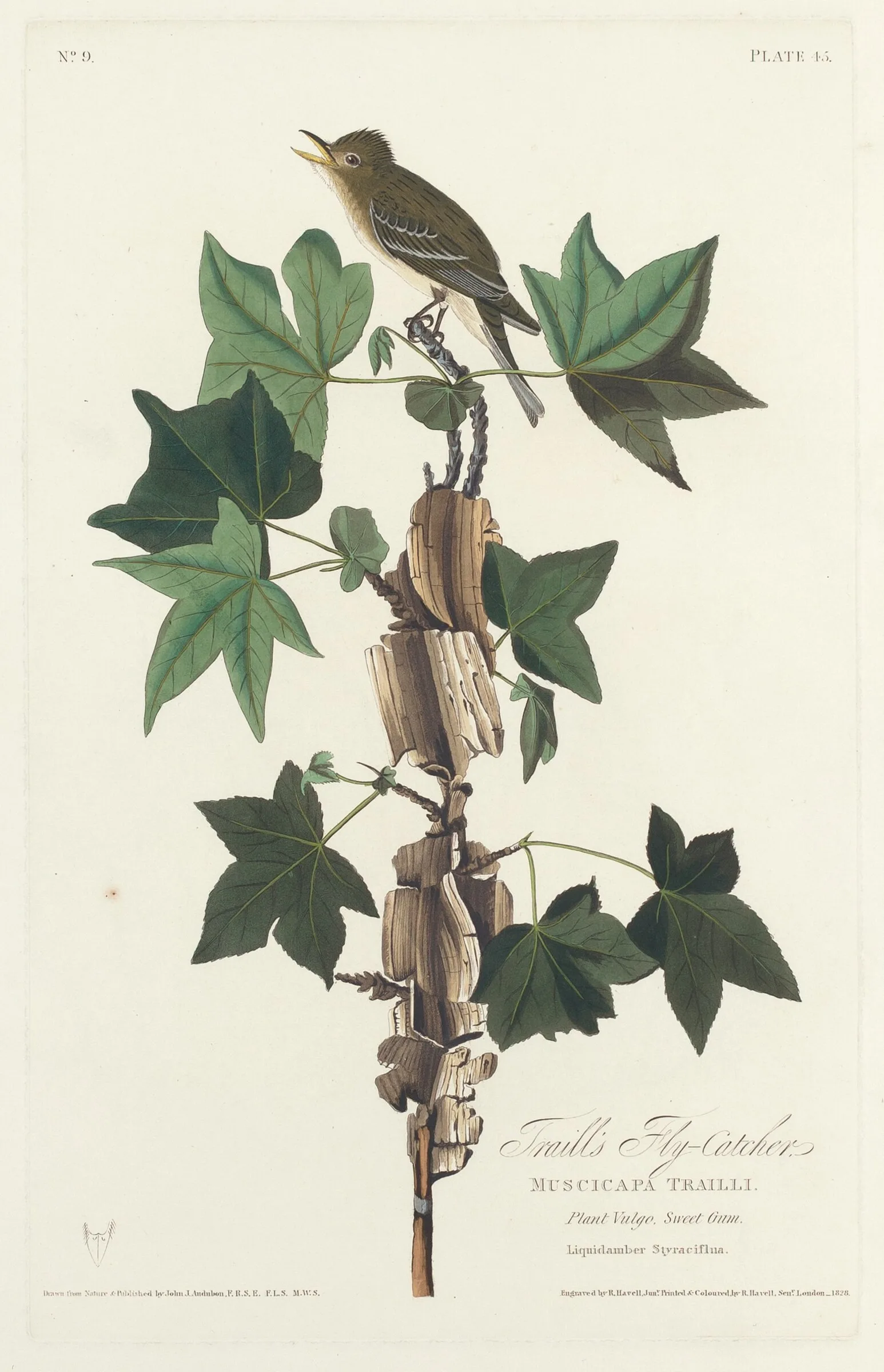
Audubon's “Traill's Flycatcher”, The Birds of America, plate XLV
Click or press Enter to enlarge
Open the full-resolution image (2511 px, National Gallery of Art)
| Plate | 45 (XLV) |
|---|---|
| Audubon's name | Traill's Flycatcher |
| Modern name | Willow Flycatcher |
| Scientific name | Empidonax traillii |
| Status | Least Concern |
| Engraved by | Robert Havell, after Audubon's watercolor |
| Date | 1828 |
| Medium | Hand-colored engraving and aquatint on Whatman wove paper |
| Plants and setting | Sweet Gum (Liquidambar styraciflua) |
| Collections | Songbirds |
| This impression | National Gallery of Art, Washington, 1945.8.45; Gift of Mrs. Walter B. James |
About this plate
Plate 45 shows a single small olive flycatcher on a branch of Sweet Gum, Liquidambar styraciflua, with its star-shaped leaves. Audubon wrote that he drew the male in the inclined, rather crouching pose the bird always took when perched. The plate was engraved by Robert Havell in 1828.
Audubon found the species only in April, along woodland edges by the prairies of the Arkansas River. He watched a pair hunting insects over the tall grasses in long zigzag flights and returning to the same low trees, calling wheet, wheet as they left the branch. He suspected they had a nest nearby but could not find it. He named the bird after Dr Thomas Stewart Traill of Liverpool, a physician and naturalist who had helped him in England.
Audubon described it as a new species and his name traillii still stands. Traill's Flycatcher was later found to include two very similar species told apart mainly by song. In 1973 it was split into the Willow Flycatcher, which kept the name Empidonax traillii, and the Alder Flycatcher, Empidonax alnorum. Which of the two Audubon actually collected is not certain, but his Arkansas bird is usually taken as a Willow Flycatcher.
The Willow Flycatcher breeds in willow thickets and wet shrubby places across much of the United States and southern Canada and winters from Mexico to northern South America. It is listed as Least Concern. The southwestern subspecies is federally listed as endangered in the United States.
In Audubon's words
The notes of Traill's Fly-catcher consist of the sounds wheet, wheet, which it articulates clearly while on wing. It resides in the skirts of the woods along the prairie lands of the Arkansas river, where alone I have been able to procure it. When leaving the top branches of a low tree, this bird takes long flights, skimming in zigzag lines, passing close over the tops of the tall grasses, snapping at and seizing different species of winged insects, and returning to the same trees to alight. Its notes, I observed, were uttered when on the point of leaving the branch. The pair chased the insects as if acting in concert, and doubtless had a nest in the immediate neighbourhood, although I was unable to discover it.
John James Audubon, Ornithological Biography, vol. 1 (1831), “Traill's Fly-catcher”. Read the full chapter.
Other impressions of this plate: The Metropolitan Museum of Art.



