Barred Owl (Plate 46)
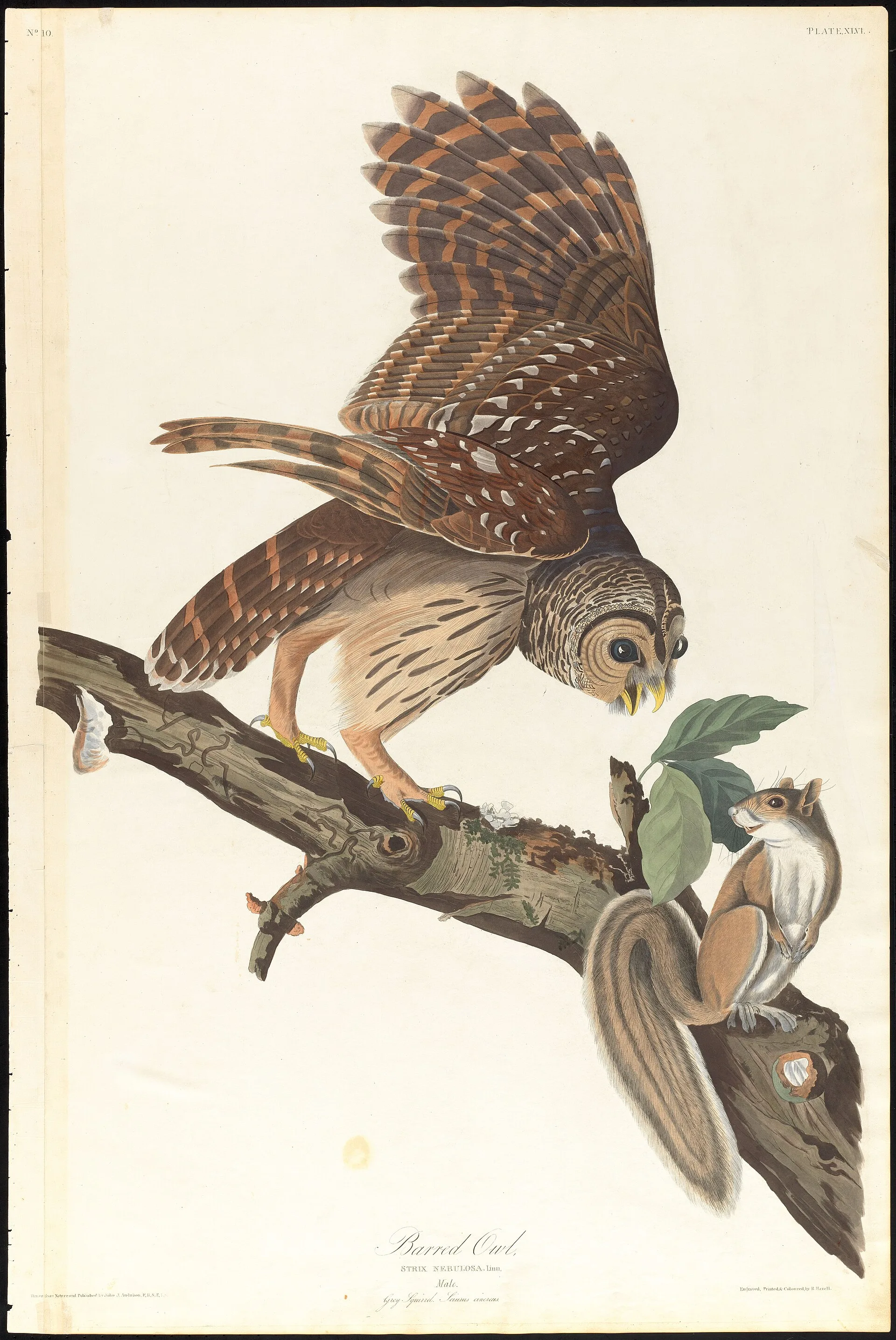
Audubon's “Barred Owl”, The Birds of America, plate XLVI
Click or press Enter to enlarge
Open the full-resolution image (Boston Public Library scan)
| Plate | 46 (XLVI) |
|---|---|
| Audubon's name | Barred Owl |
| Modern name | Barred Owl |
| Scientific name | Strix varia |
| Status | Least Concern |
| Engraved by | Robert Havell, after Audubon's watercolor |
| Date | 1828 |
| Medium | Hand-colored engraving and aquatint |
| Collections | Owls |
| This impression | Boston Public Library, Rare Books Department (public domain, via Digital Commonwealth / Wikimedia Commons) |
About this plate
Plate 46 shows a Barred Owl on a branch, turning to stare at a grey squirrel just a few inches away. Audubon explained the scene. He had seen owls startled when a grey squirrel jumped onto a branch close to them, although the owls also killed squirrels at twilight. He drew the owl gazing in amazement at the squirrel. The owl has dark eyes, a round head without ear tufts, and brown bars across the upper breast and streaks below.
Audubon opened the chapter with a long evening scene in the forests of Lower Louisiana in October, when the owl's calls begin. He wrote that it was common everywhere he travelled and more abundant in Louisiana than anywhere else, often seen by day. He described how a watched owl lowers its head, spreads its facial feathers like a ruff, and bobs its head back and forth, following the observer's every move. He saw one land on a cow's back and fly off in alarm when the cow moved.
Audubon used the name Strix nebulosa, which is now the scientific name of the Great Grey Owl. The modern name is Barred Owl, Strix varia. Its call is often written as who cooks for you, who cooks for you all.
The Barred Owl lives in mature, wet forest across eastern North America and has spread west through Canada to the Pacific Northwest during the twentieth century. There it competes with and displaces the threatened Northern Spotted Owl. It is listed as Least Concern.
In Audubon's words
On approaching one of them, its gesticulations are seen to be of a very extraordinary nature. The position of the bird, which is generally erect, is immediately changed. It lowers its head and inclines its body, to watch the motions of the person beneath, throws forward the lateral feathers of its head, which thus has the appearance of being surrounded by a broad ruff, looks towards him as if half blind, and moves its head to and fro in so extraordinary a manner, as almost to induce a person to fancy that part dislocated from the body. It follows all the motions of the intruder with its eyes; and should it suspect any treacherous intentions, flies off to a short distance, alighting with its back to the person, and immediately turning about with a single jump, to recommence its scrutiny.
John James Audubon, Ornithological Biography, vol. 1 (1831), “The Barred Owl”. Read the full chapter.