Cerulean Warbler (Plate 48)
Audubon's “Cerulean Warbler”, The Birds of America, plate XLVIII
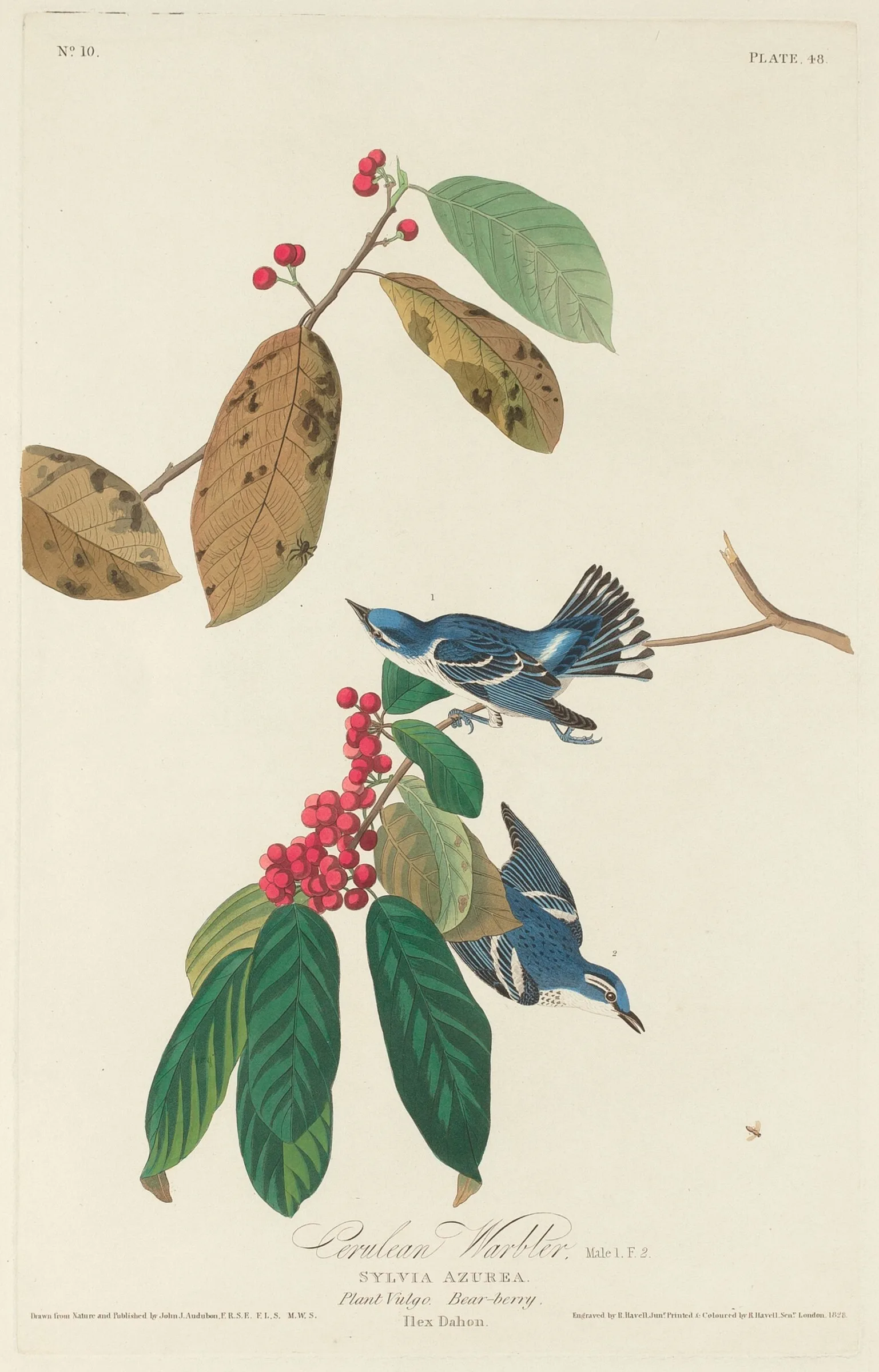
Click or press Enter to enlarge
Open the full-resolution image (2567 px, National Gallery of Art)
| Plate | 48 (XLVIII) |
|---|---|
| Audubon's name | Cerulean Warbler |
| Modern name | Cerulean Warbler |
| Scientific name | Setophaga cerulea |
| Status | Near Threatened |
| Engraved by | Robert Havell, after Audubon's watercolor |
| Date | 1828 |
| Medium | Hand-colored engraving and aquatint on Whatman wove paper |
| Plants and setting | A small berried tree of Louisiana forest edges, not named by Audubon |
| Collections | Songbirds |
| This impression | National Gallery of Art, Washington, 1945.8.48; Gift of Mrs. Walter B. James |
About this plate
Plate 48 shows a male and female Cerulean Warbler on a twig with clusters of red berries. The male is sky blue above, white below, with a thin dark band across the throat. The female is blue-green and yellowish. Audubon described the shrub as a small tree of forest edges in Louisiana whose bark peels to show yellow, resinous wood. He gave no name for it. The NGA dates the plate to 1828 and the engraver as Robert Havell.
Audubon wrote that the bird was so scarce in the Middle States that finding one in Pennsylvania had been treated as important, and that Bonaparte had figured only a young female. He described it arriving in Lower Louisiana with other warblers, breeding there and leaving in early October. He described a nest in the fork of a low tree, often a dogwood, lined with Spanish moss. He saw more toward Natchitoches and the Red River.
Audubon called it the Azure Warbler, Sylvia azurea. The modern name is Cerulean Warbler, Setophaga cerulea. It was long placed in Dendroica. The Blue-green Warbler of the next plate is now thought to be a young or female bird of this species.
The Cerulean Warbler breeds high in the canopy of large deciduous forests in the eastern United States, especially the Appalachians and the Ohio valley, and winters in the Andes of South America. It has declined steeply since the 1960s from loss of mature forest, including mountaintop mining in Appalachia and clearing of Andean forest. The IUCN lists it as Near Threatened.
In Audubon's words
It arrives in the lower parts of the State of Louisiana, in company with many other species of Warblers, breeds there and sets out again about the beginning of October. It is as lively as most species of its genus, possesses the same manner of flight, moves sidewise up and down the branches and twigs, frequently changing sides, and hangs to the extremities of bunches of leaves or berries, on which it procures the insects and larvæ of which its food is principally composed. The liveliness of its notes renders it conspicuous in those parts of the skirts of the forests which it frequents; and its song, although neither loud nor of long continuance, is extremely sweet and mellow.
John James Audubon, Ornithological Biography, vol. 1 (1831), “The Azure Warbler”. Read the full chapter.



