Cerulean Warbler (Blue-green Warbler) (Plate 49)
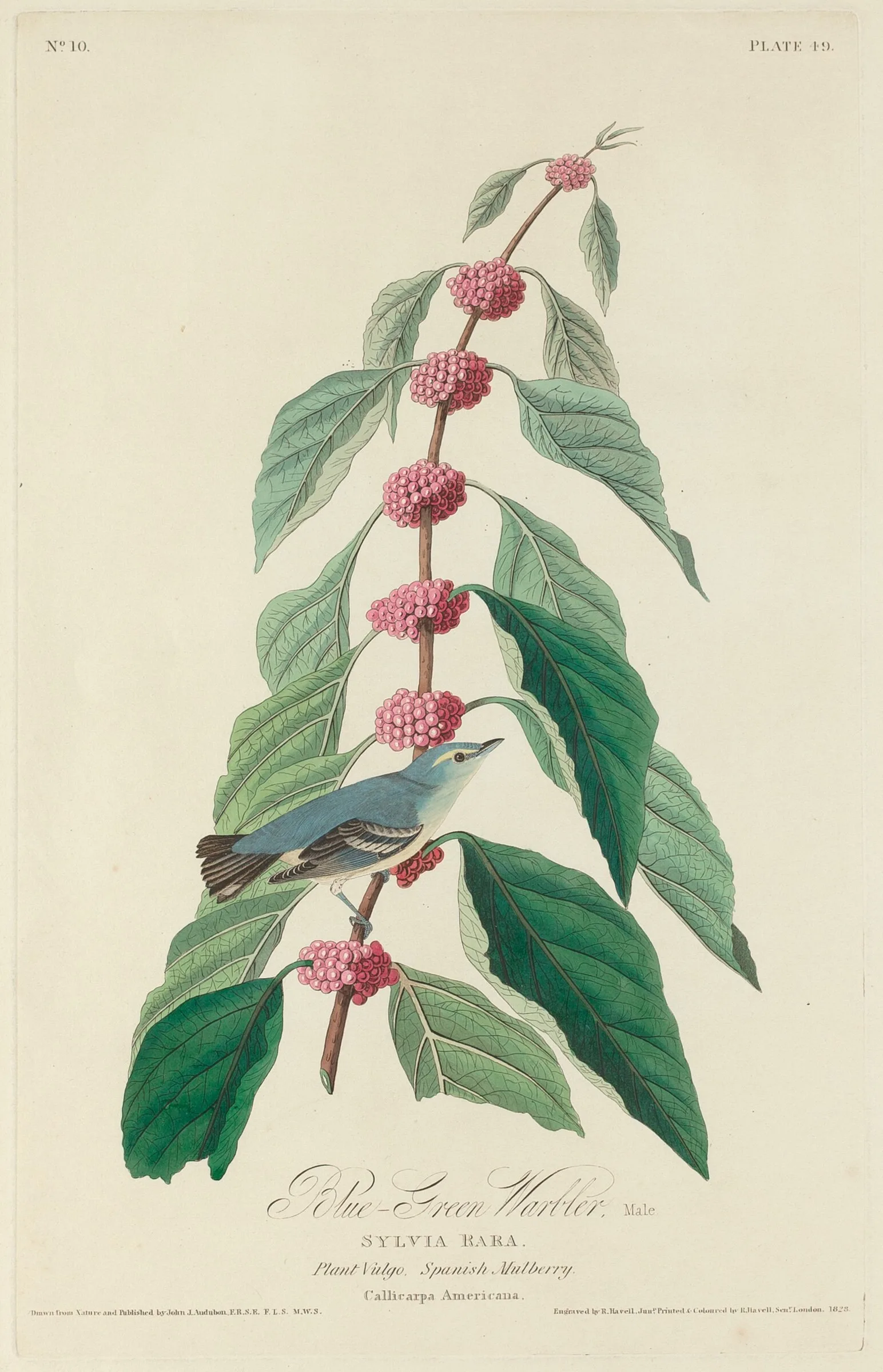
Audubon's “Blue-green Warbler”, The Birds of America, plate XLIX
Click or press Enter to enlarge
Open the full-resolution image (2561 px, National Gallery of Art)
| Plate | 49 (XLIX) |
|---|---|
| Audubon's name | Blue-green Warbler |
| Modern name | Cerulean Warbler (female or immature) |
| Scientific name | Setophaga cerulea |
| Status | Near Threatened |
| Engraved by | Robert Havell, after Audubon's watercolor |
| Date | 1828 |
| Medium | Hand-colored engraving and aquatint on Whatman wove paper |
| Plants and setting | Spanish Mulberry (probably American Beautyberry, Callicarpa americana) |
| Collections | Songbirds |
| This impression | National Gallery of Art, Washington, 1945.8.49; Gift of Mrs. Walter B. James |
About this plate
Plate 49 shows a single greenish-blue warbler with a pale eyebrow and white wing bars, perched on a plant Audubon called the Spanish Mulberry. He described it as growing along woods and fences in Louisiana, four to eight feet tall, with fruit that children ate but that tasted insipid. The botanical note describes berries in dense whorls, which fits American Beautyberry. The plate was engraved by Robert Havell in 1828.
Audubon admitted that the bird looked so like the young of his Azure Warbler that he might have treated it as a variety. He kept it separate because of differences in the bill and habits. He wrote that he shot a few in the Great Pine Swamp of Pennsylvania, saw it pass through Louisiana in April, and once shot six or seven from a single tree in autumn. He never found its nest.
Alexander Wilson had already named the bird Sylvia rara. Both Wilson's and Audubon's Blue-green Warbler are now regarded as female or immature Cerulean Warblers, Setophaga cerulea. The name Blue-green Warbler is no longer used.
The Cerulean Warbler breeds in mature deciduous forest in the eastern United States and winters in the Andes. It is listed as Near Threatened after long declines.
In Audubon's words
On its passage through the States, it is found in Louisiana, where it appears in the beginning of April. This lateness of its arrival indicates its coming from a great distance, most of the other species appearing several weeks earlier. They seem to disperse soon after, as on their first appearance several may be procured in one day, as well as during their equally short stay in autumn, when, again, I have shot six or seven from a single tree, on which they appeared as busily engaged as if so many Titmice. I have met with them singly and far apart in Kentucky, in Ohio, upon the Missouri, and along Lake Erie, but I have never found their nest.
John James Audubon, Ornithological Biography, vol. 1 (1831), “The Blue-green Warbler”. Read the full chapter.



