Chuck-will's-widow (Plate 52)
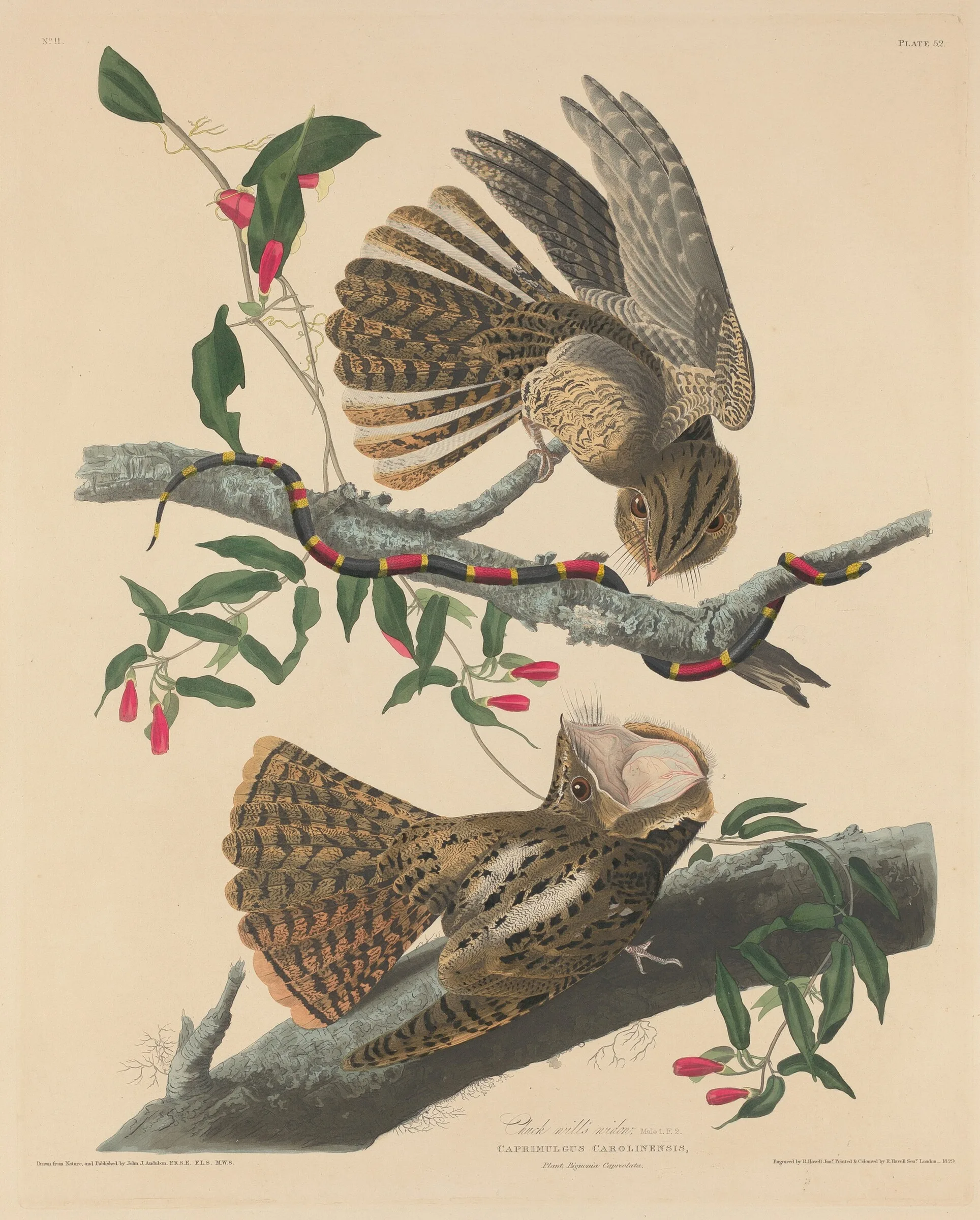
Audubon's “Chuck Will's Widow”, The Birds of America, plate LII
Click or press Enter to enlarge
Open the full-resolution image (3414 px, National Gallery of Art)
| Plate | 52 (LII) |
|---|---|
| Audubon's name | Chuck Will's Widow |
| Modern name | Chuck-will's-widow |
| Scientific name | Antrostomus carolinensis |
| Status | Near Threatened |
| Engraved by | Robert Havell, after Audubon's watercolor |
| Date | 1829 |
| Medium | Hand-colored engraving and aquatint on Whatman wove paper |
| Collections | Songbirds |
| This impression | National Gallery of Art, Washington, 1945.8.52; Gift of Mrs. Walter B. James |
About this plate
Plate 52 shows a male and female Chuck-will's-widow, cryptic brown nightjars with huge mouths and long wings, displaying on a branch. A small snake is included in the composition. Audubon added a note on it at the end of the chapter, saying that it fed mainly on insects and that its usual size was as shown in the plate. The plate was engraved by Robert Havell in 1829.
Audubon described the bird as the southern goatsucker of the United States, most common in Louisiana, Florida and the lower parts of Alabama and Georgia, arriving from Mexico in March. He described the call, chuck-will's-widow, repeated six or seven times in as many seconds at dusk, and its light, sweeping flight over cotton fields and sugar plantations, which led him to call it the fairy of the night. He wrote that if the eggs or small young were touched, the parents moved them elsewhere.
The name is unchanged in English. The scientific name is now Antrostomus carolinensis. American nightjars were moved from Caprimulgus to Antrostomus in 2010. Audubon's claim that the birds move their eggs has been repeated by later observers but is still not well documented.
Chuck-will's-widow is the largest nightjar in North America. It breeds in pine and oak woods of the southeastern United States and winters in Florida, the Caribbean and Central America. Its population has fallen substantially since the 1960s, and the IUCN lists it as Near Threatened.
In Audubon's words
This over, the bird launches into the air, and is seen sweeping over the cotton fields or the sugar plantations, cutting all sorts of figures, mounting, descending, or sailing, with so much ease and grace, that one might be induced to call it the Fairy of the night. If it passes close to one, a murmuring noise is heard, at times resembling that spoken of when the bird is caught by day. It suddenly checks its course, inclines to the right or left, secures a beetle or a moth, continues its flight over the field, passes and repasses hundreds of times over the same ground, and now and then alights on a fence-stake, or the tallest plant in the place, from which it emits its notes for a few moments with increased vivacity.
John James Audubon, Ornithological Biography, vol. 1 (1831), “Chuck-will's-widow”. Read the full chapter.



