Painted Bunting (Plate 53)
Audubon's “Painted Bunting”, The Birds of America, plate LIII
Click or press Enter to enlarge
Open the full-resolution image (2566 px, National Gallery of Art)
| Plate | 53 (LIII) |
|---|---|
| Audubon's name | Painted Bunting |
| Modern name | Painted Bunting |
| Scientific name | Passerina ciris |
| Status | Least Concern |
| Engraved by | Robert Havell, after Audubon's watercolor |
| Date | 1829 |
| Medium | Hand-colored engraving and aquatint on Whatman wove paper |
| Size | plate: 49.5 x 30.8 cm (19 1/2 x 12 1/8 in.) sheet: 99.7 x 67.3 cm (39 1/4 x 26 1/2 in.) |
| Plants and setting | Chickasaw Wild Plum (Prunus angustifolia) |
| Collections | Songbirds |
| This impression | National Gallery of Art, Washington, 1945.8.53; Gift of Mrs. Walter B. James |
About this plate
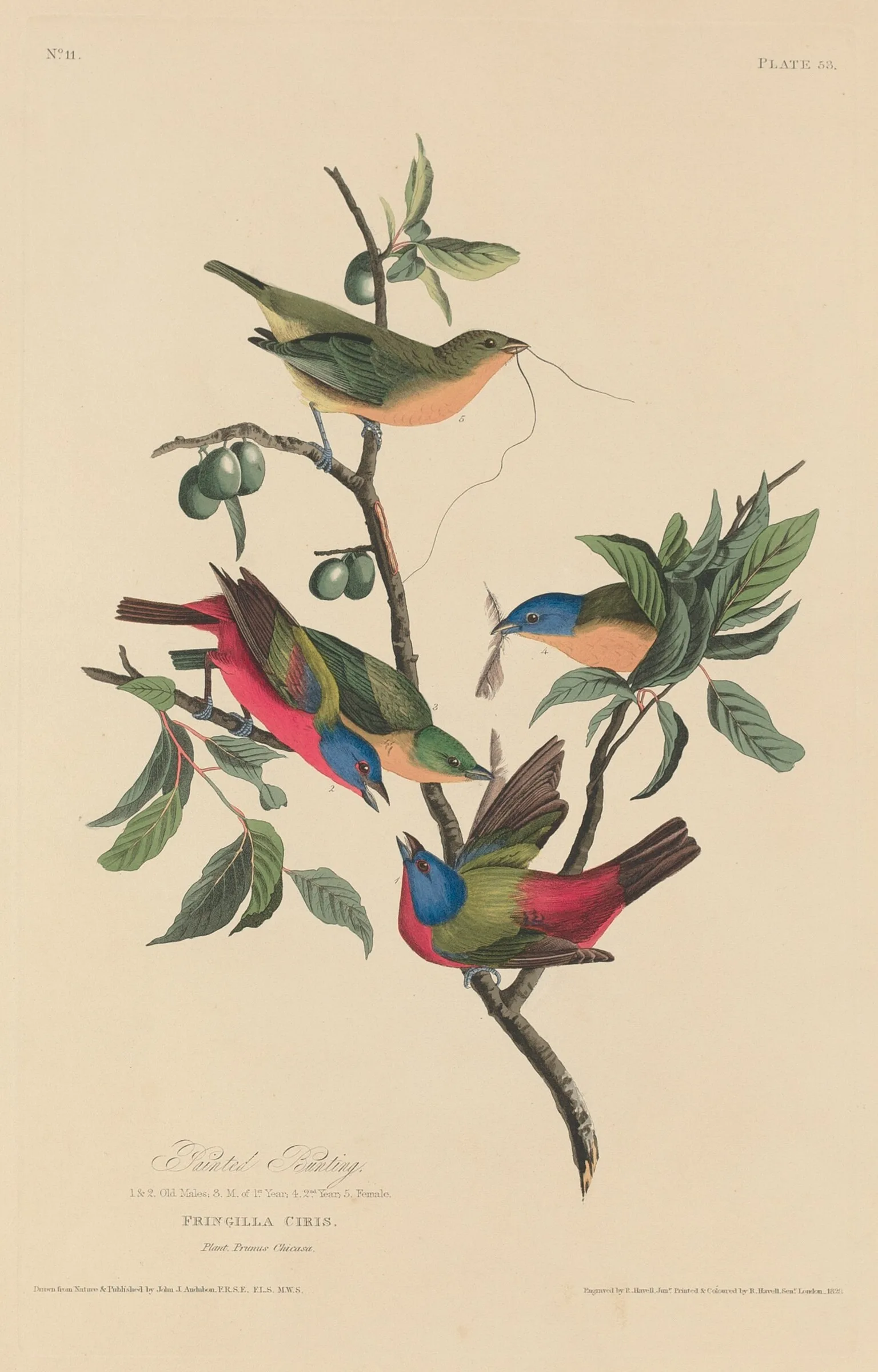
Plate 53 shows a group of Painted Buntings on a twig of Chickasaw Wild Plum, Prunus angustifolia. Audubon wrote that he drew the group to show the plumage changes in a single picture rather than describe them. Females and young are bright green. Adult males have a blue head, red underparts and a yellow-green back. He said colours speak for themselves and that long descriptions were only fit to be read to the blind. The plate was engraved by Robert Havell in 1829.
Audubon described a trapping business in the New Orleans markets. Trappers set a stuffed male among seed near a trap-cage in the orange groves, and live males attacked it and were caught. Caged birds were then sold in the city. He noted the local names Nonpareil and Pape, and wrote that the bird was seldom seen above Natchez or east of the Carolinas.
Audubon called it the Painted Finch, Fringilla ciris. The modern name is Painted Bunting, Passerina ciris. It belongs to the cardinal family, not the true buntings. Audubon described males taking until their fourth year to gain full colour. In fact males reach adult plumage in their second year, after a year in female-like green.
The Painted Bunting has two separate breeding populations. One is on the Atlantic coast from North Carolina to Florida and the other in the south-central states and northern Mexico. Trapping for the cage-bird trade continues illegally in parts of its winter range. It is listed as Least Concern.
In Audubon's words
A group thus occupied I have attempted to represent in the plate. I have at the same time endeavoured to save you the trouble of reading a long description of the changes which take place in their plumage, from the time at which the young leave the nest, until the fourth year following, when the males attain the full beauty of their brilliant livery. Where in fact would be the necessity of telling you more, than that the young, during the first summer, are similar in colouring to the female; that the next spring, the head of the males only has become of a handsome blue; that, the spring following, the same bird is mottled more or less with azure, carmine, yellow and green; and that it requires another return of the warm season before all these colours are perfected and rendered permanent; when at a single glance you can determine all this at once. Long descriptions of this kind are only fit to be read to the blind. Colours speak for themselves.
John James Audubon, Ornithological Biography, vol. 1 (1831), “The Painted Finch”. Read the full chapter.



