Bobolink (Plate 54)
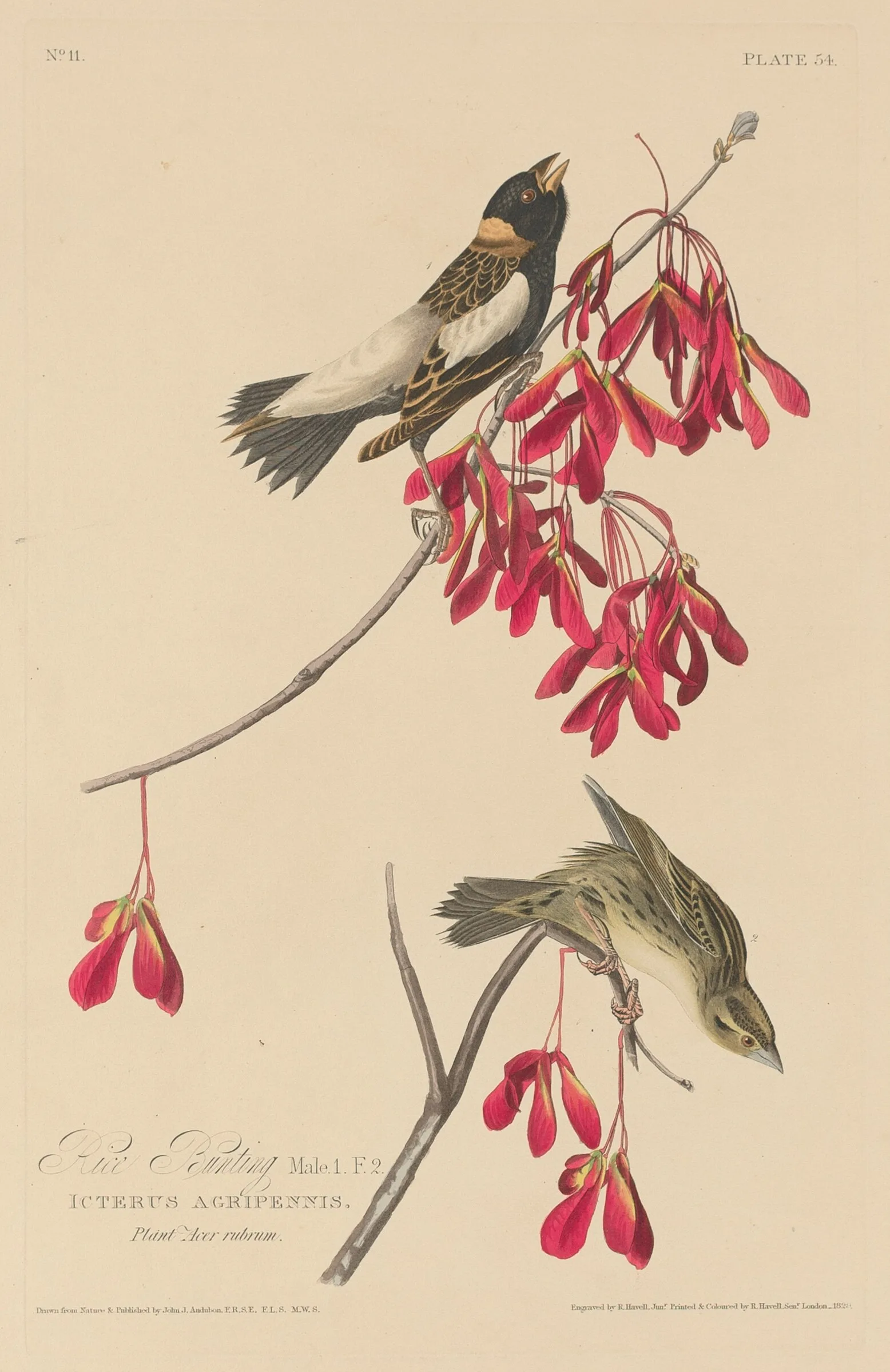
Audubon's “Rice Bunting”, The Birds of America, plate LIV
Click or press Enter to enlarge
Open the full-resolution image (2582 px, National Gallery of Art)
| Plate | 54 (LIV) |
|---|---|
| Audubon's name | Rice Bunting |
| Modern name | Bobolink |
| Scientific name | Dolichonyx oryzivorus |
| Status | Least Concern |
| Engraved by | Robert Havell, after Audubon's watercolor |
| Date | 1829 |
| Medium | Hand-colored engraving and aquatint on Whatman wove paper |
| Collections | Songbirds |
| This impression | National Gallery of Art, Washington, 1945.8.54; Gift of Mrs. Walter B. James |
About this plate
Plate 54 shows a male Bobolink in breeding plumage, black below with a buff nape and white back and rump, and a streaky buff female. The NGA dates the plate to 1829 and the engraver as Robert Havell. The plate title in the NGA record is Rice Bunting, and the chapter calls the bird the Rice Bird.
Audubon wrote that few Bobolinks passed through Louisiana and that they kept mainly to the Atlantic states, where they passed in huge numbers. He noted a belief in Louisiana that their arrival in spring foretold a bad harvest. He described autumn flocks feeding on ripe reed seed along rivers and coasts and the sport of shooting Reed Birds at sunset, when a single shot could raise a flock covering several acres.
The modern name is Bobolink, Dolichonyx oryzivorus. The scientific name means long-clawed rice eater. Audubon used Bonaparte's Icterus agripennis. The bird was called Bobolink in the North for its bubbling song, Reed Bird in the Middle States, and Rice Bird in the South, where flocks did great damage to rice plantations and were killed by the thousands. Fattened Reed Birds were sold as a table delicacy into the twentieth century.
The Bobolink breeds in hayfields and wet meadows across southern Canada and the northern United States and winters in the grasslands of southern South America, one of the longest migrations of any songbird. Earlier mowing of hayfields has caused steep declines, but the species is listed as Least Concern.
In Audubon's words
In Louisiana, small detached flocks of males or of females appear about the middle of March and beginning of April, alighting in the meadows and grain-fields, where they pick up the grubs and insects found about the roots of the blades. I have heard it asserted, though I cannot give it as a fact, that the appearance of the Rice Bird in spring forebodes a bad harvest. The idea probably originates from the circumstance that these birds do not pass through Louisiana regularly every year, there being sometimes three or four springs in succession in which they are not observed.
John James Audubon, Ornithological Biography, vol. 1 (1831), “The Rice Bird”. Read the full chapter.



