Cuvier's Kinglet (Plate 55)
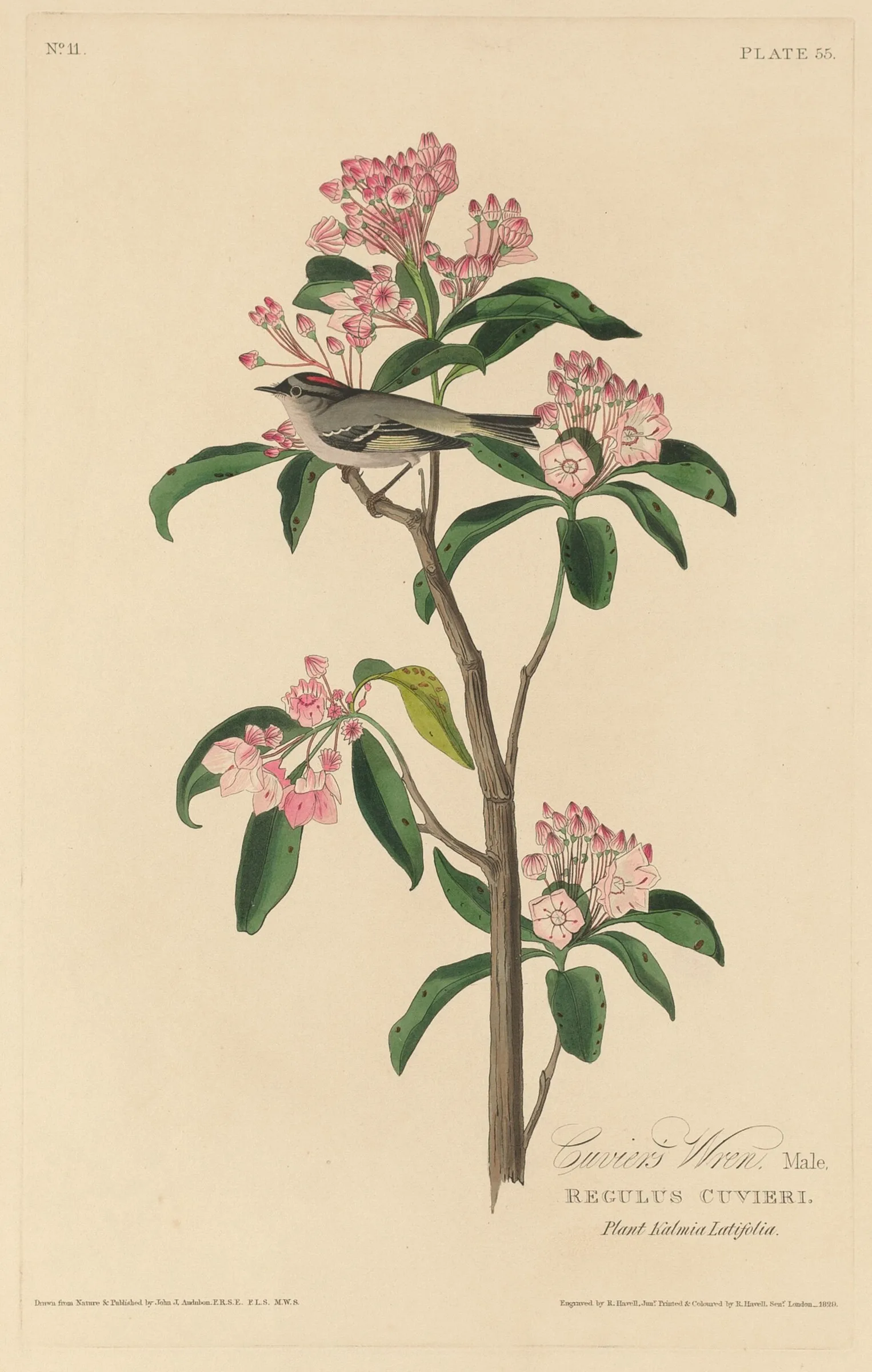
Audubon's “Cuvier's Wren”, The Birds of America, plate LV
Click or press Enter to enlarge
Open the full-resolution image (2587 px, National Gallery of Art)
| Plate | 55 (LV) |
|---|---|
| Audubon's name | Cuvier's Wren |
| Modern name | Cuvier's Kinglet (mystery bird, unidentified) |
| Scientific name | Regulus cuvieri (not recognized) |
| Status | Not evaluated |
| Engraved by | Robert Havell, after Audubon's watercolor |
| Date | 1829 |
| Medium | Hand-colored engraving and aquatint on Whatman wove paper |
| Plants and setting | Mountain Laurel (Kalmia latifolia) in bloom |
| Collections | Songbirds |
| This impression | National Gallery of Art, Washington, 1945.8.55; Gift of Mrs. Walter B. James |
About this plate
Plate 55 shows a single small kinglet on a flowering branch of Mountain Laurel, Kalmia latifolia. It has a black-bordered red crown patch and a dark line through the eye. Audubon wrote that the bird was feeding among the leaves and blossoms of the laurel when he shot it. He also noted that the laurel grows in great profusion in rocky, hilly ground in Pennsylvania and along the Alleghenies. The plate was engraved by Robert Havell in 1829.
Audubon shot the bird on 8 June 1812 at Fatland Ford on the Schuylkill River in Pennsylvania, the plantation of his father-in-law William Bakewell. He thought it was a Ruby-crowned Kinglet until he picked it up. He kept the drawing for years without describing it and never saw another. Bonaparte suggested the name Regulus carbunculus, but Audubon named it instead for Baron Georges Cuvier, the French zoologist, whom he had met in Paris.
Cuvier's Kinglet is one of the mystery birds of The Birds of America. No specimen survives and no similar bird has been recorded since. Explanations include an aberrant Golden-crowned or Ruby-crowned Kinglet, a hybrid between the two, or an extinct or very rare form. None is proven.
Both living North American kinglets breed in northern and mountain conifer forests and pass through Pennsylvania on migration. A June record in a laurel thicket is unusual for either species, which adds to the puzzle. Both are listed as Least Concern.
In Audubon's words
I shot the bird represented in the Plate, on my father-in-law's plantation of Fatland Ford, on the Skuylkill River in Pennsylvania, on the 8th June 1812, while on a visit to my honoured relative Mr WILLIAM BAKEWELL. The drawing which I then made I have kept to this date, without having described the bird from which it was taken. I killed this little bird, supposing it to be one of its relatives, the Ruby-crested Wren, whilst it was searching for insects and larvæ amongst the leaves and blossoms of the Kalmia latifolia, on a branch of which you see it represented, and was not aware of its being a different bird until I picked it up from the ground. I have not seen another since, nor have I been able to learn that this species has been observed by any other individual. It might, however, be very easily mistaken for the Ruby-crowned Wren, the manners of which appear to be much the same.
John James Audubon, Ornithological Biography, vol. 1 (1831), “Cuvier's Regulus”. Read the full chapter.



