Red-shouldered Hawk (Plate 56)
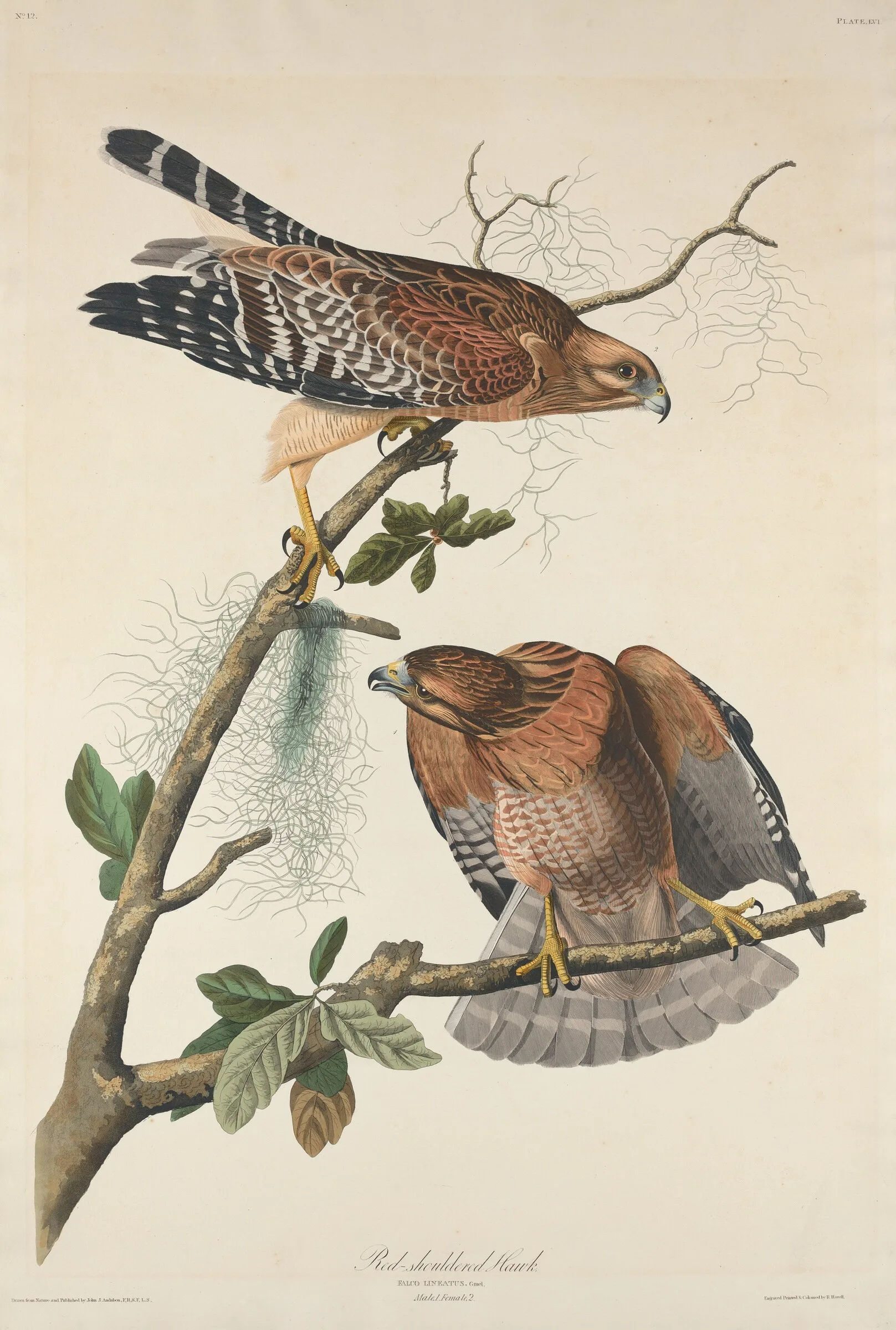
Audubon's “Red-shouldered Hawk”, The Birds of America, plate LVI
Click or press Enter to enlarge
Open the full-resolution image (4870 px, National Gallery of Art)
| Plate | 56 (LVI) |
|---|---|
| Audubon's name | Red-shouldered Hawk |
| Modern name | Red-shouldered Hawk |
| Scientific name | Buteo lineatus |
| Status | Least Concern |
| Engraved by | Robert Havell, after Audubon's watercolor |
| Date | 1829 |
| Medium | Hand-colored engraving and aquatint on Whatman wove paper |
| Size | plate: 97.3 x 65.5 cm (38 5/16 x 25 13/16 in.) sheet: 100.2 x 68.5 cm (39 7/16 x 26 15/16 in.) |
| Collections | Hawks, Eagles and Falcons |
| This impression | National Gallery of Art, Washington, 1945.8.56; Gift of Mrs. Walter B. James |
About this plate
Plate 56 shows an adult male and female Red-shouldered Hawk. Audubon wrote that he knew this pair for three years and found their new nest each spring within a few hundred yards of the old one. He said he would rather have called the bird the Red-breasted Hawk, after the rusty barring on its underparts.
Audubon opened the chapter by arguing that European authors, and even Alexander Wilson, had confused this bird with the Winter Hawk. He painted the Winter Hawk separately as plate 71. The joke is on him: the Winter Hawk is now known to be the immature Red-shouldered Hawk, so both plates show the same species. The Linnaean name in his heading, Falco lineatus, survives as the species name in Buteo lineatus.
The Red-shouldered Hawk lives in wet woodland and river bottoms across the eastern United States and southeastern Canada, with a separate population in California. It hunts from a perch for frogs, snakes, small mammals and birds. Audubon described its loud, repeated ka-hee call, heard most in spring as pairs circle high over the woods, and noted that it seldom takes poultry. It is common and listed as Least Concern.
In Audubon's words
This bird is one of the most noisy of its genus, during spring especially, when it would be difficult to approach the skirts of woods bordering a large plantation without hearing its discordant shrill notes, ka-hee, ka-hee, as it is seen sailing in rapid circles at a very great elevation. Its ordinary flight is even and protracted, excepting when it is describing the circles just mentioned, when it often dives and gambols. It is a more general inhabitant of the woods than most of our other species, particularly during the summer, and in autumn and winter; now and then only, in early spring, shewing itself in the open grounds, and about the vicinity of small lakes, for the purpose securing Red-winged Starlings and wounded Ducks. The interior of woods seems, as I have said, the fittest haunts for the Red-shouldered Hawk.
John James Audubon, Ornithological Biography, vol. 1 (1831), “Red-shouldered Hawk”. Read the full chapter.