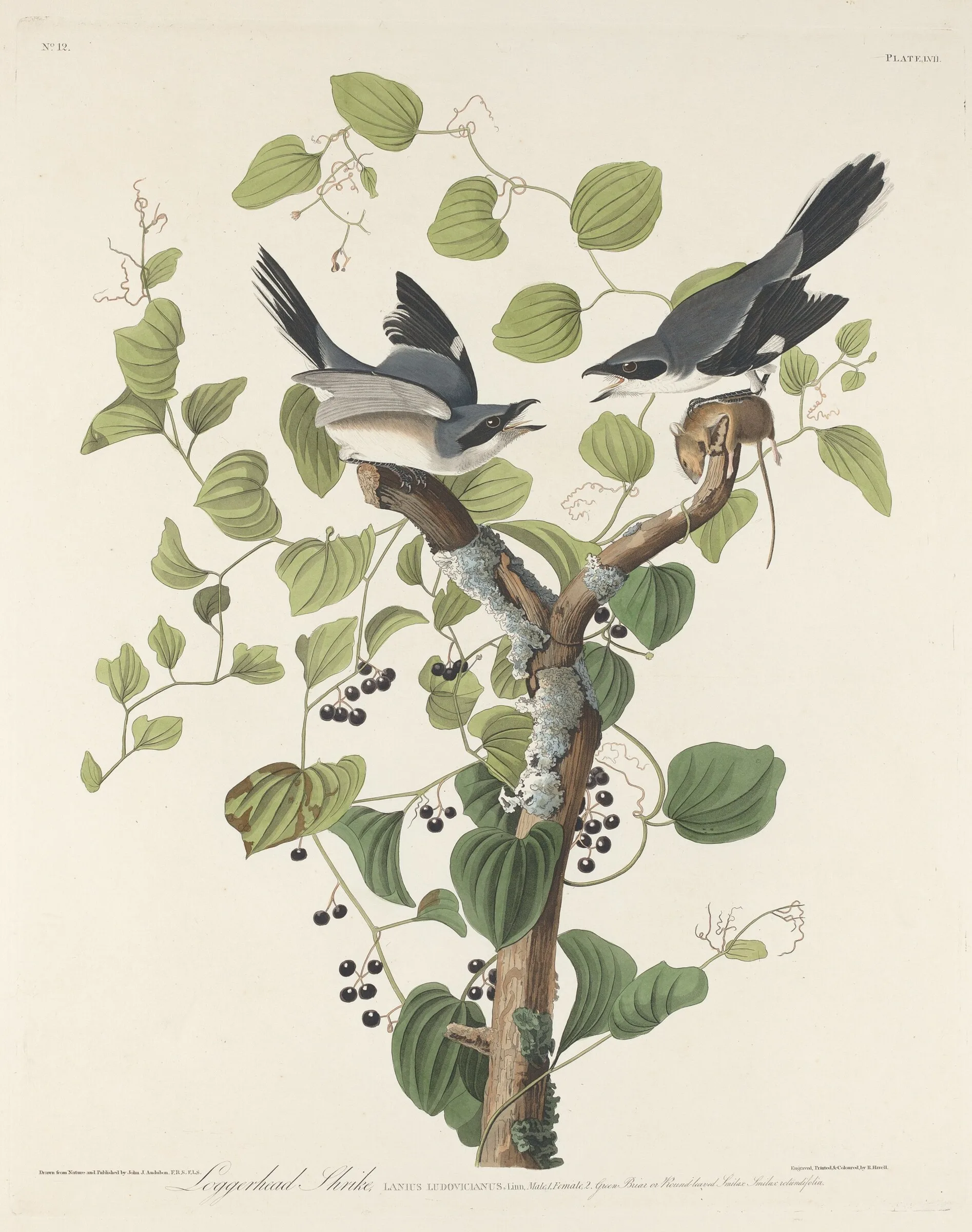
Loggerhead Shrike (Plate 57)
Audubon's “Loggerhead Shrike”, The Birds of America, plate LVII
Click or press Enter to enlarge
Open the full-resolution image (3460 px, National Gallery of Art)
| Plate | 57 (LVII) |
|---|---|
| Audubon's name | Loggerhead Shrike |
| Modern name | Loggerhead Shrike |
| Scientific name | Lanius ludovicianus |
| Status | Near Threatened |
| Engraved by | Robert Havell, after Audubon's watercolor |
| Date | 1829 |
| Medium | Hand-colored engraving and aquatint on Whatman wove paper |
| Plants and setting | Round-leaved smilax (Smilax rotundifolia); a field mouse |
| Collections | Songbirds |
| This impression | National Gallery of Art, Washington, 1945.8.57; Gift of Mrs. Walter B. James |
About this plate
Plate 57 shows a male and female Loggerhead Shrike on a stem of round-leaved smilax, or greenbrier, a thorny vine of fences and old fields. The chapter also describes a field mouse, the shrike's main prey, which appears with the birds. Audubon noted that the shrike pounces on its prey like a hawk, striking first with its bill.
Audubon knew the bird from the rice plantations of the Carolinas, Georgia and Florida, where it sat on fences and bushes and killed field mice, large grubs and insects. He described its spring call as the creak of a rusty hinge and its courtship as cold and haughty. His sense of its range was too narrow. The Loggerhead Shrike breeds across much of the United States, southern Canada and Mexico.
Shrikes are songbirds that behave like small raptors. They lack talons, so they impale prey on thorns or barbed wire to hold it while feeding, which earned them the name butcher bird. The Loggerhead Shrike has declined steeply across its range since the 1960s, especially in the Midwest and Northeast, and is listed as Near Threatened. Loss of pasture and hedgerows and pesticide use are thought to be the main causes.
In Audubon's words
The Loggerhead has no song, but utters a shrill clear creaking prolonged note, resembling the grating of a rusty hinge slowly moved to and fro. This sound is heard only during the spring season, and whilst the female is sitting. About the beginning of March these birds begin to pair. They exhibit at this time few of those marks of the tender affection which birds usually shew. The male courts the female without much regard, and she, in return, appears to receive his haughty attentions with merely just as much condescension as enables her to become the mother of a family, whose feelings are destined to be of the same cold nature. The nest is fixed in a low bush, generally near the centre of a dwarf hawthorn, and is so little concealed as to be easily discovered.
John James Audubon, Ornithological Biography, vol. 1 (1831), “The Loggerhead Shrike”. Read the full chapter.



