Hermit Thrush (Plate 58)
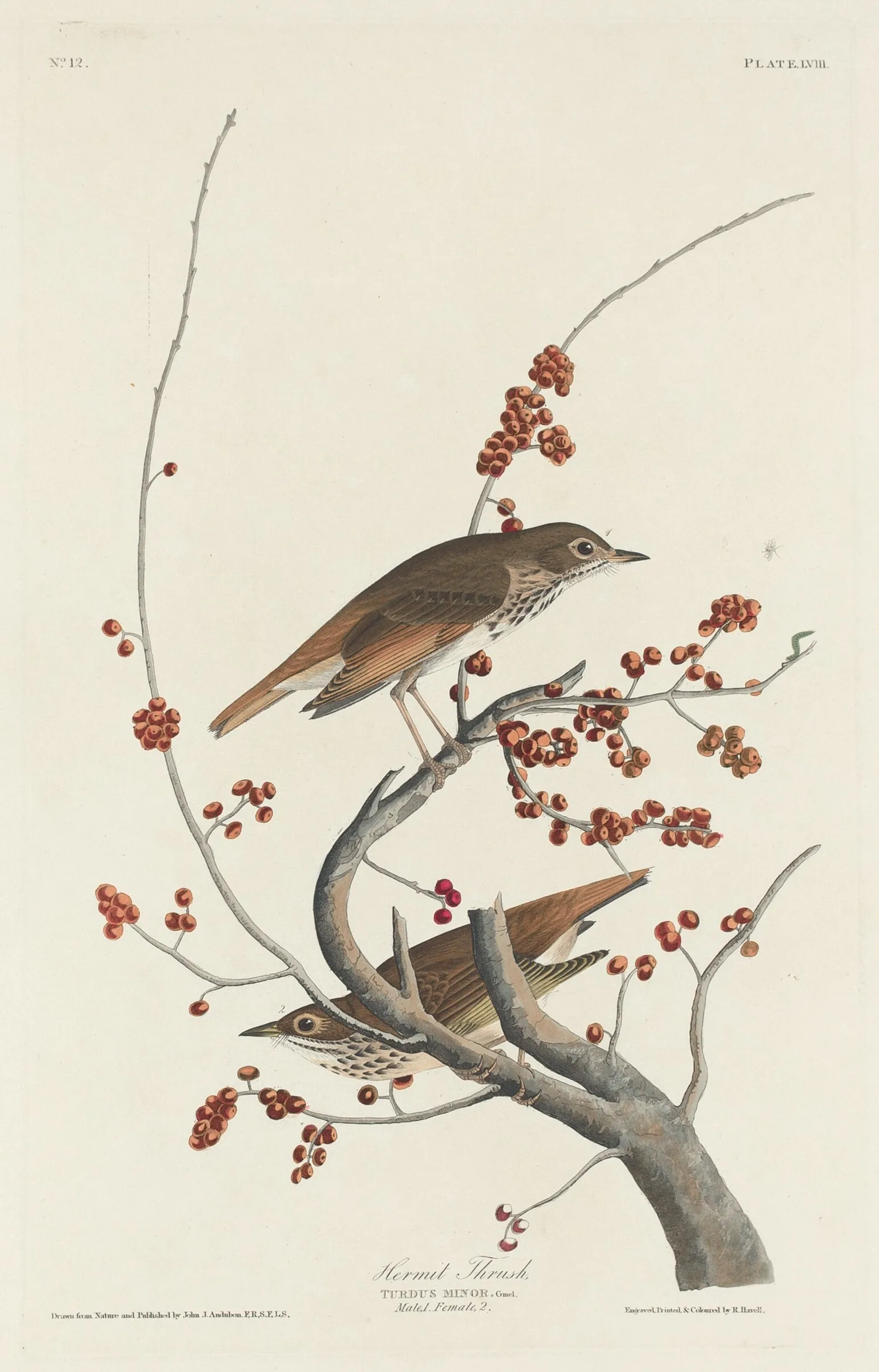
Audubon's “Hermit Thrush”, The Birds of America, plate LVIII
Click or press Enter to enlarge
Open the full-resolution image (2616 px, National Gallery of Art)
| Plate | 58 (LVIII) |
|---|---|
| Audubon's name | Hermit Thrush |
| Modern name | Hermit Thrush |
| Scientific name | Catharus guttatus |
| Status | Least Concern |
| Engraved by | Robert Havell, after Audubon's watercolor |
| Date | 1829 |
| Medium | Hand-colored engraving and aquatint on Whatman wove paper |
| Collections | Songbirds |
| This impression | National Gallery of Art, Washington, 1945.8.58; Gift of Mrs. Walter B. James |
About this plate
Plate 58 shows a male and female Hermit Thrush, small brown thrushes with spotted breasts and reddish tails. Audubon described the bird hopping on the ground like a European Robin, with drooped wings and raised tail, then running a few steps and looking about. He compared its low, gliding flight with that of the Wood Thrush, his favourite, which he painted as plate 73.
His account has problems. He wrote that the Hermit Thrush breeds in the dark canebrakes of the Mississippi and has no song, only a soft plaintive note. The Hermit Thrush in fact breeds in the cool forests of Canada, the northern United States and the western mountains, and visits the Deep South only in winter. Its song, a clear opening note followed by rising and falling flute-like phrases, is among the most admired in North America. Audubon may have confused his summer birds with another thrush.
The Hermit Thrush is the only spotted brown thrush that winters widely in the United States. It eats insects in summer and berries in winter, and it often flicks its wings and slowly raises and lowers its reddish tail. It is common, with a growing population, and listed as Least Concern. It is the state bird of Vermont.
In Audubon's words
Except during winter, this Thrush prefers the darkest, most swampy, and most secluded cane-brakes along the margins of the Mississippi, where it breeds and spends the summer, retiring to higher lands during the period when the alluvial grounds are covered with the water which, during freshets, generally inundates these low cane-brakes and swampy retreats. The flight of the Hermit Thrush is performed low over the ground, and in a gliding manner, as the bird shifts from one place to another at a short distance. In this respect, it differs greatly from its relative, my great favourite, the Wood Thrush, the flight of which is more protracted, and is performed at a greater elevation. The Hermit Thrush has no song, and only utters a soft plaintive note, seldom heard at a greater distance than twenty-five or thirty yards.
John James Audubon, Ornithological Biography, vol. 1 (1831), “The Hermit Thrush”. Read the full chapter.
Other impressions of this plate: The Metropolitan Museum of Art.



