Chestnut-sided Warbler (Plate 59)
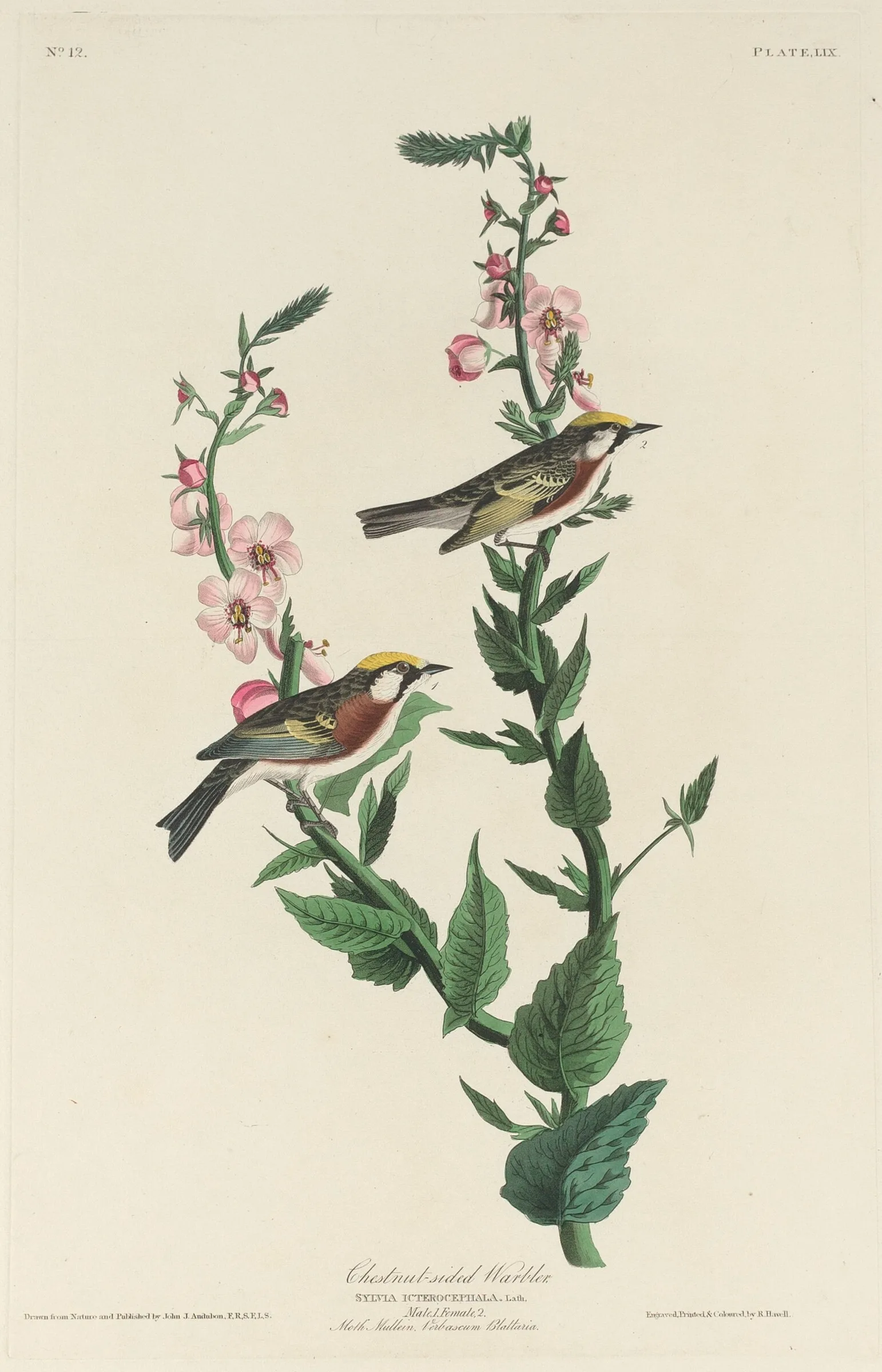
Audubon's “Chestnut-sided Warbler”, The Birds of America, plate LIX
Click or press Enter to enlarge
Open the full-resolution image (2583 px, National Gallery of Art)
| Plate | 59 (LIX) |
|---|---|
| Audubon's name | Chestnut-sided Warbler |
| Modern name | Chestnut-sided Warbler |
| Scientific name | Setophaga pensylvanica |
| Status | Least Concern |
| Engraved by | Robert Havell, after Audubon's watercolor |
| Date | 1829 |
| Medium | Hand-colored engraving and aquatint on Whatman wove paper |
| Plants and setting | Moth mullein (Verbascum blattaria), a pale-flowered variety |
| Collections | Songbirds |
| This impression | National Gallery of Art, Washington, 1945.8.59; Gift of Mrs. Walter B. James |
About this plate
Plate 59 shows a male and female Chestnut-sided Warbler on moth mullein. Audubon said the plant was a variety with large whitish or pale rose flowers instead of the usual yellow, and that he chose it because it grows in fields and flowers at the start of May, when he found the birds.
His whole experience of the species was a single cold morning in early May 1808 near Pottsgrove, Pennsylvania. Snow had fallen on peach and apple trees already in bloom. He found five birds, two males and three females, huddled on the lower rails of a fence and searching for spiders, and shot all of them. He wrote that he never saw another, and that he had searched the shores of Lakes Ontario, Erie and Michigan without finding where it bred.
Audubon's rarity is now a common bird. The Chestnut-sided Warbler breeds in shrubby second growth, young forest and overgrown fields from southern Canada through the Great Lakes, New England and the Appalachians, and winters in Central America. It was probably scarce in his day because it depends on cut-over and regrowing land, which spread as the eastern forests were cleared. It is listed as Least Concern.
In Audubon's words
In the beginning of May 1808, I shot five of these birds, on a very cold morning, near Potts-grove, in the State of Pennsylvania. There was a slight fall of snow at the time, although the Peach and Apple trees were already in full bloom. I have never met with a single individual of this species since. They all had their wings drooping, as if suffering severely from the sudden change of the weather, and had betaken themselves to the lower rails of a fence, where they were engaged in searching after insects, particularly spiders. I procured every one of those which I met with that morning, and which were five in number, two of them males, and the rest females. Where this species goes to breed I am unable to say, for to my inquiries on this subject I never received any answers which might have led me to the districts resorted to by it.
John James Audubon, Ornithological Biography, vol. 1 (1831), “The Chestnut-sided Warbler”. Read the full chapter.



