Carbonated Warbler (Plate 60)
Audubon's “Carbonated Warbler”, The Birds of America, plate LX
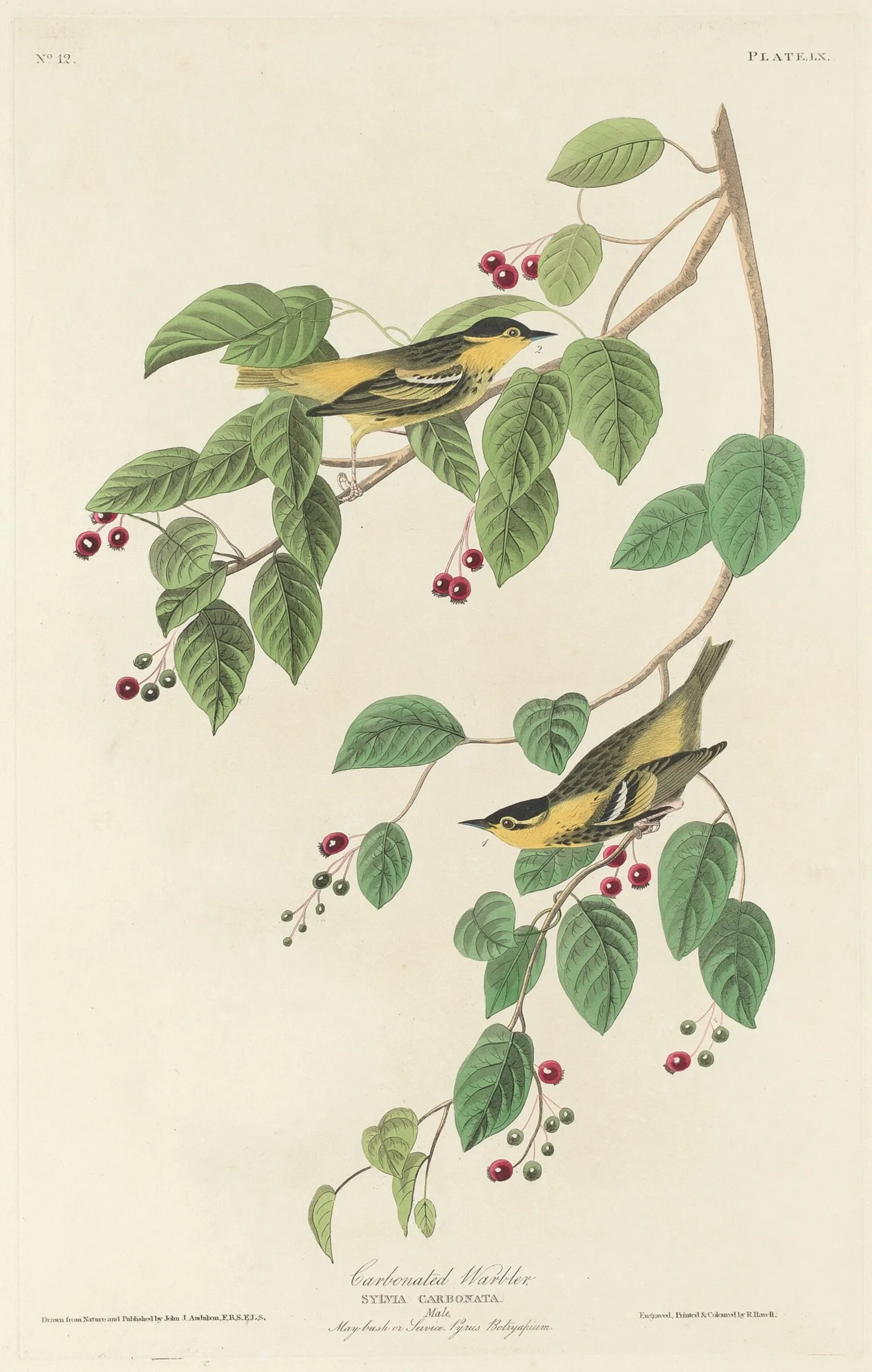
Click or press Enter to enlarge
Open the full-resolution image (2486 px, National Gallery of Art)
| Plate | 60 (LX) |
|---|---|
| Audubon's name | Carbonated Warbler |
| Modern name | Carbonated Warbler (unidentified mystery bird) |
| Scientific name | Sylvia carbonata (unidentified) |
| Engraved by | Robert Havell, after Audubon's watercolor |
| Date | 1829 |
| Medium | Hand-colored engraving and aquatint on Whatman wove paper |
| Plants and setting | Service tree (serviceberry, Amelanchier) |
| Collections | Songbirds |
| This impression | National Gallery of Art, Washington, 1945.8.60; Gift of Mrs. Walter B. James |
About this plate
Plate 60 shows two small warblers with black crowns, dusky streaked backs and yellow underparts, on a branch of service tree, or serviceberry. Audubon wrote that he shot both birds near Henderson, Kentucky, in May 1811 while they fed among the leaves of a dogwood. Both proved to be males, which he took for young birds not yet in full plumage. He drew them at once, but added the branch the following summer.
The Carbonated Warbler is one of Audubon's mystery birds. No one has collected or reliably seen a bird that matches the plate since, and no specimen survives. Suggested explanations include an immature Cape May Warbler, a hybrid, or a drawing made partly from memory, but none fits every feature. It is usually listed with the Small-headed Flycatcher, Cuvier's Kinglet and the Blue Mountain Warbler as birds Audubon painted that cannot be matched to a known species.
Audubon himself admitted he could say nothing more about the bird. His notes on the plant are more certain: the service tree seldom grows taller than thirty or forty feet, prefers hilly ground, and has sweet berries that many birds eat, the Red-headed Woodpecker among them. Because the bird is unidentified it has no conservation status.
In Audubon's words
I shot the two little birds here represented, near the village of Henderson, in the State of Kentucky, in May 1811. They were both busily engaged in searching for insects along the branches and amongst the leaves of a Dog-wood tree. Their motions were those common to all the species of the genus Sylvia. On examination, they were found to be both males. I am of opinion, that they were both young birds of the preceding year, and not in full plumage, as they had no part of their dress seemingly complete, excepting the head. Not having met with any other individuals of the species, I am at this moment unable to say any thing more about them. They were drawn, like all the other birds which I have represented, immediately after being killed; but the branch on which you see them was not added until the following summer.
John James Audubon, Ornithological Biography, vol. 1 (1831), “The Carbonated Warbler”. Read the full chapter.



