Great Horned Owl (Plate 61)
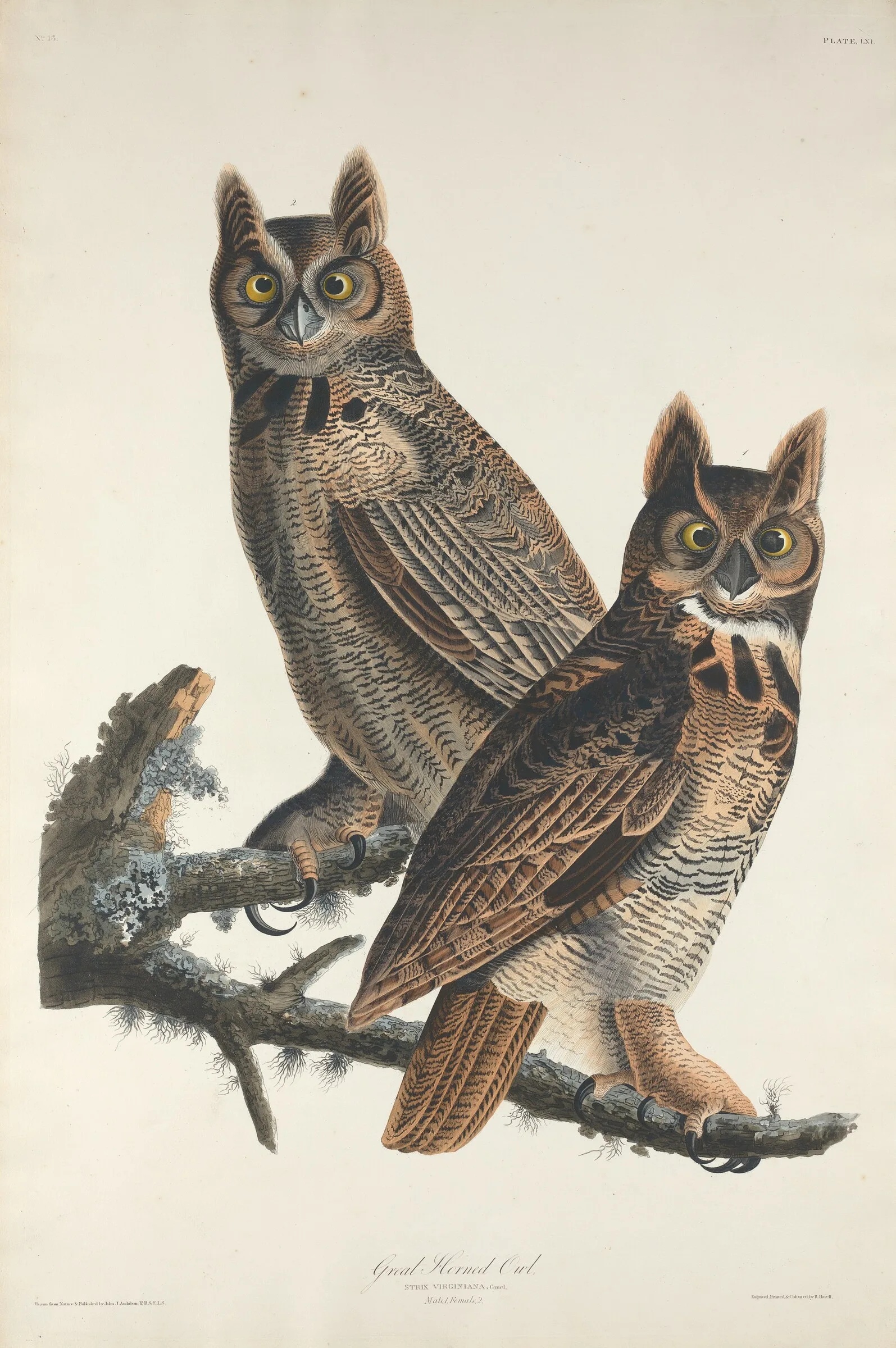
Audubon's “Great Horned Owl”, The Birds of America, plate LXI
Click or press Enter to enlarge
Open the full-resolution image (4823 px, National Gallery of Art)
| Plate | 61 (LXI) |
|---|---|
| Audubon's name | Great Horned Owl |
| Modern name | Great Horned Owl |
| Scientific name | Bubo virginianus |
| Status | Least Concern |
| Engraved by | Robert Havell, after Audubon's watercolor |
| Date | 1829 |
| Medium | Hand-colored engraving and aquatint on Whatman wove paper |
| Collections | Owls |
| This impression | National Gallery of Art, Washington, 1945.8.61; Gift of Mrs. Walter B. James |
About this plate
Plate 61 shows a male and female Great Horned Owl, the large eared owl of the Americas. Audubon opened the chapter with a night scene on a western river: an owl hunting a squatter's poultry by moonlight, a Turkey hen rousing the yard as she spreads her wings over her young, and the settler shooting the owl from a dead branch.
The chapter also holds one of his stories about the cost of collecting. Running to pick up an owl he had shot on a willow bar, he sank in quicksand up to his armpits and had to keep still until his boatmen made a bridge of oars and driftwood to pull him out. He found these owls roosting by day in young cottonwoods and willows on river sandbars and in cypress swamps hung with Spanish moss.
The Great Horned Owl ranges from the Arctic treeline to southern South America and lives in almost every habitat, from desert to city parks. It takes prey as large as skunks, rabbits, geese and other owls. Pairs nest very early, often in January or February, usually in an old hawk or crow nest. Audubon's heading name, Strix virginiana, records that the species was first described from Virginia, and the scientific name is now Bubo virginianus. It is common and listed as Least Concern.
In Audubon's words
The Great Owl, with eyes keen as those of any falcon, is now seen hovering above the place. He has already espied the quarry, and is sailing in wide circles meditating his plan of attack. The Turkey-hen, which at another time might be sound asleep, is now, however, so intent on the care of her young brood, that she rises on her legs and purs so loudly, as she opens her wings and spreads her tail, that she rouses her neighbours, the hens, together with their protector. The cacklings which they at first emit soon become a general clamour. The squatter hears the uproar, and is on his feet in an instant, rifle in hand; the priming examined, he gently pushes open his half closed door, and peeps out cautiously, to ascertain the cause by which his repose has been disturbed.
John James Audubon, Ornithological Biography, vol. 1 (1831), “The Great Horned Owl”. Read the full chapter.
Great Horned Owl (Plate 61): the story behind one of the most famous plates in the collection →