White-eyed Vireo (Plate 63)
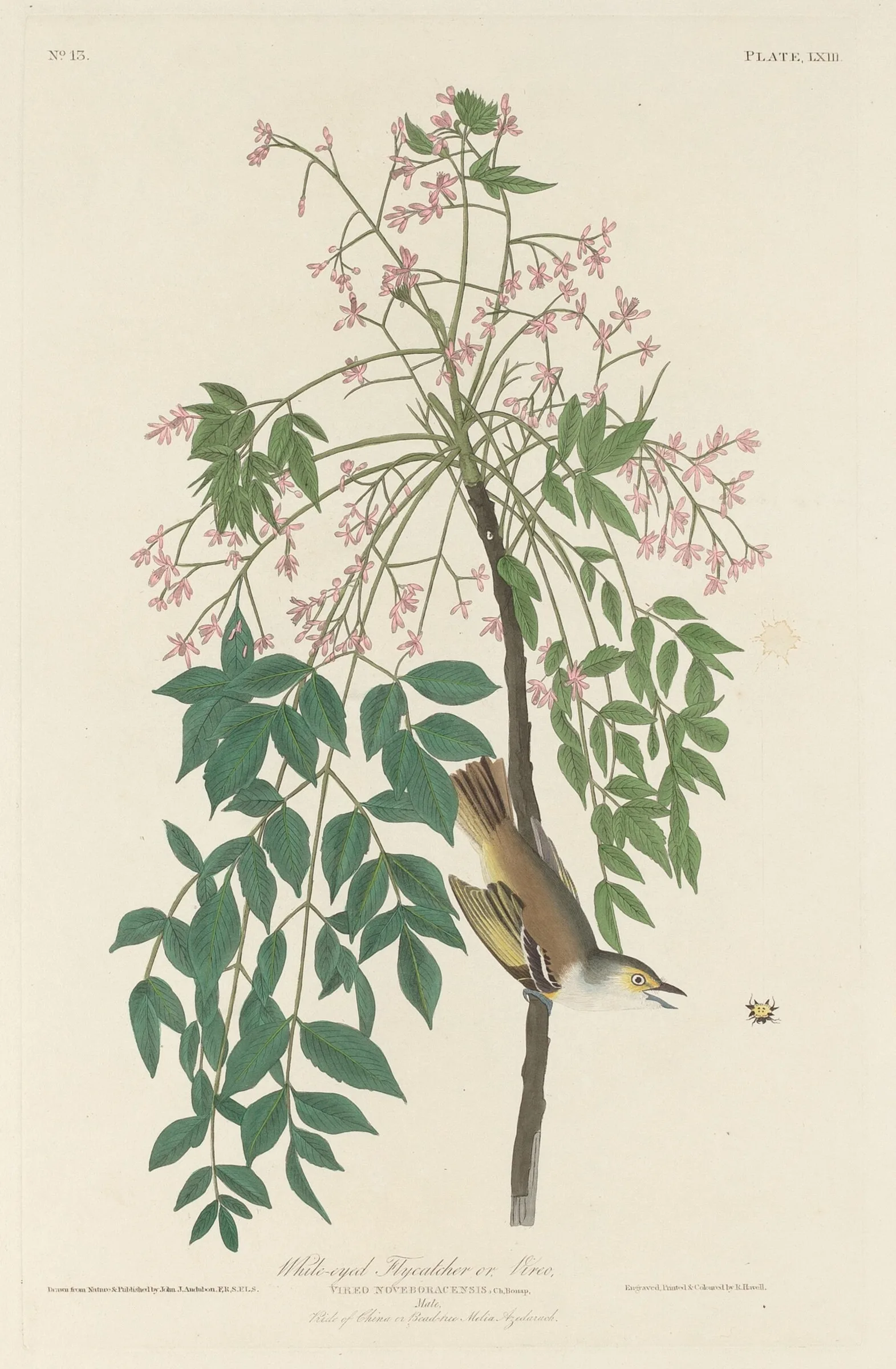
Audubon's “White-eyed Fly Catcher”, The Birds of America, plate LXIII
Click or press Enter to enlarge
Open the full-resolution image (2492 px, National Gallery of Art)
| Plate | 63 (LXIII) |
|---|---|
| Audubon's name | White-eyed Fly Catcher |
| Modern name | White-eyed Vireo |
| Scientific name | Vireo griseus |
| Status | Least Concern |
| Engraved by | Robert Havell, after Audubon's watercolor |
| Date | 1829 |
| Medium | Hand-colored engraving and aquatint on Whatman wove paper |
| Plants and setting | Pride of China, or chinaberry (Melia azedarach) |
| Collections | Songbirds |
| This impression | National Gallery of Art, Washington, 1945.8.63; Gift of Mrs. Walter B. James |
About this plate
Plate 63 shows a male White-eyed Vireo on a branch of Pride of China, also called chinaberry or bead-tree. Audubon noted that in southern Europe the hard seeds were bored and strung as rosary beads. The tree is native to Asia and was already planted around southern towns in his day.
Audubon wrote that the bird reaches Louisiana by the first of March and throws itself into thickets of briars, sumac and evergreen bushes in abandoned fields, where its loud, varied song gives it away at once. He found it so common there that it was harder to miss one than to see a dozen on a morning walk. He also described it sipping dew from the tips of leaves.
Vireos are not flycatchers. They form their own family of small songbirds with thicker, slightly hooked bills, and they glean insects from leaves rather than catching them in the air. The White-eyed Vireo's pale iris is visible in adults. It breeds in dense shrubby habitat across the southeastern and central United States, winters from the Gulf Coast to Central America, and is listed as Least Concern. Audubon's name, Vireo noveboracensis, was later replaced by Vireo griseus.
In Audubon's words
These birds become at once so abundant, that it would be more difficult not to meet one, than to observe a dozen or more, during a morning walk. Their motions are as animated as their music. They pass from twig to twig, upwards or downwards, examining every opening bud and leaf, and securing an insect or a larva at every leap. Their flight is short, light, and easy. Their migrations are performed during the day, and by passing from one low bush to another, for these birds seldom ascend to the tops of even moderately tall trees. Like all our other visitors, they move eastward as the season opens, and do not reach the Middle States before the end of April, or the beginning of May. Notwithstanding this apparently slow progress, they reach and disperse over a vast expanse of country.
John James Audubon, Ornithological Biography, vol. 1 (1831), “The White-eyed Fly-catcher, or Vireo”. Read the full chapter.



