Swamp Sparrow (Plate 64)
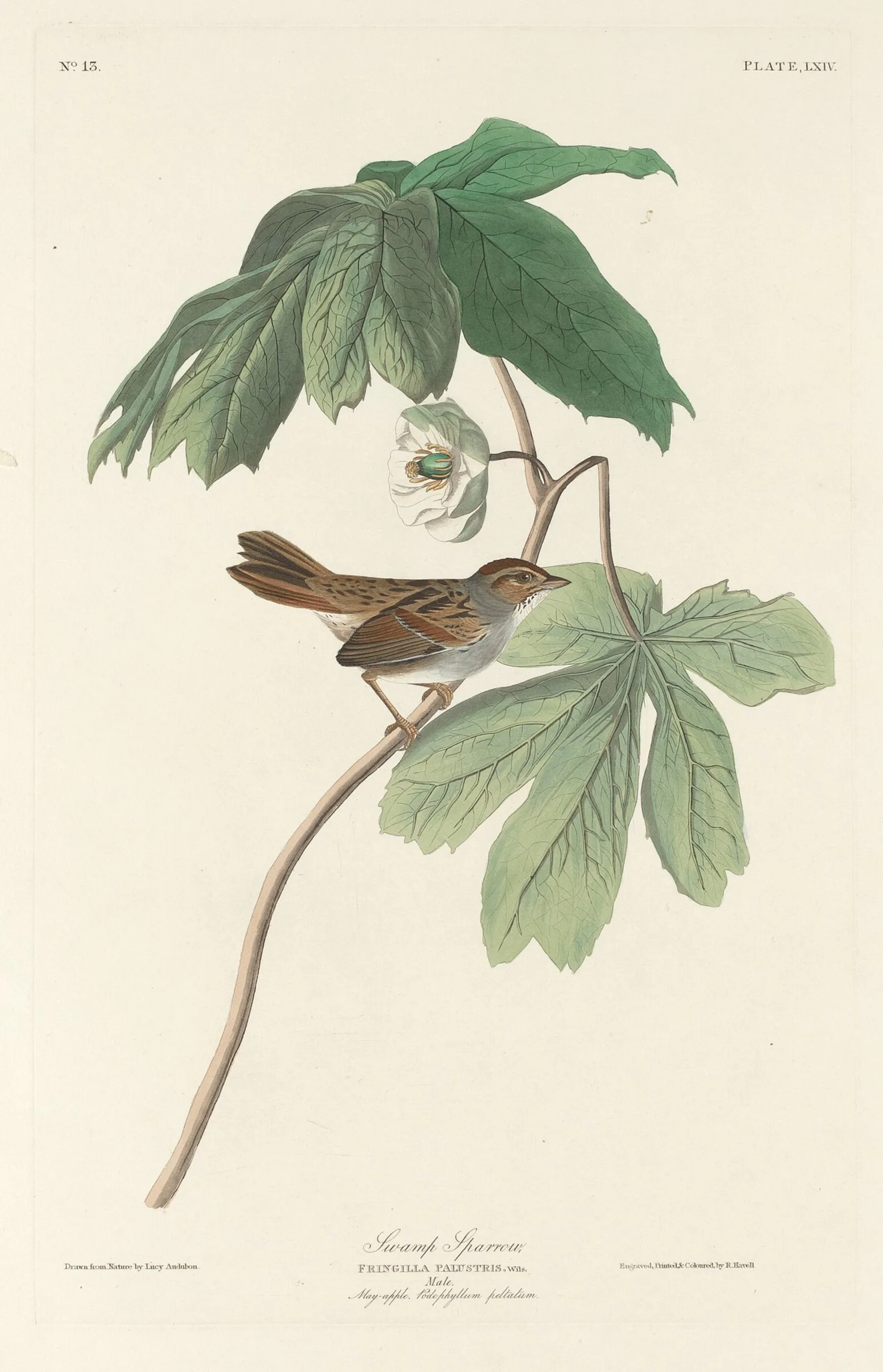
Audubon's “Swamp Sparrow”, The Birds of America, plate LXIV
Click or press Enter to enlarge
Open the full-resolution image (2569 px, National Gallery of Art)
| Plate | 64 (LXIV) |
|---|---|
| Audubon's name | Swamp Sparrow |
| Modern name | Swamp Sparrow |
| Scientific name | Melospiza georgiana |
| Status | Least Concern |
| Engraved by | Robert Havell, after Audubon's watercolor |
| Date | 1829 |
| Medium | Hand-colored engraving and aquatint on Whatman wove paper |
| Plants and setting | May-apple (Podophyllum peltatum) |
| Collections | Songbirds |
| This impression | National Gallery of Art, Washington, 1945.8.64; Gift of Mrs. Walter B. James |
About this plate
Plate 64 shows a male Swamp Sparrow on a May-apple, the woodland plant with two umbrella-like leaves and a single white flower in the fork. Audubon described the plant's large yellow fruit, the size of a plum when ripe.
Audubon met the Swamp Sparrow in huge numbers on the grassy sandbars and swamps of the Mississippi in autumn and winter, where he saw it hunted by Sparrow Hawks, Pigeon Hawks and Hen-harriers. He also found it in summer in the marshes of the Cayuga Lakes in New York and along the Illinois River, and in winter far up the Arkansas River. He noted that wounded birds swim to the nearest tuft of grass to hide.
He called it destitute of song, which is wrong for the breeding season. On its northern marshes the male sings a slow, sweet, even trill from a cattail or shrub. The Swamp Sparrow breeds in wet meadows, bogs and marsh edges across Canada and the northeastern and Great Lakes states, including a coastal-plain subspecies in tidal marshes of the mid-Atlantic, and winters in the southeastern United States. It wades more than other sparrows and picks insects from the water surface. It is listed as Least Concern.
In Audubon's words
The shores and such flat sand-bars as are overgrown with grasses and rank weeds, along the Mississippi, from its mouth to a great height, as well as the swamps that occur in the woods, within a short distance from the margins of that river, are the resorts of the Swamp Sparrow, during autumn and winter. Although these birds do not congregate in flocks, their numbers are immense. They form the principal food of the many Sparrow Hawks, Pigeon Hawks, and Hen-harriers, which follow them as well as several other species, on their return from the Middle Districts, where they go towards spring, for the purpose of breeding. In those districts they continue to prefer low swampy places, damp meadows, and the margins of creeks and rivers. It is a timid species, destitute of song, and merely uttering a single cheep, which is now and then heard during the day, but more frequently towards evening.
John James Audubon, Ornithological Biography, vol. 1 (1831), “The Swamp Sparrow”. Read the full chapter.



