Rathbone Warbler (Yellow Warbler) (Plate 65)
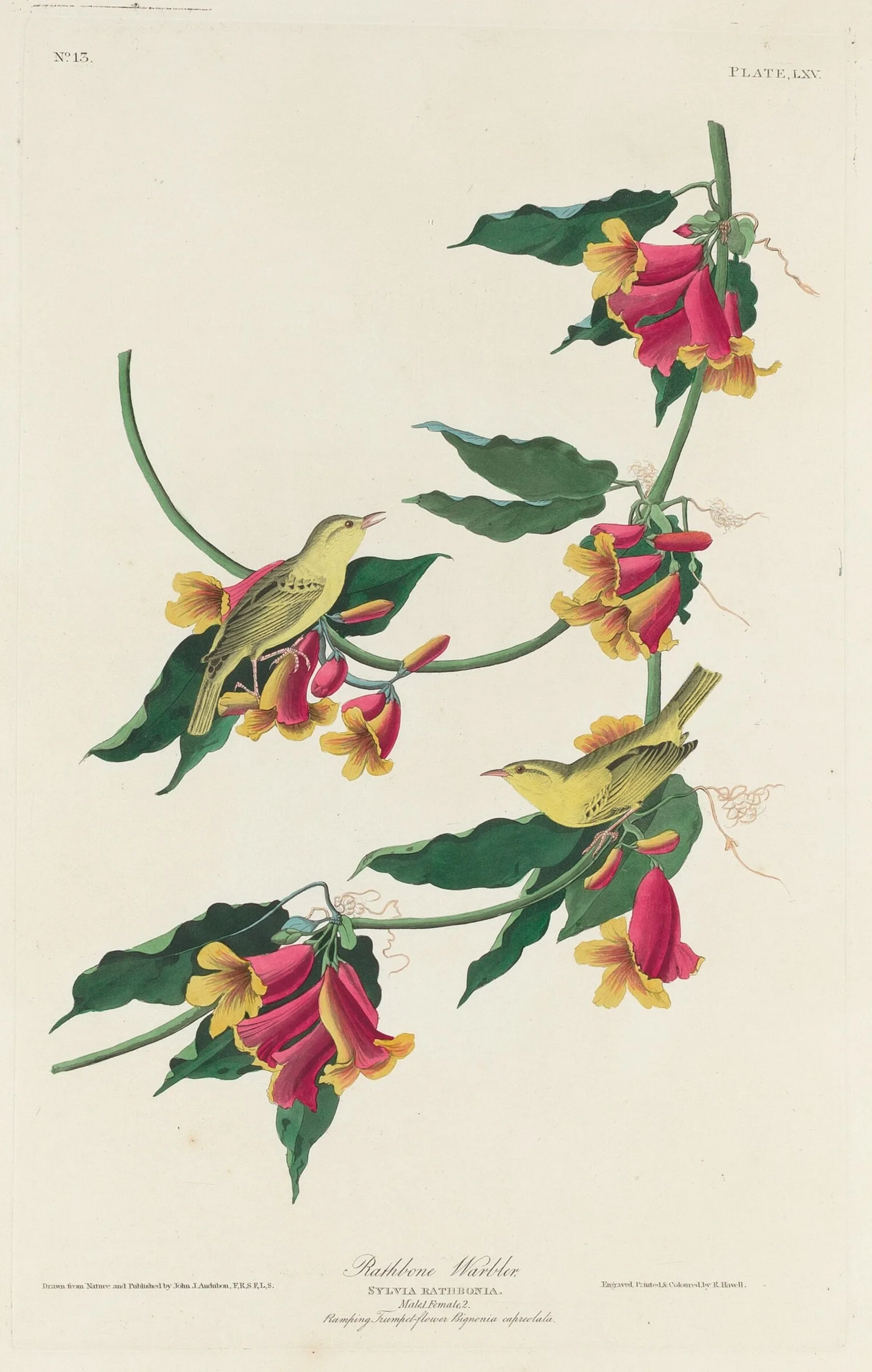
Audubon's “Rathbone Warbler”, The Birds of America, plate LXV
Click or press Enter to enlarge
Open the full-resolution image (2549 px, National Gallery of Art)
| Plate | 65 (LXV) |
|---|---|
| Audubon's name | Rathbone Warbler |
| Modern name | Yellow Warbler (Audubon's Rathbone Warbler) |
| Scientific name | Setophaga petechia |
| Status | Least Concern |
| Engraved by | Robert Havell, after Audubon's watercolor |
| Date | 1829 |
| Medium | Hand-colored engraving and aquatint on Whatman wove paper |
| Plants and setting | Bignonia, a trumpet-flowered vine |
| Collections | Songbirds |
| This impression | National Gallery of Art, Washington, 1945.8.65; Gift of Mrs. Walter B. James |
About this plate
Plate 65 shows a male and female small yellow warbler among the orange trumpet flowers of a Bignonia vine. Audubon wrote that the vine grows in the low alluvial grounds of Mississippi and Louisiana, climbs the trunks of trees, and draws hummingbirds that search its flowers for insects.
Audubon named the bird for the Rathbone family of Liverpool, Quaker merchants who welcomed him in 1826 when he arrived in England with his drawings and helped launch his subscription. He asked future naturalists to keep the name. He said he met the species only once, when he collected the pair shown, and could find neither a nest nor more birds.
The Rathbone Warbler has not held up as a species. Later ornithologists treated it as a Yellow Warbler, and the figures are usually read as Yellow Warblers with some details that do not match exactly. Audubon painted the Yellow Warbler again as plate 95. The Yellow Warbler breeds across most of North America in willows, alder thickets and gardens, and winters from Mexico to South America. It is common and listed as Least Concern.
In Audubon's words
Kind reader, you are now presented with a new and beautiful little species of Warbler, which I have honoured with the name of a family that must ever be dear to me. Were I at liberty here to express the gratitude which swells my heart, when the remembrance of all the unmerited kindness and unlooked-for friendship which I have received from the Rathbones of Liverpool comes to my mind, I might produce a volume of thanks. But I must content myself with informing you, that the small tribute of gratitude which alone it is in my power to pay, I now joyfully accord, by naming after them one of those birds, to the study of which all my efforts have been directed. I trust that future naturalists, regardful of the feelings which have guided me in naming this species, will continue to it the name of the Rathbone Warbler.
John James Audubon, Ornithological Biography, vol. 1 (1831), “The Rathbone Warbler”. Read the full chapter.



